Whether you are a non-technical founder building an MVP or a seasoned VP of Engineering scaling an existing application, finding a reliable, senior freelance Laravel developer is challenging. The internet is flooded with developers claiming "full stack Laravel expertise" who simply generate code from tutorials, paste untested snippets into production, and disappear when tricky performance or security issues arise.
Hiring the wrong contractor doesn't just cost money—it wastes months of time and produces unmaintainable technical debt.
As an engineer shipping Laravel and web applications for teams worldwide since 2017, here is the practical hiring playbook I recommend to evaluate candidates, structure contracts, and hire a top-tier freelance Laravel engineer.
1. Defining What You Actually Need: Junior, Mid, or Senior?
Before posting a job description, clarify what tier of engineering capability your project actually requires:
| Level | Ideal For | Typical Weakness |
|---|---|---|
| Junior ($15–$25/hr) | Routine CRUD forms, minor CSS styling, content updates. | Needs detailed architectural guidance; struggles with database optimization. |
| Mid-Level ($30–$60/hr) | Standard features, standard REST APIs, third-party API integrations. | Can build features but may overlook edge cases, queue scaling, and long-term modularity. |
| Senior / Lead ($70–$150+/hr) | Architecture design, legacy refactoring, database tuning, security audits, team leadership. | Higher rate, but ships 5x faster with zero rework and high test coverage. |
Note: By working directly with an independent senior engineer without agency overhead, you can access senior-level architectural execution at very competitive direct hourly rates.
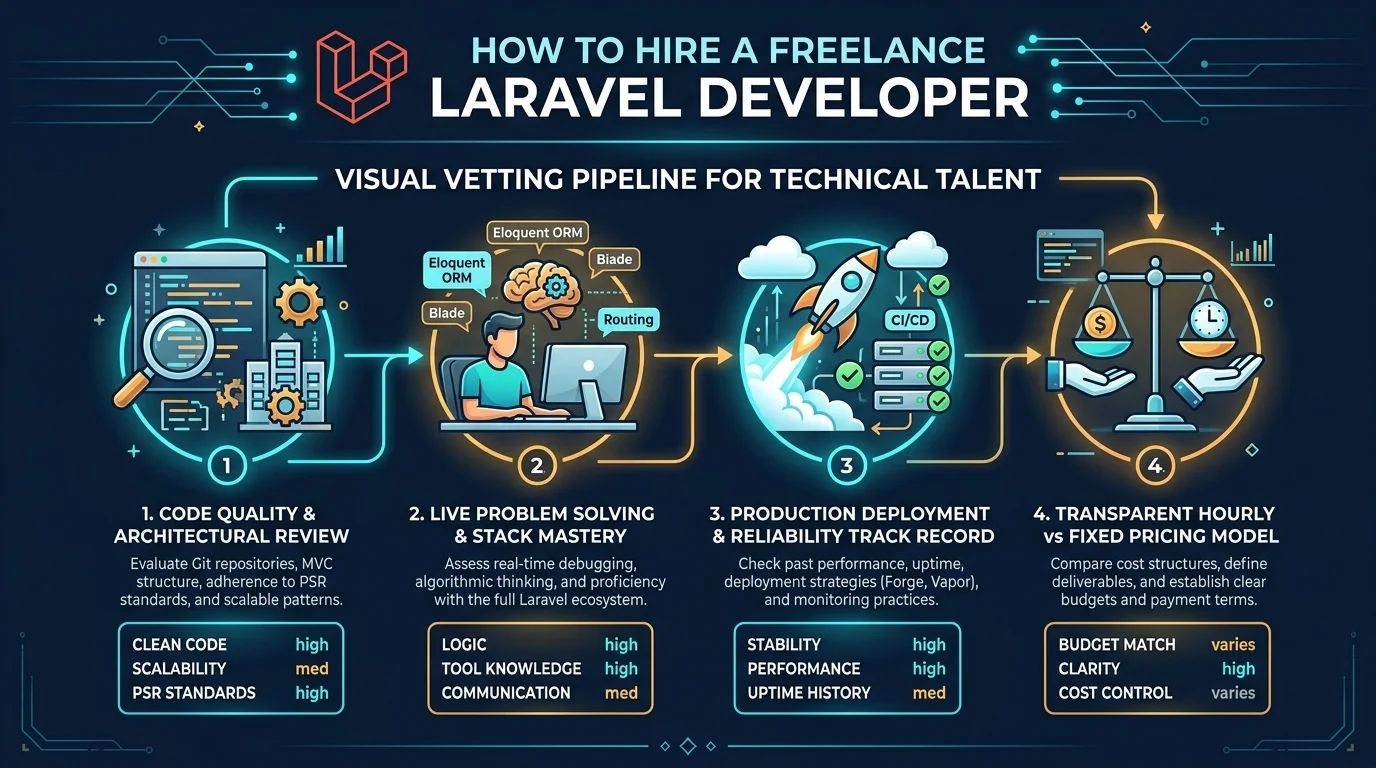
2. The 4-Stage Vetting Pipeline
Don't rely on polished slide decks or generic resumes. Use this 4-stage technical vetting process:
Stage 1: The GitHub & Architecture Review
Ask candidates to share a link to public repositories or code samples they personally authored. Look for:
- Clean Git Commit History: Do commit messages reflect logical, atomic units of work (
fix(billing): handle failed stripe webhook retries) or vague messages likeupdates,fix bug? - Adherence to Modern Standards: Are they using PHP 8.2+ features (constructor property promotion, typed return values, enums)?
- Thin Controllers: Do their controllers delegate complex business logic to dedicated Action classes, Services, or Form Requests?
Stage 2: The Practical Problem-Solving Conversation
Skip generic whiteboard algorithm questions like reversing a binary tree. Ask real-world architectural questions:
- "How do you diagnose and eliminate an N+1 query problem in an Eloquent relationship?" (Listen for mentions of
with(),load(), andModel::preventLazyLoading()). - "How do you handle background jobs that hit third-party API rate limits?" (Listen for Redis queues, exponential backoff, job middleware, and dead-letter queue strategies).
- "How do you prevent race conditions when two users attempt to purchase the last inventory item simultaneously?" (Listen for database transactions and pessimistic locking:
lockForUpdate()).
Stage 3: The Paid Micro-Trial
Never commit to a 3-month contract without testing the working relationship first. Hire the candidate for a paid 4-hour test task on your actual codebase:
- Have them fix a real non-critical bug on a staging branch.
- Ask them to write a feature test covering an edge case.
- Review their pull request: Is the code clean? Did they follow your coding style? Did they communicate clearly?
3. Red Flags to Watch Out For
Watch out for these warning signs during initial conversations:
- ❌ "Yes to everything without questions": A true senior developer pushes back on ambiguous requirements, asks about edge cases, and discusses performance trade-offs before estimating a timeline.
- ❌ No automated tests: If a developer considers unit and feature testing "optional" or "something we do later," your application will suffer regressions with every release.
- ❌ Editing directly on production: If they ask for live SSH or FTP access to edit files directly on your production server without Git version control, end the engagement immediately.
- ❌ Agency middleman secrecy: If you interview a charismatic technical lead, but all the actual code is outsourced to undisclosed junior subcontractors you cannot speak to, code quality will inevitably plummet.
4. Structuring the Engagement: Hourly vs. Fixed-Price
When to Choose Hourly Billing:
- Ongoing product development where requirements change based on user feedback.
- Debugging, performance audits, and legacy software refactoring.
- High flexibility: You pay only for verified hours worked, with detailed activity logs and full control to scale hours up or down.
When to Choose Fixed-Price:
- Turnkey deliverables with locked wireframes, detailed functional specifications, and strict scopes (such as our Website in 7 Days Package).
Work with an Experienced Independent Laravel Engineer
If you are looking for senior-level execution without the friction and markups of traditional agencies, I would be glad to help. Since 2017, I have partnered with remote teams and founders worldwide to build, optimize, and scale mission-critical web applications.
Check out our transparent Hourly Developer Pricing or schedule a discovery conversation to discuss your project requirements.