Every B2B startup founder remembers their first major enterprise sales breakthrough. The customer says "yes," the contract value is five or ten times larger than any deal before it, and the team celebrates.
Then comes week two of implementation.
The client's technical team reveals that their data isn't in a clean REST API—it is locked in an on-premises Oracle database with no documentation, an outdated SOAP service, and a custom CSV export dumped on an SFTP server every night at 2:00 AM.
Your core engineering team pushes back: "We can't butcher our clean codebase to support one customer's weird legacy setup!" Meanwhile, the enterprise client says: "If this isn't running by next month, we cancel the contract."
This is the exact operational chasm that a Forward Deployed Software Engineer (FDSE) is built to solve.
If your startup is navigating enterprise rollouts or complex client integrations, here is why bringing in a Forward Deployed Software Engineer is the fastest way to accelerate ARR and keep your core engineering team focused.
1. What Makes the FDSE Model Unique?
Originally pioneered by defense and enterprise technology giants like Palantir, the Forward Deployed Software Engineer model inverts traditional software development.
In conventional teams:
- Product Managers write tickets.
- Engineers build features against those tickets in isolation.
- Customer Success attempts to explain why the feature doesn't quite match what the client actually needed.
In the Forward Deployed model:
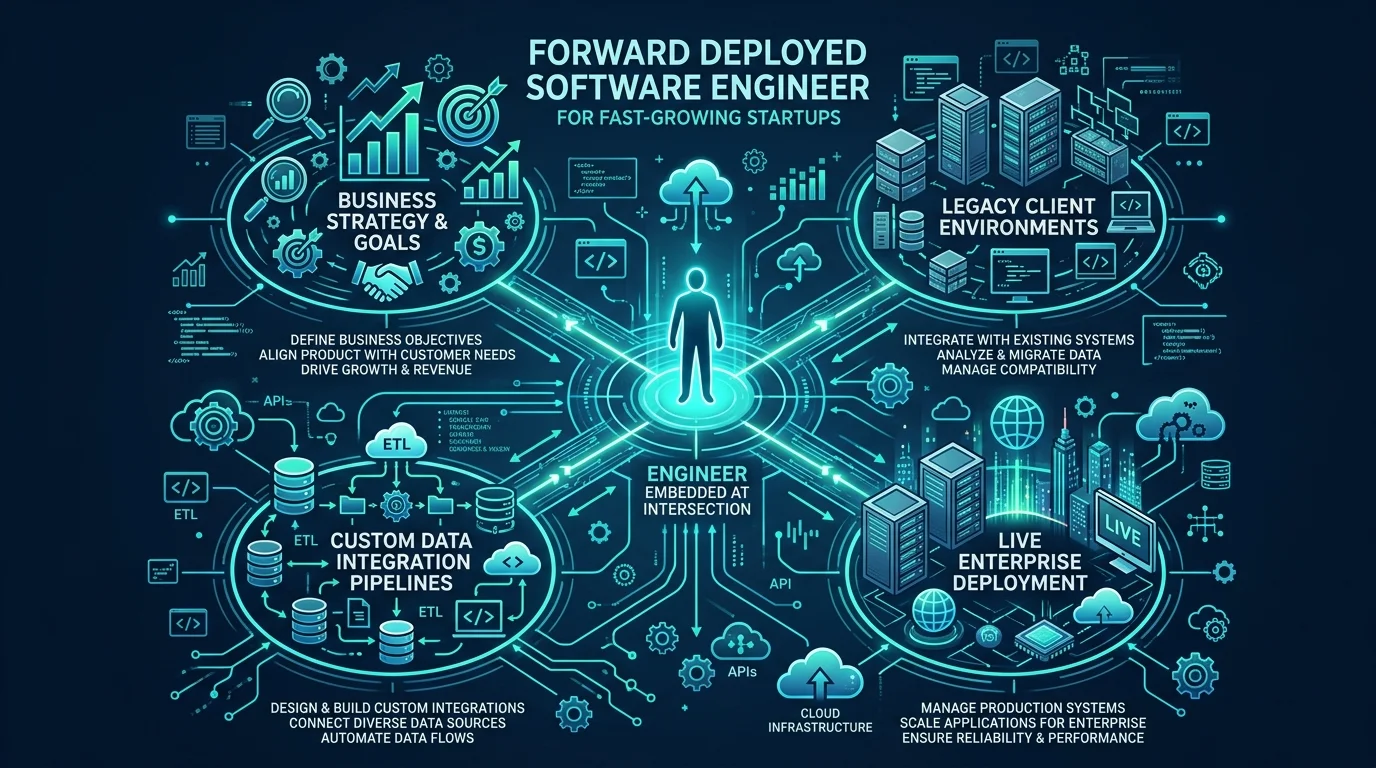
- The FDSE embeds directly at the customer frontier.
- They sit in stakeholder meetings, learn the customer's terminology, inspect the client's messy real-world infrastructure, and write production-grade code directly to bridge the gap.
- Once the custom integration or operational solution is proven in production, the FDSE distills the learnings back to the core product team as a reusable, standardized module.
2. Three Critical Problems an FDSE Solves for Startups
Problem 1: Unblocking Stalled Enterprise Implementations
Enterprise clients rarely change their internal systems to match your startup's clean API. They expect you to adapt to them.
An FDSE takes full ownership of the customer's messy reality:
- Writing custom data transformation pipelines that ingest legacy formats (XML, EDI, fixed-width text files) into your modern data models.
- Building custom bi-directional webhooks and reverse ETL syncs.
- Deploying inside client on-premises VPCs, Docker clusters, or sovereign cloud environments.
Problem 2: Protecting Your Core Product Roadmap
If you pull your lead product engineer off the core roadmap every time a large prospect needs a custom feature, your product roadmap grinds to a halt. Six months later, your technical debt has doubled and your main product is falling behind competitors.
An FDSE acts as a technical shield:
- They absorb the bespoke customer requirements independently.
- They build modular integration layers that wrap around your core product without polluting its core domain logic.
- Your core product engineers stay 100% focused on shipping the roadmap.
Problem 3: Compressing Time-to-Value from Months to Days
Enterprise churn happens when customers wait six months after signing an agreement before seeing any working software. An FDSE operates with rapid iteration cycles:
- Week 1: Understand the real problem, establish security clearance, and access staging environments.
- Week 2: Deploy the first working data bridge or pipeline.
- Week 3: Refine against live operational feedback.
3. Core Engineer vs. Solutions Architect vs. FDSE
To understand where an FDSE fits in your team, compare the three disciplines:
| Dimension | Core Product Engineer | Solutions Architect | Forward Deployed Engineer |
|---|---|---|---|
| Location | Internal team | Sales/Customer facing | Embedded at customer frontier |
| Orientation | The universal product | High-level technical design | The immediate customer problem |
| Code Output | High (core platform) | Low to none (diagrams, docs) | High (production code & bridges) |
| Ambiguity Tolerance | Low (needs clear specs) | Medium (understands sales) | High (diagnoses undefined chaos) |
| Metric of Success | Sprint velocity & uptime | Deal closed / RFP signed | Working software in production |
4. When Should Your Startup Engage an FDSE?
Engaging a forward deployed engineer makes strategic sense when:
- You have enterprise pipeline value at risk: High-value deals are stuck in technical discovery or stalled implementation phases.
- Client data is messy and bespoke: Customers require custom ingest pipelines, legacy database synchronization, or complex multi-tenant onboarding.
- Core developers are overwhelmed: Your engineering leads are spending more than 20% of their week on customer support calls and one-off integration scripts.
Embed Senior Deployment Capability into Your Team
You don't need to hire a $300k full-time executive to unlock enterprise delivery. Working with an experienced independent Forward Deployed Software Engineer gives your startup immediate access to senior capability when you need it most.
Learn more about the Forward Deployed Engineering philosophy, check my background and experience, or book a direct conversation to discuss how we can unblock your next major customer deployment.