Building a software-as-a-service (SaaS) platform is one of the highest-leverage business models in tech. However, one of the most critical decisions you will make during technical design is how to structure your multi-tenancy model.
Get this architecture right, and your application will onboard tenants in minutes, scale effortlessly across thousands of accounts, and keep infrastructure overhead lean. Get it wrong, and you will face cross-tenant data leaks, agonizingly slow database migrations, and expensive infrastructure rewrites.
As an engineer who has built and deployed multi-tenant platforms where a new tenant is provisioned in under 30 minutes with automated custom domains, this guide compares single-database versus multi-database tenancy in Laravel and outlines the end-to-end architecture needed for production success.
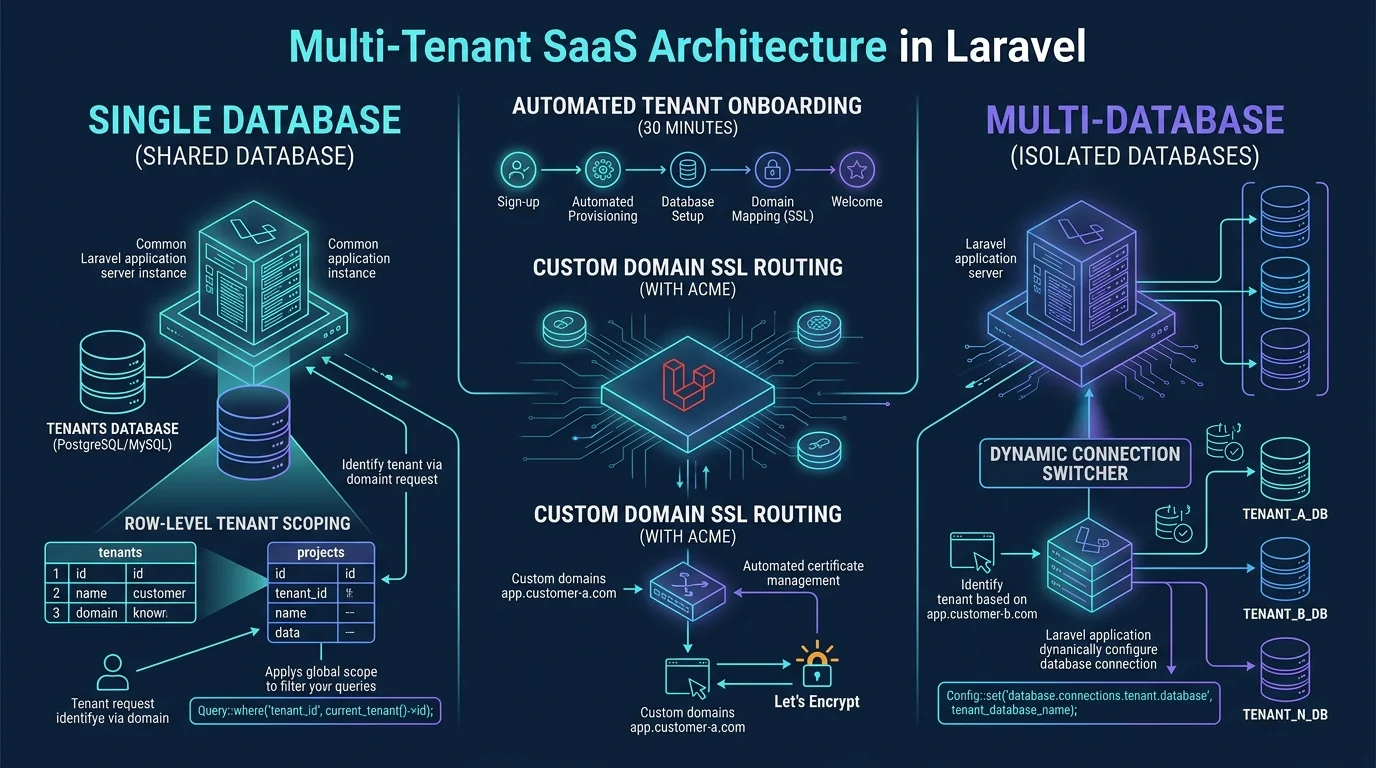
1. Single Database vs. Multi-Database: The Architectural Face-Off
Every multi-tenant application must answer one core question: Where does tenant data live?
Option A: Single Database (Row-Level Scoping)
In this model, all customer data shares the exact same database and tables. Every table containing tenant data includes a tenant_id foreign key.
- Advantages:
- Ultra-Low Cost: Run thousands of tenants on a modest database instance.
- Frictionless Migrations: Running
php artisan migrateupdates all tenants simultaneously in seconds. - Simple Cross-Tenant Analytics: Easily generate platform-wide reporting, usage aggregates, and cohort retention charts.
- Drawbacks:
- Data Leak Risk: If a developer forgets to apply a tenant scope on a raw SQL query, data from another customer could be exposed.
- Challenging Backups: Restoring a single customer's data from 3 days ago requires exporting and filtering specific rows rather than doing a point-in-time database snapshot.
Option B: Multi-Database (Isolated Schemas)
In this model, each tenant has their own isolated MySQL or PostgreSQL database. When an HTTP request arrives, middleware identifies the tenant and dynamically switches the database connection at runtime.
- Advantages:
- Absolute Data Isolation: Physical separation eliminates accidental cross-tenant data leakage.
- Compliance Ready: Meets strict healthcare (HIPAA) and enterprise financial security audits.
- Targeted Backups: Back up, restore, or destroy a single tenant's database with standard CLI tools (
mysqldump).
- Drawbacks:
- Migration Overhead: Running database migrations across 1,000 separate databases takes significant queue orchestration.
- Connection Limits: High traffic across hundreds of active tenant databases can quickly exhaust MySQL connection pools.
2. Implementing Single-Database Multi-Tenancy in Laravel
If you are building a B2B SaaS where cost efficiency and rapid iteration are paramount, single-database architecture with global Eloquent scopes is the industry standard.
Step 1: The Tenant Identification Middleware
Identify the current tenant by inspecting the subdomain or authenticated user context:
namespace App\Http\Middleware;

use Closure;
use App\Models\Tenant;
use Illuminate\Http\Request;

class IdentifyTenant
{
    public function handle(Request $request, Closure $next)
    {
        $subdomain = explode('.', $request->getHost())[0];
        $tenant = Tenant::where('subdomain', $subdomain)->firstOrFail();

        // Bind the tenant instance into the application container
        app()->instance('current_tenant', $tenant);

        return $next($request);
    }
}
Step 2: The Universal BelongsToTenant Trait
Create a reusable Eloquent trait that enforces scoping across all your tenant-owned models:
namespace App\Models\Traits;

use App\Models\Scopes\TenantScope;
use Illuminate\Database\Eloquent\Relations\BelongsTo;

trait BelongsToTenant
{
    protected static function bootBelongsToTenant(): void
    {
        // Automatically injects WHERE tenant_id = ? into all queries
        static::addGlobalScope(new TenantScope);

        // Automatically populates tenant_id when saving new records
        static::creating(function ($model) {
            if (app()->bound('current_tenant') && empty($model->tenant_id)) {
                $model->tenant_id = app('current_tenant')->id;
            }
        });
    }

    public function tenant(): BelongsTo
    {
        return $this->belongsTo(\App\Models\Tenant::class);
    }
}
By adding use BelongsToTenant; to your models (Project, Invoice, Customer), Eloquent guarantees that no record is queried or saved without the tenant constraint.
3. Automated Tenant Provisioning in Under 30 Minutes
Enterprise SaaS platforms must not require manual sysadmin intervention when a customer registers. The entire onboarding lifecycle should run asynchronously via Laravel Queues:
graph LR
    A[Customer Registers] --> B[Create Tenant Record]
    B --> C[Provision Stripe Subscription]
    C --> D[Seed Default Roles & Data]
    D --> E[Issue SSL Certificate]
    E --> F[Send Welcome Magic Link]
Using queued event listeners:
namespace App\Listeners;

use App\Events\TenantRegistered;
use Illuminate\Contracts\Queue\ShouldQueue;

class ProvisionTenantEnvironment implements ShouldQueue
{
    public function handle(TenantRegistered $event): void
    {
        $tenant = $event->tenant;

        // 1. Seed essential lookup tables and default settings
        $tenant->seedInitialWorkspaceData();

        // 2. Dispatch DNS / Domain mapping verification
        dispatch(new ConfigureTenantDomainJob($tenant));

        // 3. Dispatch automated onboarding email series
        $tenant->owner->notify(new WorkspaceReadyNotification($tenant));
    }
}
4. Custom Domains and Dynamic SSL Management
When your tenants want to run on their own custom domains (e.g., portal.clientbrand.com) rather than your platform subdomain (clientbrand.yourapp.com), SSL certificate provisioning must be automated.
Modern platforms achieve this using:
- Cloudflare for SaaS: Allows tenants to point a CNAME to your fallback origin. Cloudflare manages SSL termination and renewal automatically.
- Caddy Reverse Proxy with On-Demand TLS: Caddy issues Let's Encrypt certificates automatically over HTTP/TLS challenges as new host headers hit your servers:
The{ on_demand_tls { ask http://localhost:8000/api/internal/verify-domain } } :443 { tls { on_demand } reverse_proxy localhost:8080 }verify-domainendpoint queries yourtenantstable to ensure the domain belongs to an active paid subscriber before Caddy issues the certificate, preventing certificate abuse.
5. Scaling Multi-Tenant Workloads
As your tenant count grows into the hundreds:
- Partition Queue Workers: Don't let one runaway tenant's 10,000 CSV import stall email delivery for all other tenants. Use high, default, and low priority queues in Laravel Horizon.
- Cache by Tenant Tag: When using Redis cache, always prefix or tag cache keys with the tenant ID:
Cache::tags(["tenant:{$tenant->id}"])->remember(...). - Database Indexing: Always make
tenant_idthe first column in composite indexes:$table->index(['tenant_id', 'status', 'created_at']);.
Build Your Next SaaS with Senior Engineering Expertise
Architecting a multi-tenant platform demands deep experience in database design, performance tuning, and infrastructure automation. Avoiding architectural pitfalls in week one saves hundreds of thousands of dollars in technical debt down the line.
Explore our Full Stack Development Services and review our real-world Case Studies of multi-tenant systems in production. Ready to turn your software idea into a scalable SaaS? Get in touch with Smit Desai to plan your architecture.