Every established business eventually reaches a crossroads with its core software. The application that powered initial growth from five customers to five thousand has become brittle, slow, and expensive to change. New feature requests take three months instead of three days. Developers complain that "the whole codebase is spaghetti" and demand a complete greenfield rebuild.
Management hears the promise of a clean slate and modern architecture, but rewrites are notorious traps. Studies across enterprise software show that over 70% of complete rewrites exceed their budgets, miss delivery deadlines by months, or get cancelled entirely.
As an engineer who has both rescued troubled codebases and led successful modernization projects, I know there is a better way. If your team is struggling with legacy technical debt, this guide breaks down the financial and operational trade-offs between rebuilding and refactoring, and details how to execute an incremental modernization using the Strangler Fig pattern.
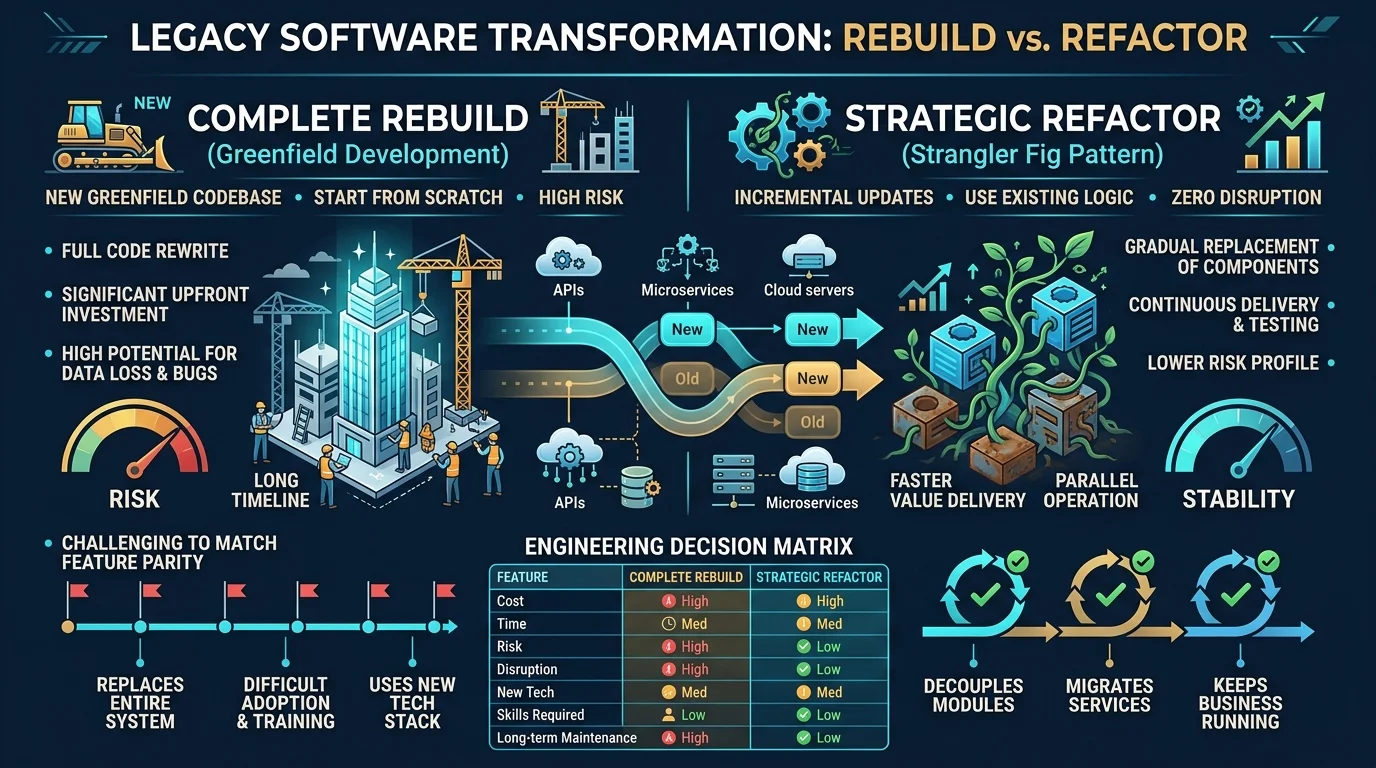
The Hidden Cost of the "Clean Slate" Fallacy
When developers advocate for a complete rewrite, they often suffer from the Clean Slate Fallacy. They assume that building the system again will be fast because they now understand the domain. What they forget is that old codebases are filled with hundreds of subtle bug fixes, tax calculations, accounting edge cases, and weird third-party quirks that took five years of production reality to uncover.
The Second-System Effect
While your engineering team spends 12 months rebuilding the software from scratch:
- Feature Freezes: The live production app receives almost no new commercial features because developer capacity is tied up in the rewrite.
- Moving Target: Your competitors keep shipping, and customers request new workflows. The rewrite project must constantly adjust its scope to match the shifting legacy baseline.
- Data Migration Nightmares: Migrating 10 years of historical data with broken constraints into a newly designed normalized schema often uncovers thousands of edge cases late in the project.
Rebuild vs. Refactor: The Decision Matrix
Before choosing a path, score your current system against these core technical and organizational dimensions:
| Factor | Consider a Strategic Refactor | Consider a Complete Rebuild |
|---|---|---|
| Business Disruption | Zero. Changes ship continuously behind live traffic. | High. Cutover carries risk of critical service disruption. |
| Time to First Value | Days to weeks (quick performance wins, isolated modules). | 6 to 18 months before users see any benefit. |
| Domain Logic | Intact. Battle-tested business rules remain preserved. | High risk of omitting undocumented historical edge cases. |
| Team Velocity | Improves incrementally with each refactored domain. | Stalls during the rewrite cycle. |
| Cost Predictability | High. Billed on defined milestones or transparent hourly blocks. | Low. Rewrites routinely suffer from scope expansion. |
| Tech Stack Viability | Core language (PHP, Python, JS) is viable, just outdated. | Technology is extinct, unmaintained, or impossible to hire for. |
The Proven Path: The Strangler Fig Modernization Pattern
Instead of gambling the entire company on a single cutover weekend, elite engineering teams use the Strangler Fig Application Pattern (originally coined by Martin Fowler).
Just as a strangler fig tree germinates around an existing host tree and slowly replaces it, we build a new, clean application layer that gradually envelops and replaces legacy components until the old code can be safely decommissioned.
Step 1: Place a Reverse Proxy in Front
Deploy Nginx, Cloudflare, or AWS API Gateway in front of your live servers. Route 100% of incoming traffic to your existing legacy app by default:
# Nginx Reverse Proxy Configuration
server {
    listen 443 ssl http2;
    server_name app.yourbusiness.com;

    # New Modernized Modules (Laravel 11 / PHP 8.4)
    location /billing/ {
        proxy_pass http://modern_laravel_upstream;
        proxy_set_header Host $host;
        proxy_set_header X-Real-IP $remote_addr;
    }

    # Legacy Application Catch-All
    location / {
        proxy_pass http://legacy_monolith_upstream;
        proxy_set_header Host $host;
        proxy_set_header X-Real-IP $remote_addr;
    }
}
Step 2: Carve Out High-Value, Low-Dependency Modules
Identify an isolated subsystem causing immediate commercial pain—such as billing, user authentication, reports, or a new customer API.
Build this specific module cleanly inside a modern Laravel 11 application. Share the underlying MySQL database initially using read-only database connections or events to keep data synchronized.
Step 3: Flip Traffic via Reverse Proxy
Update the proxy configuration to route requests for that single subsystem to the modern application. Your customers continue using the same domain and cookies seamlessly, but that piece of functionality is now running 10x faster with clean architecture and modern test coverage.
Step 4: Repeat and Decommission
Module by module, repeat the process. With every iteration, your technical debt shrinks, application performance increases, and your business remains completely operational without a single moment of high-risk downtime.
When a Full Rebuild IS the Right Decision
Refactoring is superior in 85% of cases, but a total rewrite is warranted when:
- The Technology is Obsolete: The app runs on technologies with zero developer supply (e.g. PHP 4, ASP Classic, or Flash backends).
- Fundamental Business Model Shift: The entire data model has inverted (e.g., transitioning from a single-tenant on-prem desktop tool to a cloud multi-tenant SaaS).
- Severe Security or Architecture Flaws: The underlying database schema is so hopelessly corrupt that data integrity cannot be mathematically guaranteed.
How to Get Started with Modernization
You don't need to commit to an expensive, multi-year rebuild project to fix technical drag. Most legacy codebases can see dramatic speed improvements and security hardening within the first two weeks of focused refactoring.
Learn more about our dedicated Legacy Software Modernization Services or explore our transparent Hourly Engineering Packages. If you have an aging system that needs an experienced set of eyes, contact me today to schedule a confidential technical review.