What guests look for on a holiday rental website
People booking a cottage or a cabin are planning something they have looked forward to for months, often for a whole family or a group of friends. Before they send a message they want to answer a handful of practical questions on their phone: does it sleep all of us, is there a sauna or a hot tub, are our dates free, how far is it from the slopes or the lake, and roughly what will a week cost. If the site answers those quickly, they ask to book. If it does not, they go back to the portal and book something else.
They also want to trust the place. Clear house rules, check-in and check-out times, what is included in the price, how the deposit works and who they will be dealing with matter as much as the pictures. A rental website that reads like the owner talking, with the real details of each cabin, wins over a page of adjectives.
How the demo handles it
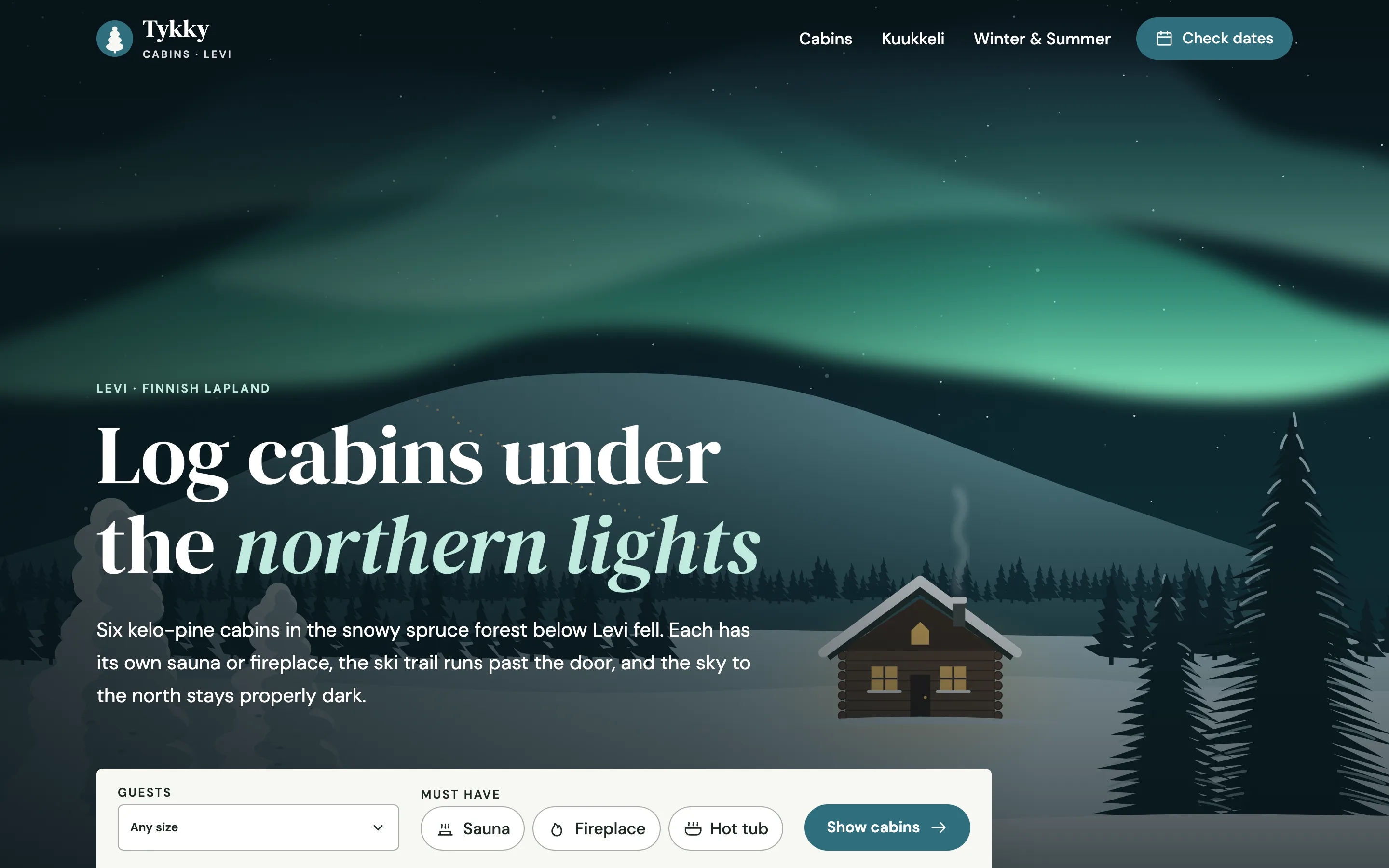
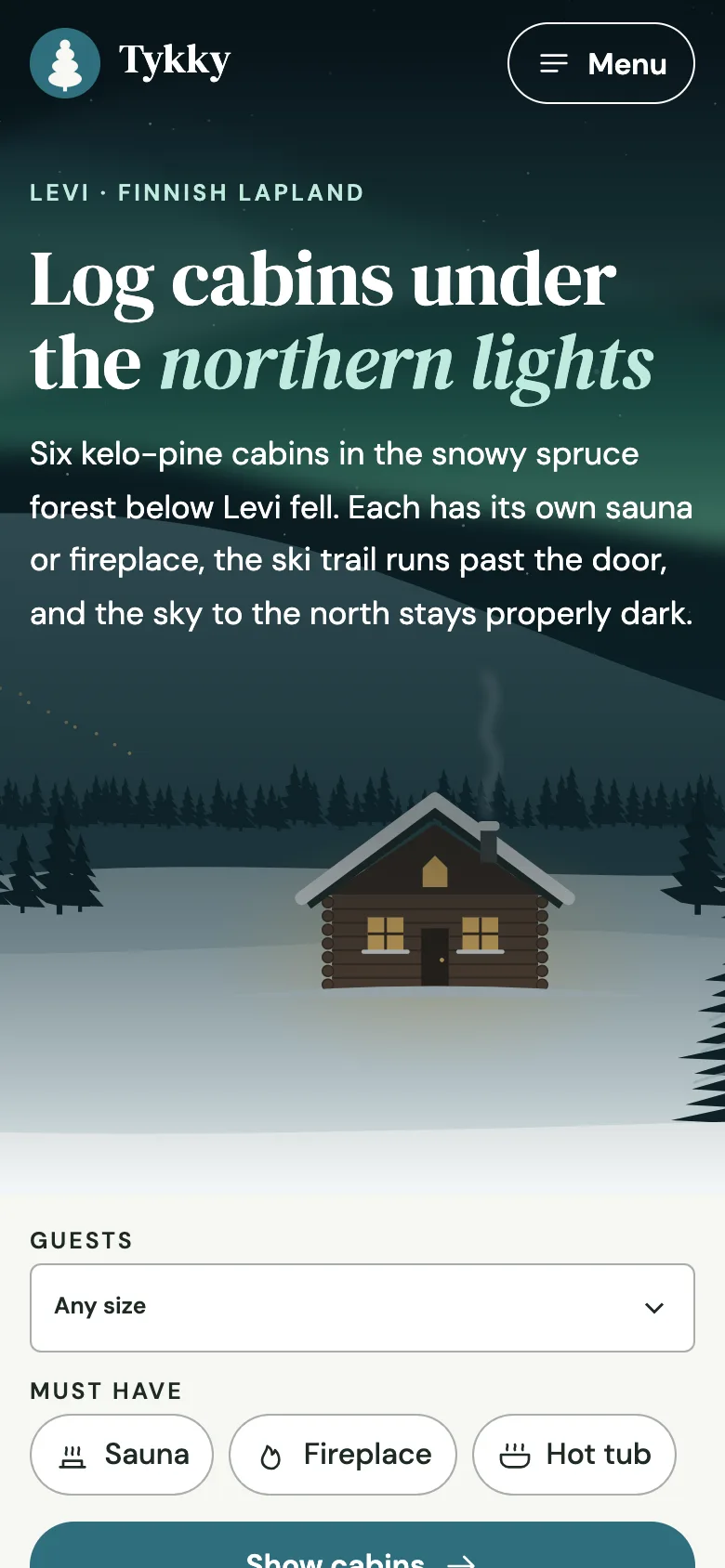
Tykky Cabins Levi is a fictional group of six log cabins in the forest at Levi, in Finnish Lapland. The home page opens on an edge-to-edge illustrated scene of the northern lights over the snowy forest, with a search bar docked to its bottom edge: pick a group size and tick sauna, fireplace or hot tub, and the cabins page opens already filtered.
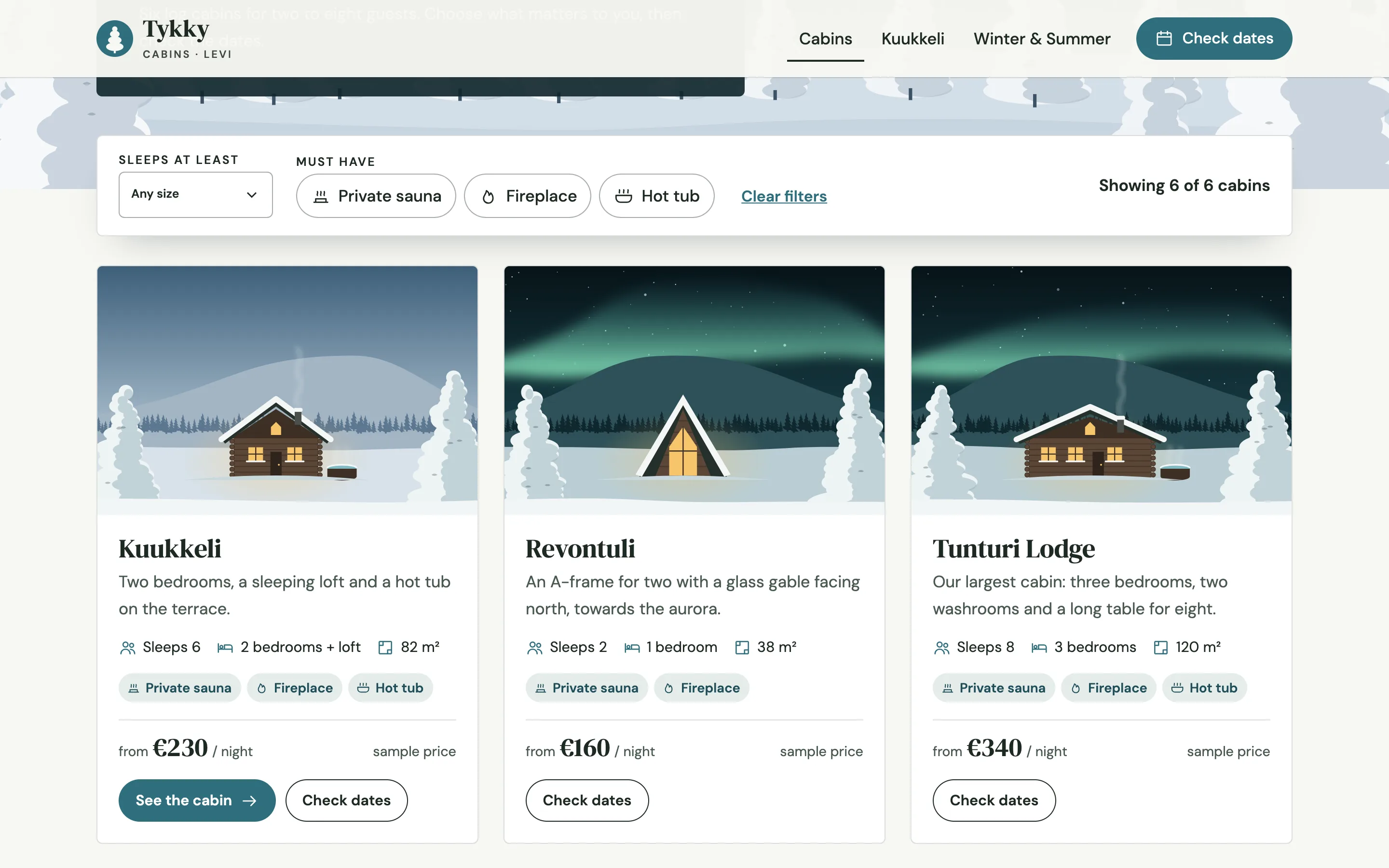
The cabins page lists every cabin as a card with sleeps, bedrooms, floor area, amenities and a sample "from" price per night. Filters for group size, private sauna, fireplace and hot tub work instantly, show a live count and keep the choice in the address, so a link shared in a family chat opens the same shortlist. If nothing matches, the page says so and suggests booking two neighbouring cabins.
The cabin page for Kuukkeli shows what a full listing page can hold: a fact bar with sleeps, bedrooms, size, sauna, from-price and minimum stay; a drawn floor plan that shows where the sauna, bedrooms and sleeping loft are; amenities grouped by warmth, kitchen, outdoors and practical details; and a table of sample prices by season.
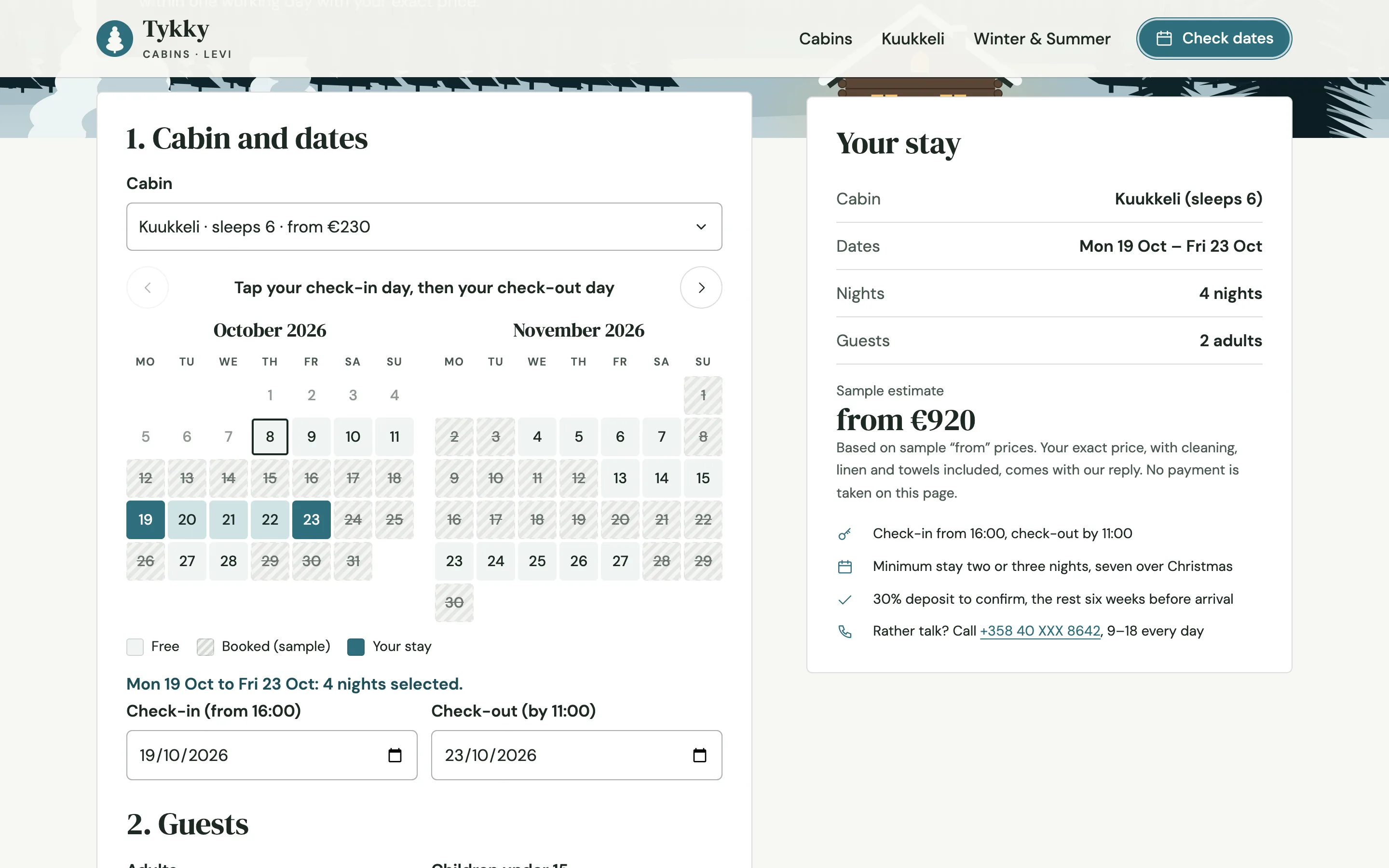
The booking page is the signature feature. Choose a cabin and a two-month calendar shows which nights are free and which are booked. Guests tap a check-in day and a check-out day, and the calendar refuses a stay that crosses a booked night while still allowing a booked night as the check-out day, the way changeovers really work. The guest count is checked against the cabin's beds, the minimum stay is checked against the dates, and a summary beside the form shows the nights and a sample estimate. On submit the demo explains that nothing was sent.
The pages
- Home: the place, the cabin search, three featured cabins, the two seasons, how booking works, sample reviews and contact details.
- Cabins: all six cabins with amenity filters and what is included in every stay.
- Kuukkeli: one complete cabin page with the floor plan, amenities and seasonal prices. A real site gives every cabin a page like it.
- Winter & Summer: polar night, spring skiing, the midnight sun and the autumn colours, and what to do in each season from the cabin door.
- Booking: the availability calendar, guests, contact details and the enquiry.
Local SEO set-up for a holiday rental
The demo marks the business up as a LodgingBusiness with check-in and check-out times, amenities and the area it is in, each cabin as a House with occupancy and floor size, and the nightly rate as an Offer. Page titles target the searches guests really type, such as cabins with a sauna or a hot tub near a named resort. For a real business I connect the site to a Google Business Profile, keep the name, area and phone number identical everywhere, and write each cabin page around its own name so returning guests can find it directly.
Country notes
Finland
Most guests search in Finnish, English and often German, so a real Finnish rental site usually needs at least Finnish and English versions with proper hreflang tags; the demo is in English for now. Prices are in euros, the Y-tunnus belongs in the footer, and the site follows the EU accessibility rules. Sauna, drying rooms and engine heater posts deserve their own lines, because guests do look for them.
Canada
Canadian cabin and cottage sites are written in Canadian English, with prices in Canadian dollars and a French version where guests come from Quebec. Guests want to know about road access in winter, wood stoves, lake access and whether pets are welcome. Provincial accommodation registration numbers, where required, can sit in the footer and on each listing.
Australia
Australian holiday house sites use Australian English, Australian dollars and an ABN in the footer. Guests compare air conditioning, fireplaces for winter in the high country, pet policies and distance to the beach or the snowfields. Council short-stay registration numbers, where a state requires them, belong on each property page.
USA
American cabin rental sites use US English, US dollars, and feet and miles for distances. Guests filter by hot tubs, game rooms, pet-friendly cabins and driveway access in snow, and expect the site to meet WCAG accessibility guidelines. Local short-term rental permit numbers, where a county asks for them, can be shown on every listing.