
What customers look for on a moving company's website
Almost everyone who lands on a moving company's website has the same first question: roughly how much will this cost, and can you do my date? They are often comparing three or four movers in one evening, usually on a phone, and the company that answers those two questions fastest gets the enquiry. After that, they want proof that you will not damage their things or add surprise fees on the day: what is included, how the price is worked out, and whether you are licensed and insured.
Moving is also a stressful purchase with a deadline. A lease ends, a sale closes, a job starts. So the site has to make the next step obvious on every page, whether that is a call, a quick estimate or a full quote request, and it has to work well on a small screen in a hurry.
How the demo handles it
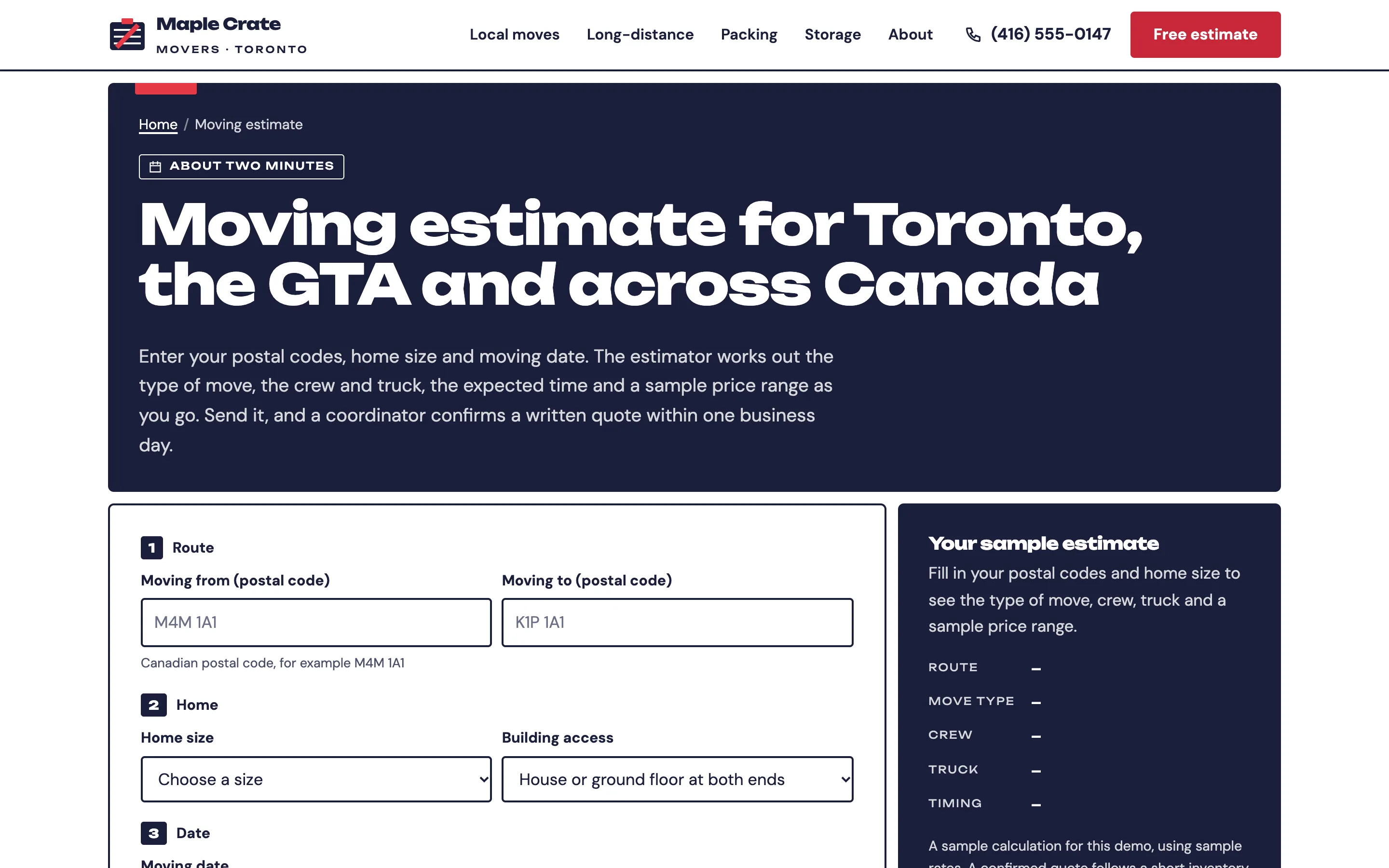
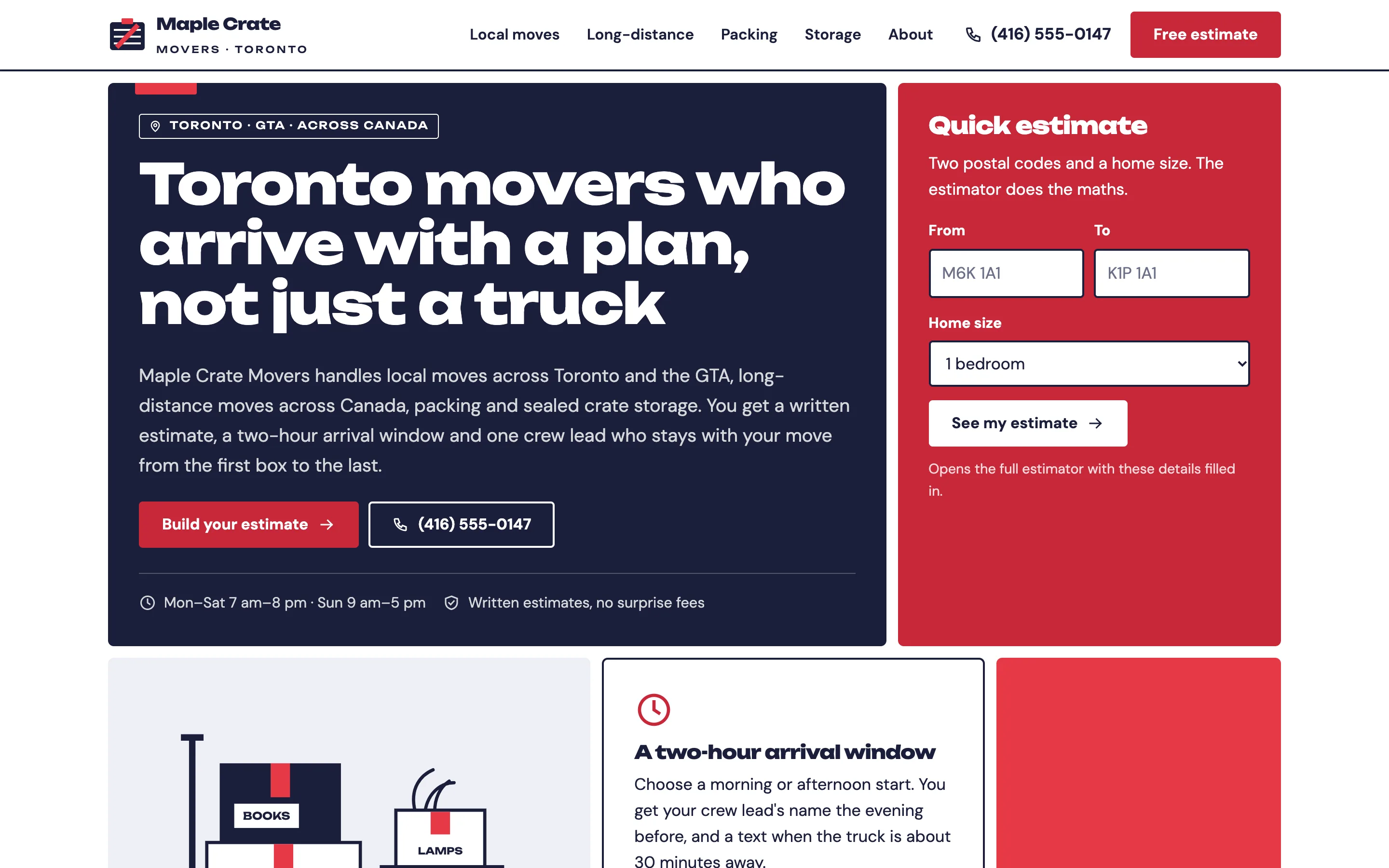
The demo, Maple Crate Movers, is a fictional Toronto mover built on a bento grid: each tile on the page answers one question. The home page opens with a quick estimate tile, where a visitor types two postal codes and a home size and is taken straight into the full estimator with those details filled in.
The estimator is the centre of the site. It reads the region from each postal code and decides whether the job is a local hourly move, a move across the wider city area or a long-distance move, with an approximate distance. As the visitor adds the home size, building access, date and extras, a summary panel shows the crew size, truck, expected hours or delivery window and a sample price range. It also adds practical notes: end-of-month dates book up first, weekend moves fill early, condo moves need a booked elevator. When the form is sent, the mover receives a qualified lead with every detail already sorted.
The rest of the site supports that decision. Every service page says what is included, how the time or price is counted, and what the customer has to do, with sample "from" prices clearly marked. Reviews sit under a heading that says they are samples, and the licence and insurance details have a fixed, visible place.
Pages included
- Home: the bento overview with the quick estimate, services, a four-step process, local moving details, reviews and FAQs.
- Local Moves: hourly crews, what every move includes, condos, houses and small offices, an illustrated service-area map and how hours are counted.
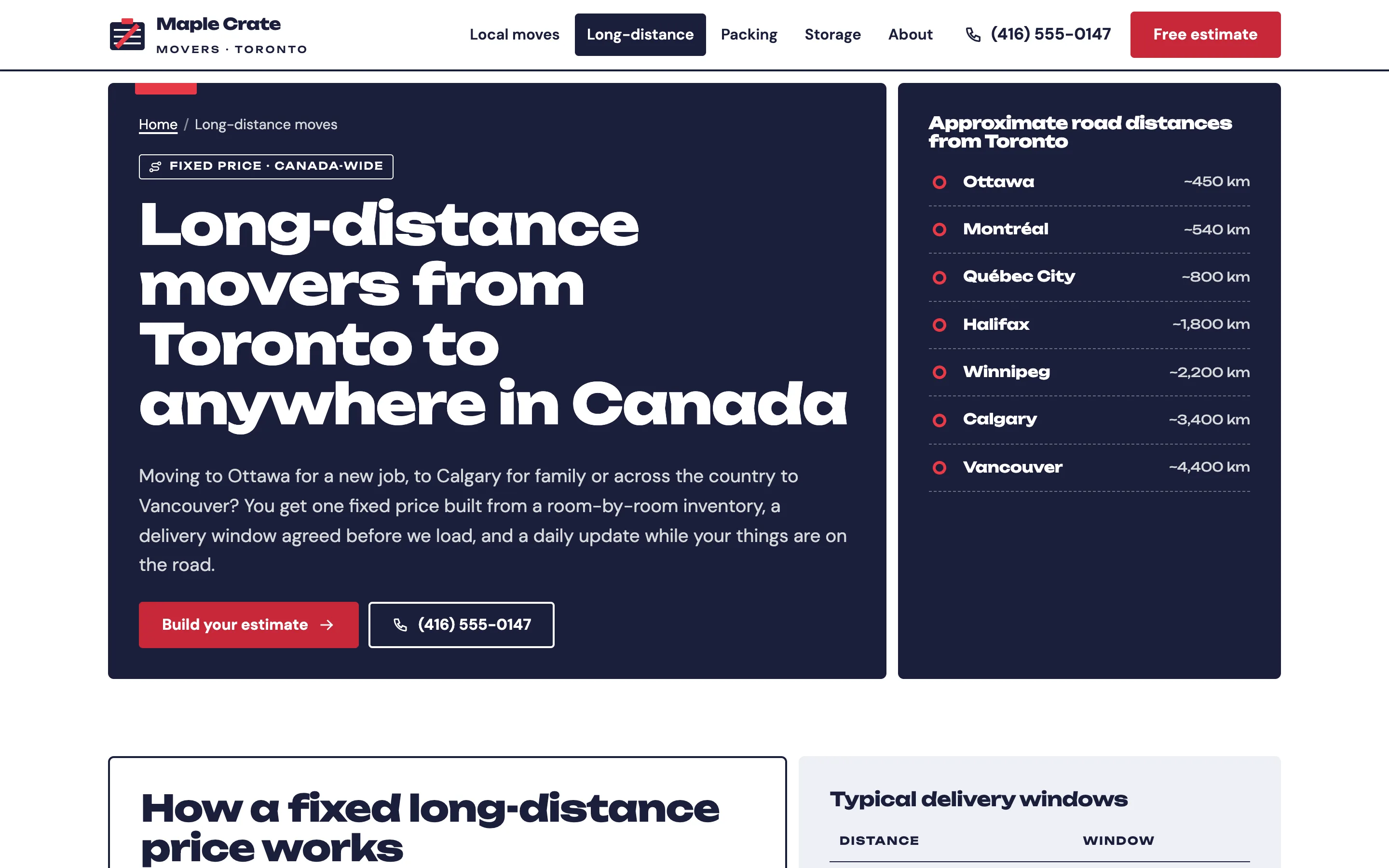
- Long-Distance: how a fixed price is built from an inventory, typical delivery windows, dedicated versus shared loads and a checklist for moving to another region.
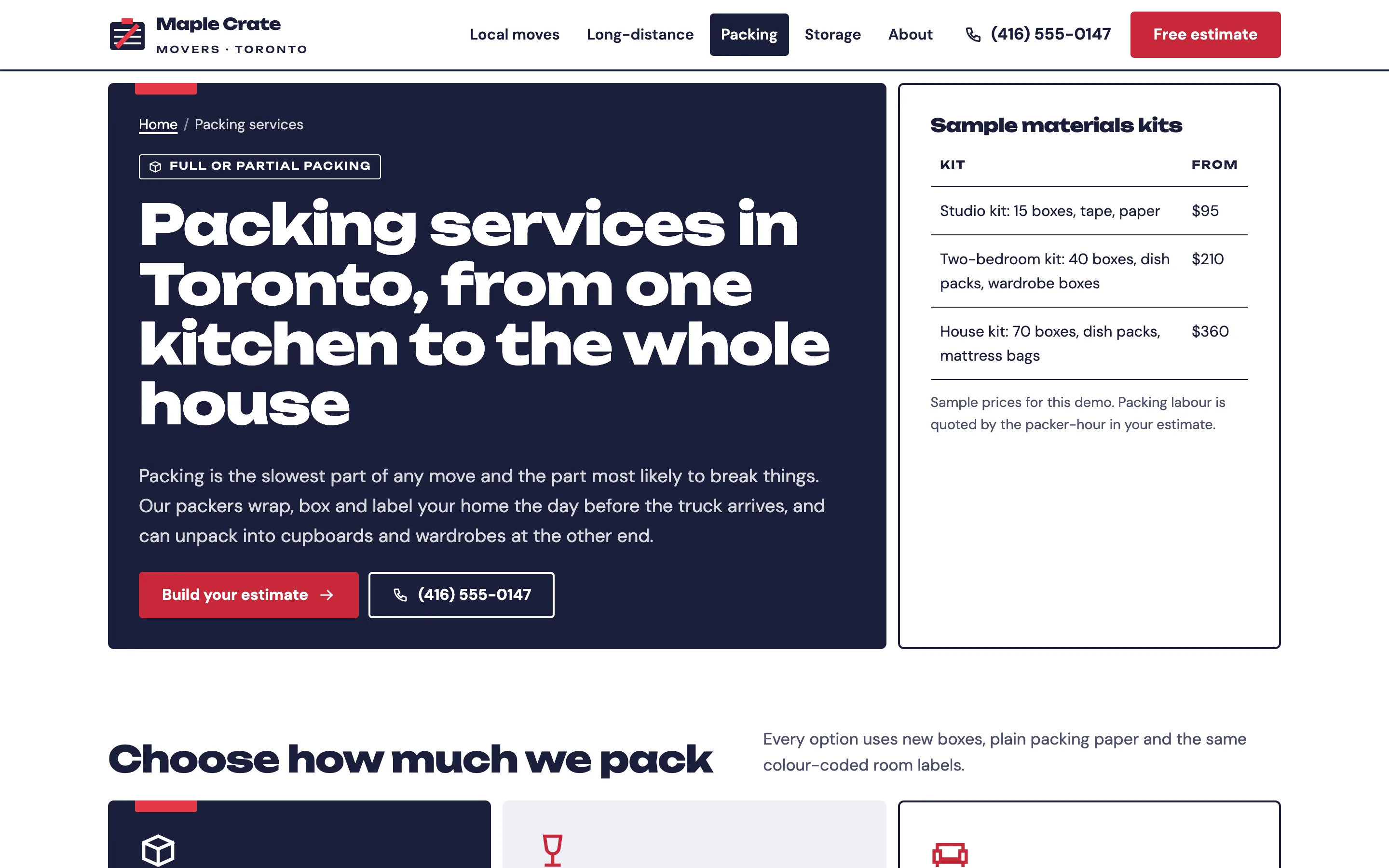
- Packing: full and partial packing, unpacking, materials kits, colour-coded room labels and specialty items such as pianos and art.
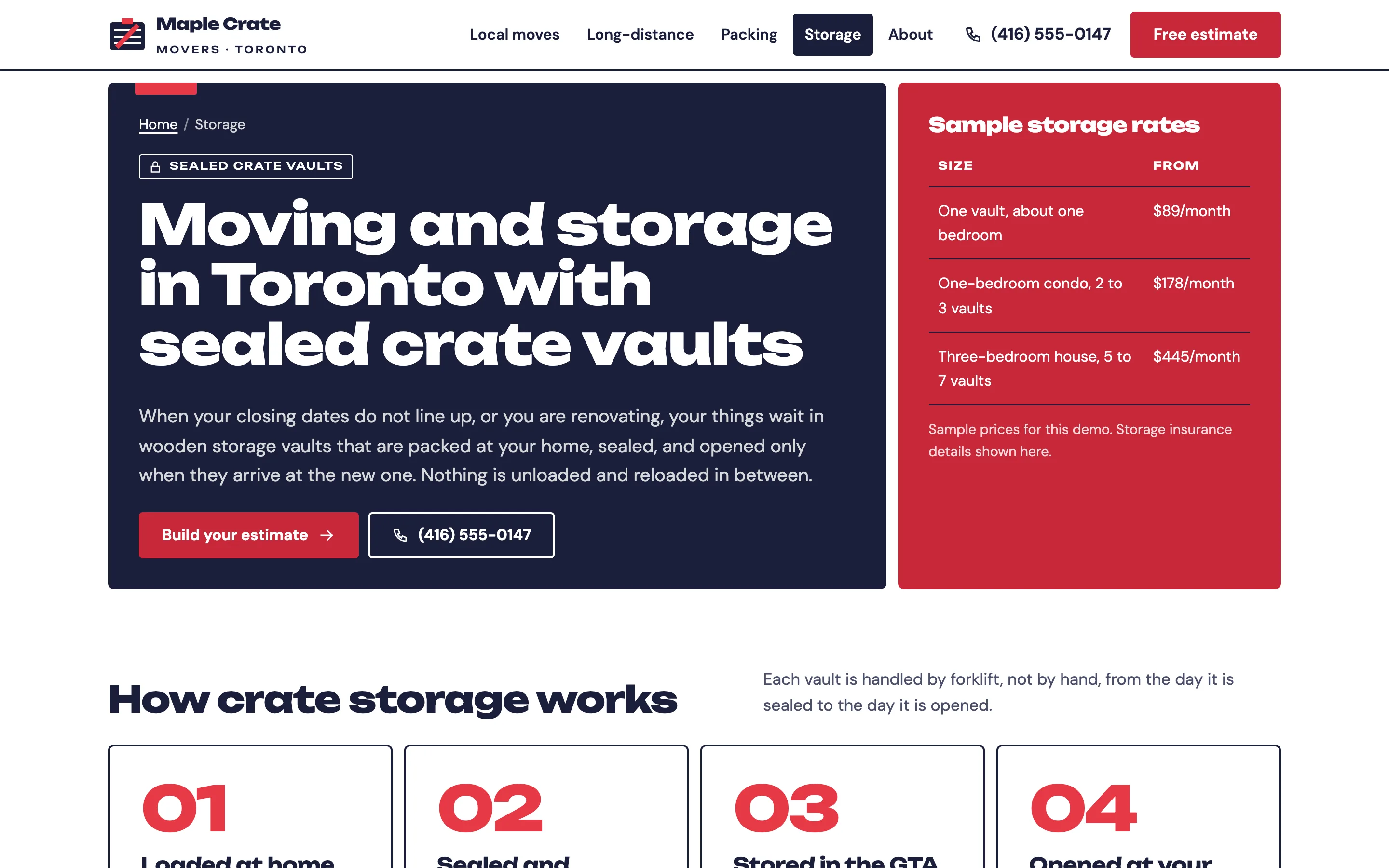
- Storage: how storage works between moves, when it helps, and sample monthly rates.
- Moving Estimate: the signature estimator and quote request.
- About: the crew, the promises made on every move, and placeholders for licences and insurance.
Local SEO set-up
Each page carries one JSON-LD graph with a MovingCompany node: name, phone, email, opening hours, logo, image and the cities served as areaServed. Service pages add Service and Offer nodes with the sample starting price, and every inner page has a BreadcrumbList. Pages with real questions and answers add FAQPage markup.
Titles and descriptions follow one pattern, service plus city plus brand, kept within the lengths Google shows. Service-area content lives where it is useful: the local moves page names the districts and suburbs covered, rather than spinning up thin pages for every postcode. For a live client we connect the site to the Google Business Profile with the same name, phone and service area, add the profile link to the structured data, and use the business categories that match the service pages.
Moving company websites by country
India
Indian customers often call or message before they fill in a form, so the site leads with a WhatsApp button next to the call button, and the estimator can send its summary to WhatsApp. Pages are in Indian English, with prices in rupees and distances in kilometres. Packers and movers in India are commonly asked about GST invoices, transit insurance and vehicle transport for cars and two-wheelers, so those get clear sections and a GST number placeholder. Payment by UPI is worth mentioning for advances and final settlement.
USA
American visitors compare movers on price and trust signals, so the site gives your USDOT number a visible place, plus the state licence where your state requires one for moves within it. Copy uses US English, US dollars, miles and ZIP codes, and the estimator works on ZIP codes instead of postal codes. Interstate moves come with specific paperwork and consumer protections, so the long-distance page explains your estimate type in plain words. Accessibility to WCAG 2.2 AA matters here because of ADA claims.
Canada
Canadian sites use Canadian English (colour, centre, kilometres), prices in Canadian dollars and the six-character postal code, which is exactly what the demo's estimator reads. Movers in Québec also need a French version of the site under the Charter of the French Language. Condo moves are a large part of the work in Toronto and Vancouver, so elevator bookings and insurance certificates deserve their own section, and winter moving deserves a mention.
Australia
Australian copy uses Australian English, dollars and kilometres. Interstate removals between Sydney, Melbourne, Brisbane and Perth are long, so delivery windows and backloading (shared loads) are worth explaining clearly. The footer has a place for your ABN, and the estimator can use four-digit postcodes. If you offer end-of-lease cleaning or storage with partners, those can sit on the same estimate.
Finland
Finnish moving customers expect a site in Finnish with an English version for international residents, so the build includes both languages with matching pages and hreflang links. Prices use the euro with Finnish number formatting, and the Y-tunnus has a fixed place in the footer. Many Finnish homes are flats with shared stairwells and lift rules, and moving dates cluster around the start of the month, so the estimator's date notes adapt to that. EU accessibility rules make WCAG 2.2 AA the baseline.