What restaurant guests need from a website
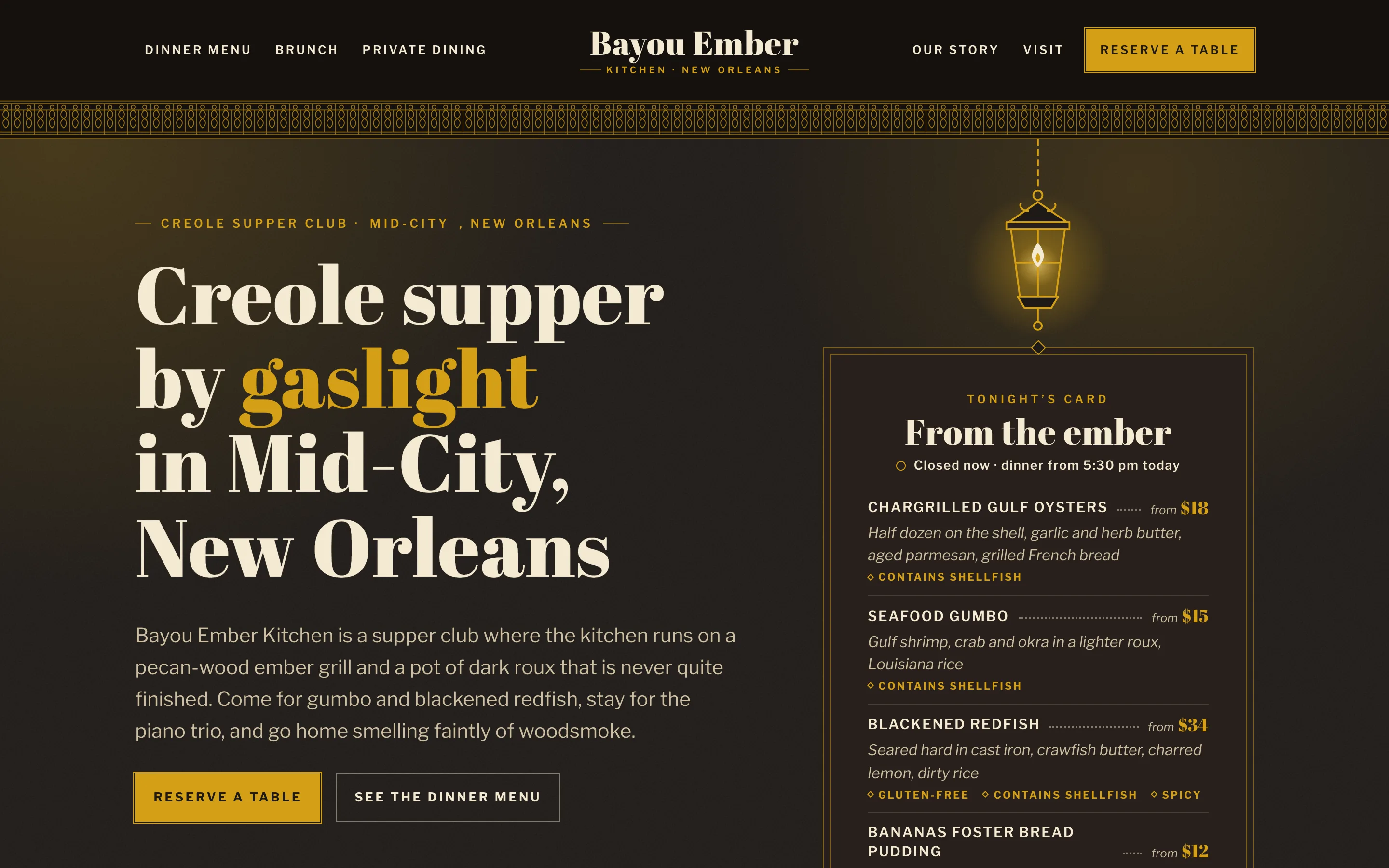
Most people visit a restaurant website on a phone, often within an hour of eating. They want three answers fast: what is on the menu, are you open, and can I get a table. Everything else, the story, the room, the music, matters only after those three are easy.
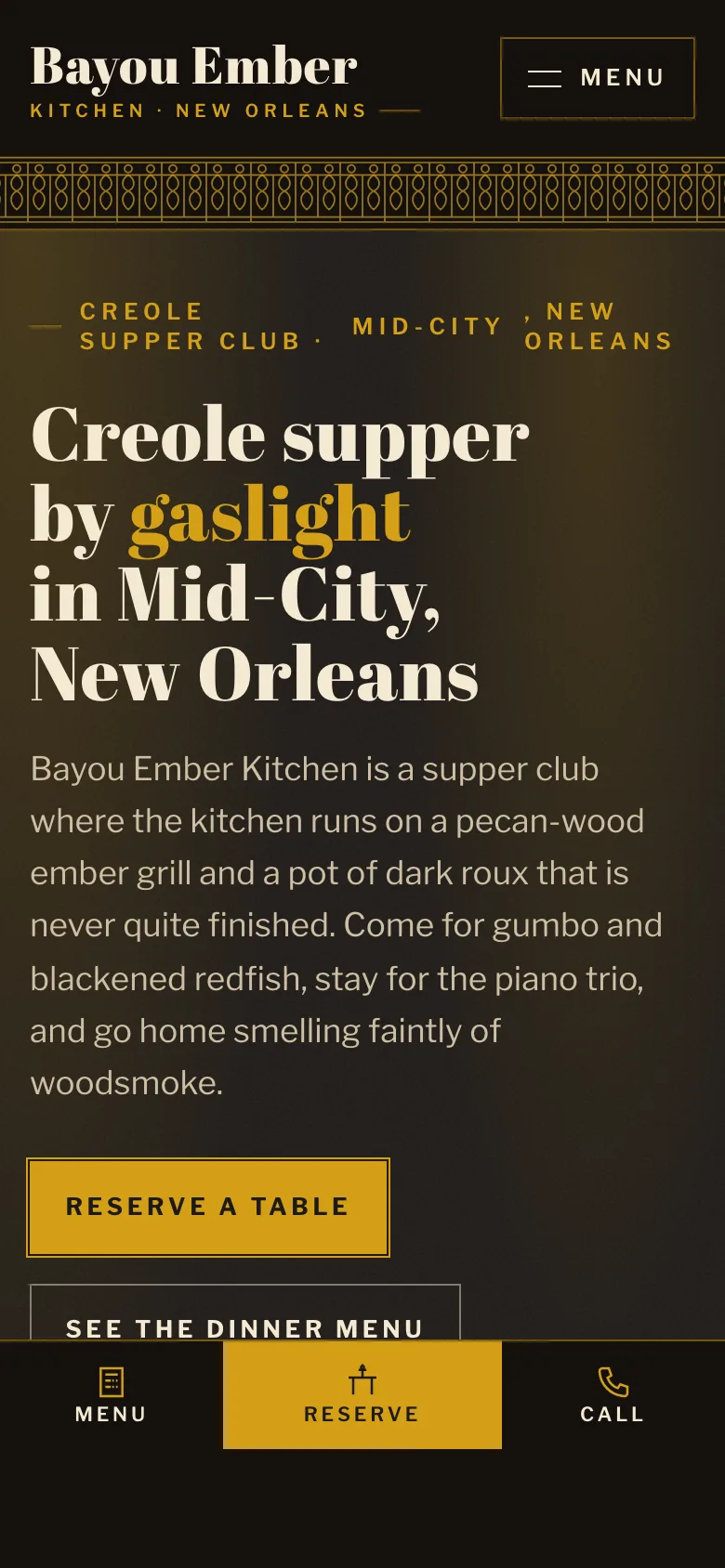
That is why the demo for Bayou Ember Kitchen, a fictional Creole supper club in New Orleans, puts the menu, a live opening status and a Reserve button on every screen. On phones a small bar at the bottom holds Menu, Reserve and Call, so the next step is always one tap away.
A menu that works on a phone
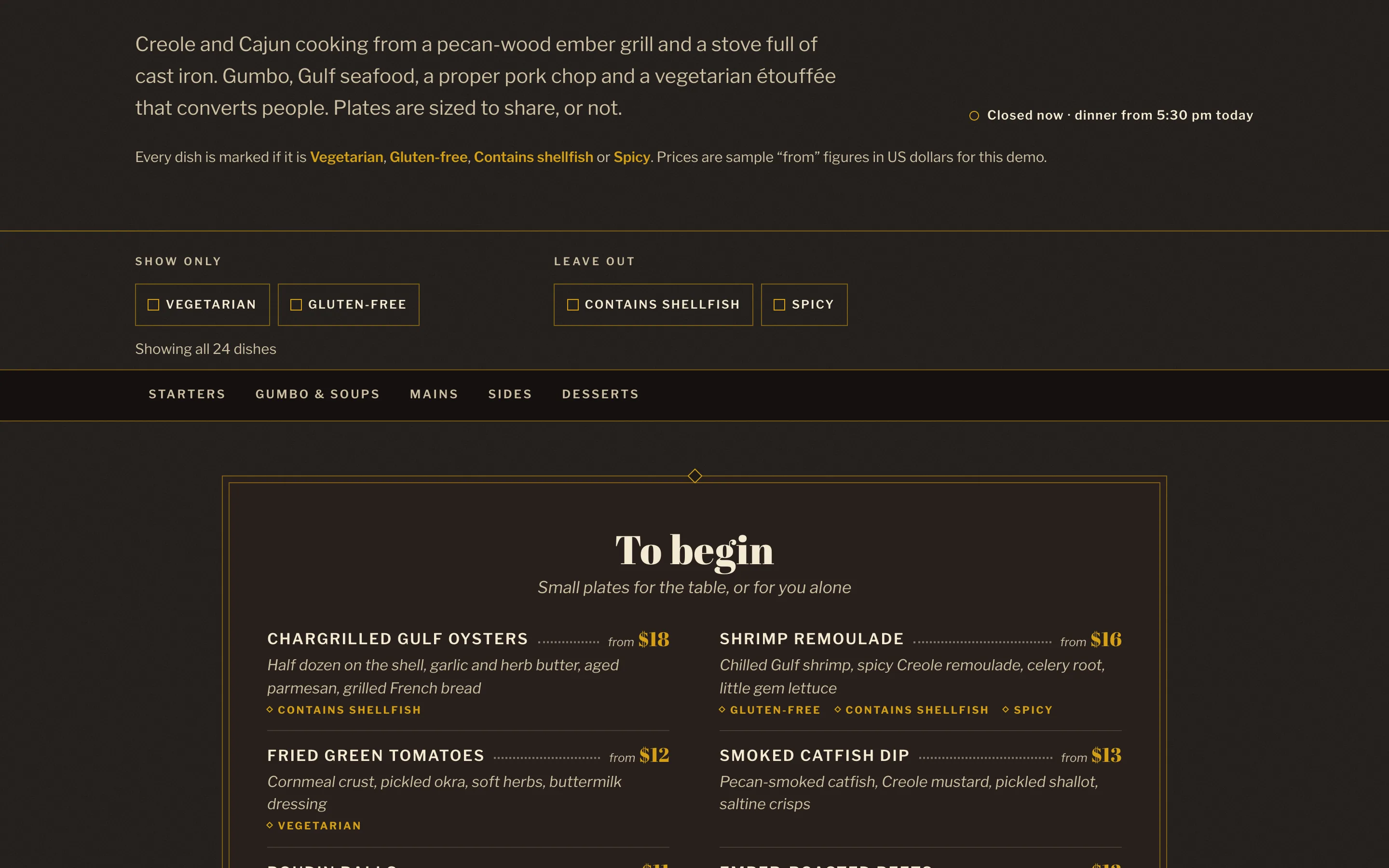
The dinner menu is real HTML, not a PDF. Each dish has a name, a short description, a sample price on a dotted leader and markers for vegetarian, gluten-free, shellfish and spicy. Guests can show only vegetarian or gluten-free dishes, or leave out shellfish and spicy plates, and the page tells them how many dishes are left. Sticky section tabs (starters, gumbo, mains, sides, desserts) follow the reader down the page and highlight the section in view.
Because the menu is written once as data, the same entries feed the visible menu and the Menu structured data, so search engines can read every dish and price. Changing a price means editing one line.
Reservations without the back-and-forth
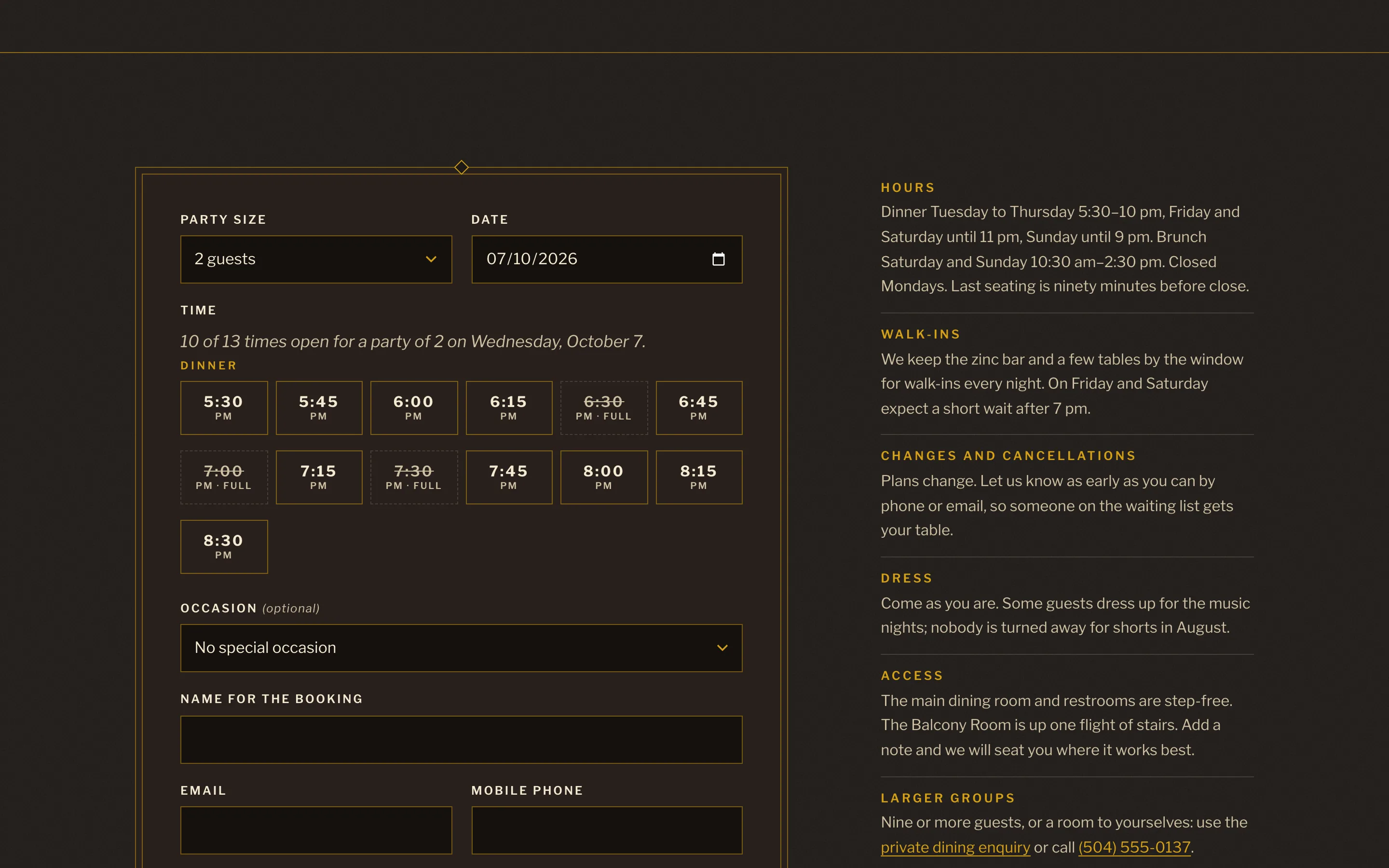
The Reserve page asks for party size, date, time, occasion and notes. Open times come from sample availability for the chosen date: brunch and dinner on weekends, dinner only on weekdays, closed on Mondays, with busy slots shown as full. Larger parties are sent to the private dining enquiry instead. The form checks every field, moves focus to the first problem and ends on a clear demo confirmation. On a live site it sends the request to your email, WhatsApp or booking system.
Private dining that sells the room
Group bookings are often a restaurant's best nights, so they get their own page: each room with a line drawing, seated and standing capacity, a minimum-spend table that stacks neatly on phones, group menu styles with sample prices per guest, and an enquiry form for date, guests, room, occasion and menu style.
Hours, directions and trust
The Visit page shows the week's hours with today highlighted and a live "open now" or "opens at" line calculated in the restaurant's own time zone, not the visitor's. An illustrated map shows the neighborhood without pinning a building, and short notes cover transit, parking, rideshare and step-free access. The Our Story page explains how the kitchen cooks and who looks after guests, without invented awards or press quotes.
Local SEO set-up
Every page has its own title, description, canonical URL and share image. The structured data describes the business as a Restaurant with cuisine, price range, opening hours, city-level area served and a ReserveAction, plus Menu, MenuSection and MenuItem with offers on the menu pages, a Service for private dining and breadcrumbs on inner pages. The opening hours match what belongs in your Google Business Profile, which is still where most local diners find you.
Restaurant websites by country
USA
US English, prices in dollars and a raw-food advisory on the menu where your state requires one. Accessibility to WCAG 2.2 AA matters for ADA claims, so the demo has visible focus, labelled controls and good contrast. Time slots use am and pm.
Canada
Canadian spelling, prices in Canadian dollars and metric weights. A restaurant in Québec needs French on its website, so the menu data can carry both languages with a switcher and hreflang tags.
Australia
Australian English, prices in Australian dollars including GST, and an ABN placeholder in the footer. Booking pages often mention card-holding for large groups; the demo never asks for card details.
India
Indian English, prices in rupees, veg and non-veg markers alongside allergens, and WhatsApp as the main booking and enquiry button. A GSTIN and FSSAI licence number can sit in the footer as placeholders until you add yours.
Finland
Finnish and English versions, prices in euros with Finnish number formats, and lunch hours shown separately from dinner. Diet markers such as L, G and V follow local custom, and EU accessibility rules make WCAG 2.2 AA the baseline.