What people look for on a yoga studio's website
Most people who open a yoga or Pilates studio's website are not ready to buy a membership. They are curious, a little nervous, and comparing two or three studios near home or work. They want to know which classes run at times that fit their week, whether there is something for a complete beginner, what the first visit costs and what happens when they walk in. People who already practise ask different questions: which styles, which teachers, how strong the classes are, and whether a class card works out cheaper than a monthly pass.
The usual studio website makes this hard. The timetable is an embedded widget that loads slowly on phones, the class names mean nothing to a beginner, prices hide behind a booking app, and the teachers are listed by name only. A calm studio ends up with a website that feels busy and vague. A good studio site does the opposite: it answers the practical questions plainly and makes the first class feel like an easy, quiet step.
How the demo handles it
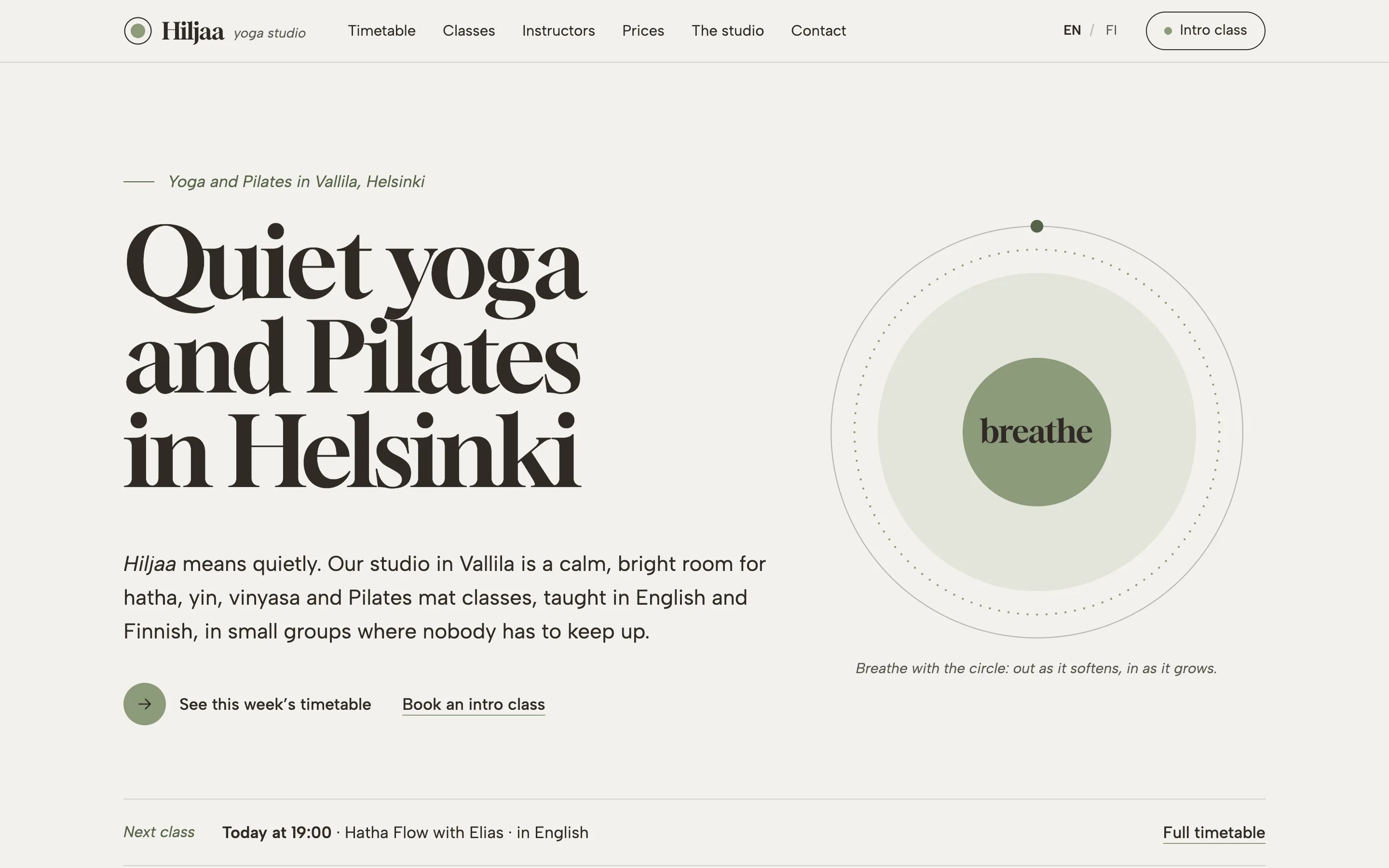
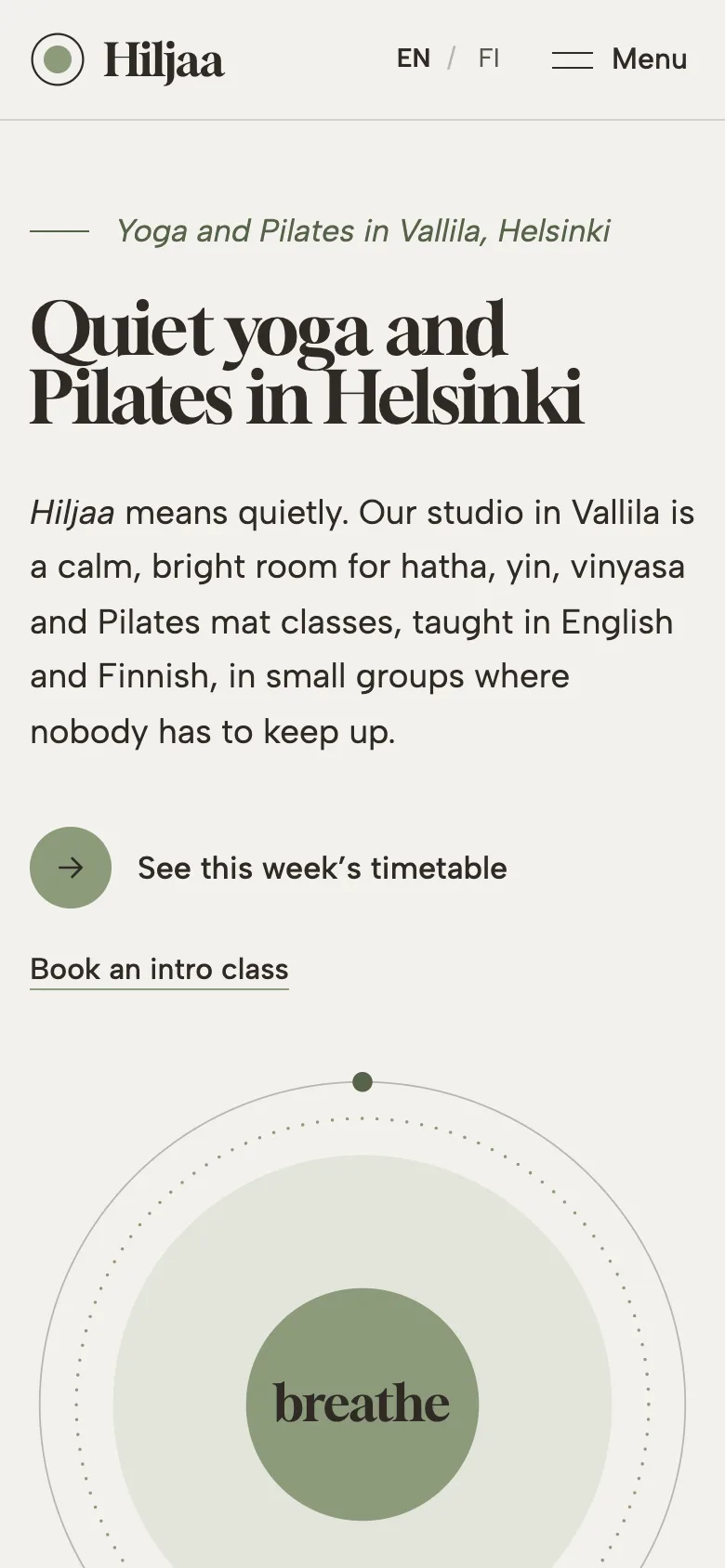
The demo is Hiljaa Yoga Studio, a fictional studio in Vallila, Helsinki, teaching hatha, yin, vinyasa and Pilates mat in English and Finnish. The design is a calm editorial layout: large serif headlines, a lot of white space, asymmetric columns, sage accents and quiet pull quotes. The home page opens with a slow breathing circle that grows and softens on a calm rhythm, and switches off for anyone who prefers reduced motion.
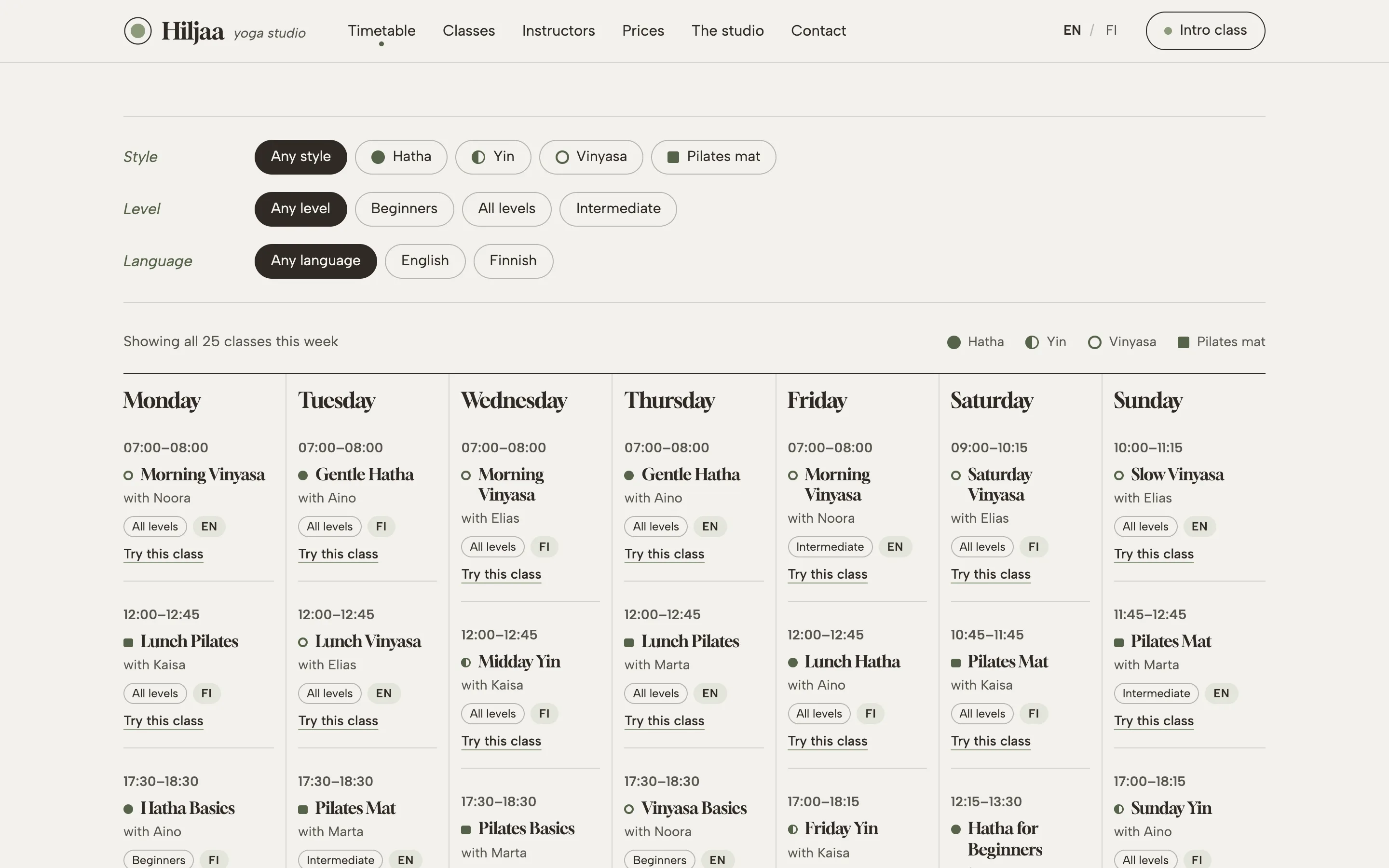
The timetable is the heart of the site. All 25 classes of the week sit on one grid, and visitors filter by style, by level (beginners, all levels or intermediate) and by class language. A live count says how many classes match, empty days explain themselves, and the filters are kept in the address so a link to "yin classes in English" can be shared. On phones the grid becomes a day-by-day list that opens on today, using Helsinki time wherever the visitor happens to be. Each class has a "Try this class" link that opens the intro-class form with that class already chosen.
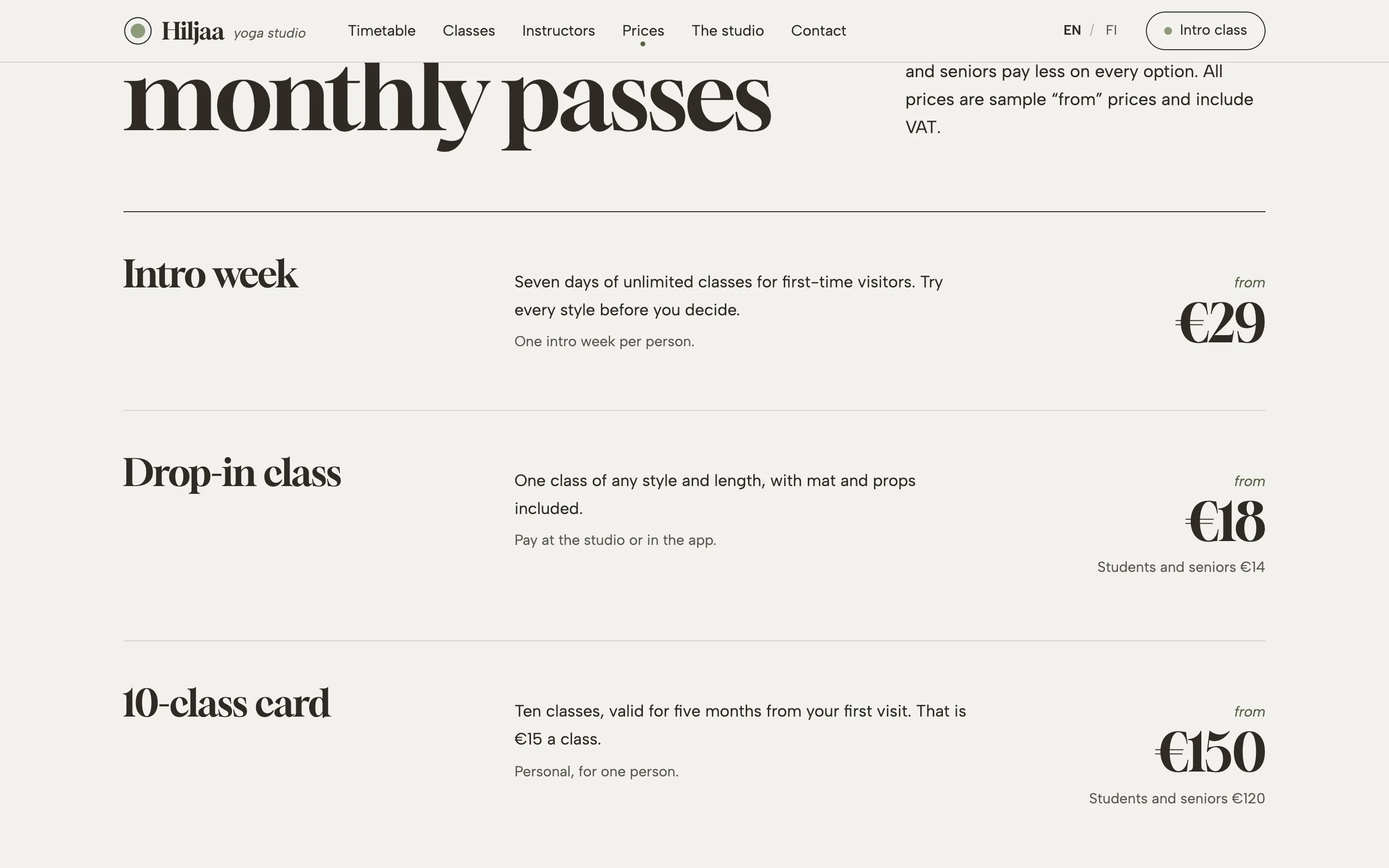
The home page shows the next class from the same timetable, so it is never out of date. Teacher profiles link to a timetable showing only that teacher's classes. The prices page lays out the intro week, drop-in, ten-class card, monthly pass and private sessions like a quiet menu, with student and senior rates, and a pass finder works out which option costs least for once, twice or three times a week.
The pages
- Home: the promise, the next class, four styles, a founder's quote, the first class in three steps, classes in two languages, the studio, the teachers, sample reviews clearly labelled as samples, and a call to book an intro class.
- Timetable: the filterable weekly grid, the phone day picker and how booking, cancelling and holidays work.
- Classes: hatha, yin, vinyasa and Pilates mat, each with its pace, length, levels, who it suits and a link to those classes in the timetable, plus a guide to choosing a first class.
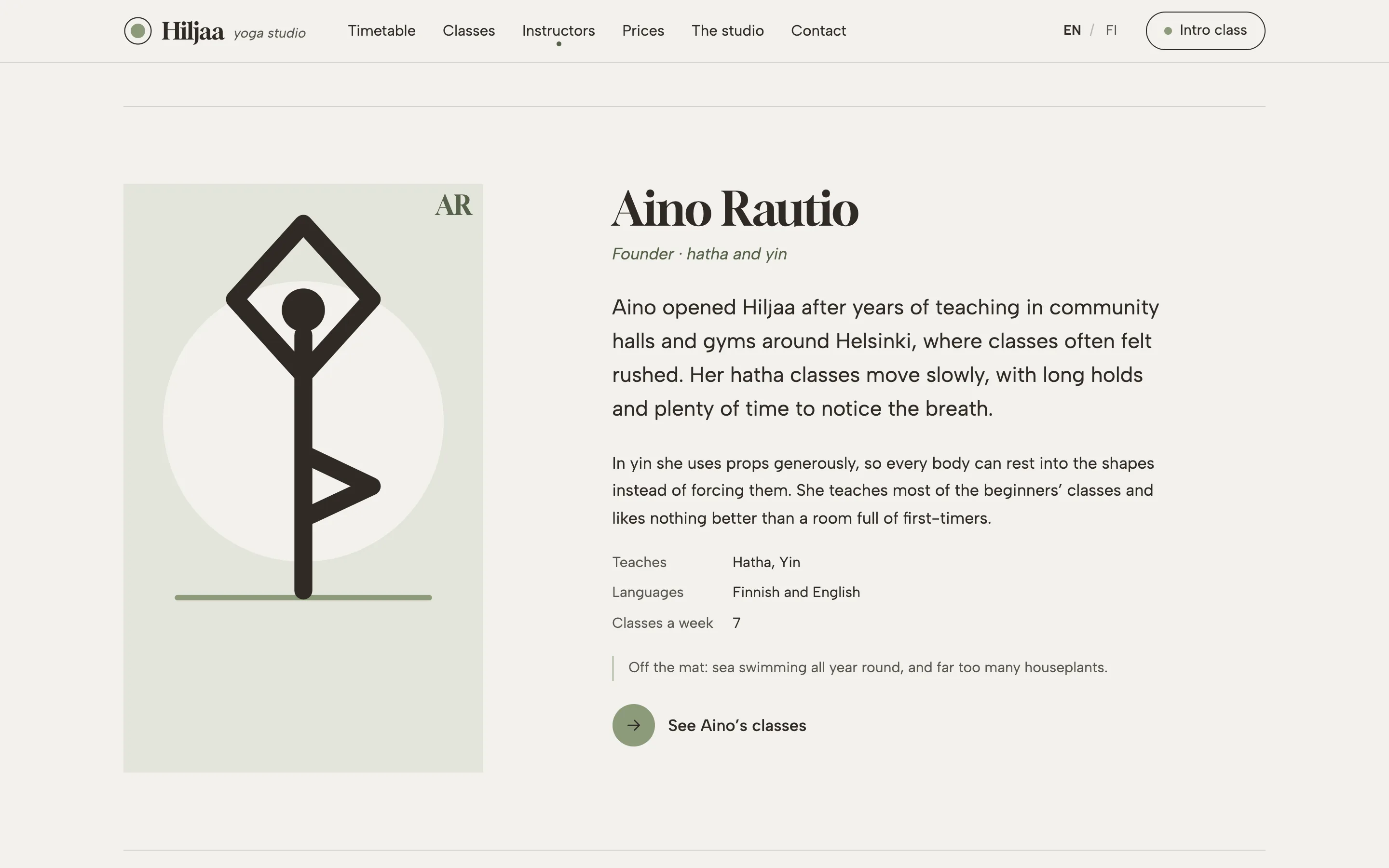
- Instructors: five teacher profiles with drawn portraits, styles, languages, number of classes a week and a link to their classes.
- Prices: the price list with reduced rates, the pass finder, the small print in plain words and common questions.
- The Studio: the room, what to bring and what is provided, how a class begins, accessibility and getting there.
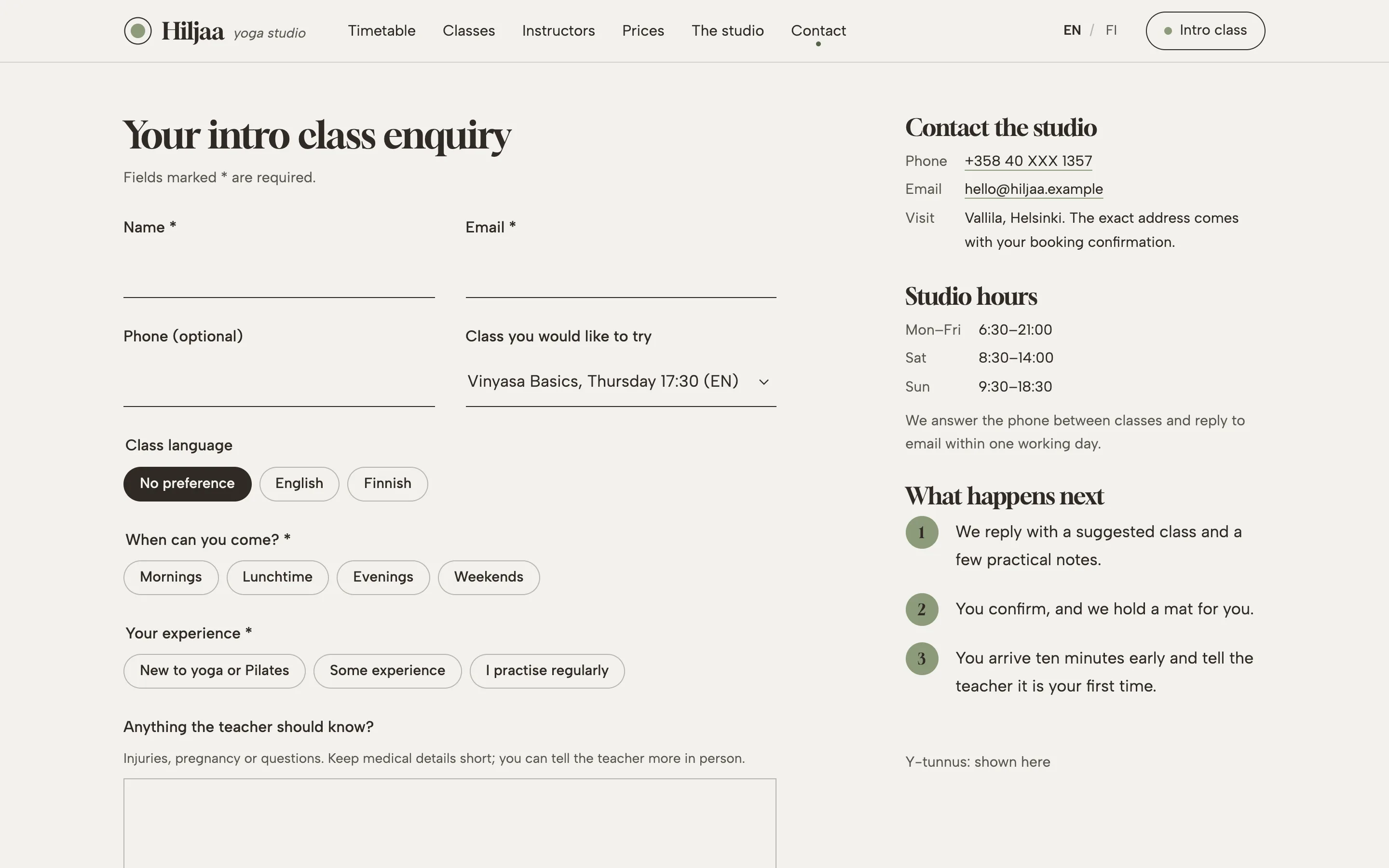
- Contact: the intro-class enquiry, contact details, studio hours and what happens next.
Local SEO set-up for a yoga studio
Every page carries SportsActivityLocation structured data with the studio's name, logo, city, languages and opening hours. Each style on the classes page is a Service, the price list is an OfferCatalog of offers in euros, teachers are listed as people who work for the studio, and the price questions are marked up as an FAQ. Inner pages add breadcrumbs, and the sample reviews have no rating markup.
Titles pair the style or service with the city, such as "Hatha, Yin, Vinyasa and Pilates Classes" and "Weekly Yoga and Pilates Timetable", because people search for "yin yoga Helsinki", "Pilates near me" or "beginner yoga" far more often than for a studio's name. Class descriptions use the words beginners actually type, not only the Sanskrit names. The Google Business Profile should list both yoga studio and Pilates studio where they apply, show the same hours as the site, and link to the timetable rather than the home page. Studios with a second location get a page for each, with its own timetable and directions.
Country notes
India
Indian English, prices in rupees as "from" figures, and WhatsApp as the main enquiry button, because most people in Indian cities ask about batch timings and fees that way. Studios often run early morning batches, monthly and quarterly packages and separate women-only batches, which the timetable filters can show as their own level or category. Mention UPI next to cards and cash, leave room for the GSTIN in the footer, and plan a page for International Day of Yoga events on 21 June.
USA
US English and dollars. Intro offers, class packs and memberships with auto-renewal are common, so renewal and cancellation terms belong on the prices page in plain words. Many studios ask new students to sign a liability waiver, which usually lives in the booking software; the intro-class page links to it rather than collecting it in a form. Accessibility matters legally as well as ethically, because fitness businesses receive ADA website claims, and the demo's contrast, focus states and labelled form fields follow WCAG 2.2 AA.
Canada
Canadian English with a French version for studios that serve Quebec, where the Charter of the French Language expects French to be at least as prominent. Prices in Canadian dollars, with a note on whether GST or HST is included. Winter is the busiest season for indoor classes, so the timetable and intro offers should be easy to update when the schedule grows in January.
Australia
Australian English, Australian dollars with GST-inclusive prices, and an ABN placeholder in the footer. Pilates is often split between mat, reformer and clinical classes; clinical Pilates run by physiotherapists may attract private health fund rebates, which belongs on the prices page only when it applies. Teachers usually hold registrations with professional bodies, and the teacher profiles have room to state them.
Finland
Finnish and English versions at /fi/ and /, prices in euros written the Finnish way (18 €), and a clear line on accepting employer sport and culture benefits (liikunta- ja kulttuurietu), because many Finns pay for classes that way. In Helsinki, Espoo and Tampere the class language matters, so each class is marked EN or FI and can be filtered. Finns usually book in an app rather than call, so the timetable and intro-class form do the work. EU accessibility rules make WCAG 2.2 AA the baseline, and the business ID (Y-tunnus) belongs in the footer.