What trade buyers look for on an acrylic sheet manufacturer's website
The people who visit an acrylic sheet supplier's website are rarely browsing. A sign maker has a job due on Friday and needs ten sheets of 5 mm clear cast. A shopfitter has a drawing with forty shelves and wants to know who can cut and polish them. An architect is comparing frosted and opal sheet for a partition, and an aquarium builder needs a supplier that stocks 20 mm cast panels at all. Each of them wants the same four answers within a minute: do you have this grade, in this thickness, in this size, and roughly what will it cost.
Most acrylic sheet websites hide those answers. They show a brochure page, a list of colours and a phone number, or a marketplace listing that says "price on request" for everything. The buyer calls three suppliers, asks the same questions three times and orders from whoever answers first. A good website does the sales desk's first five minutes for it: it shows stock thicknesses and sizes, gives a from price per sheet, explains what cutting and edge polishing involve, and collects a complete sheet list in one form.
How the demo handles it
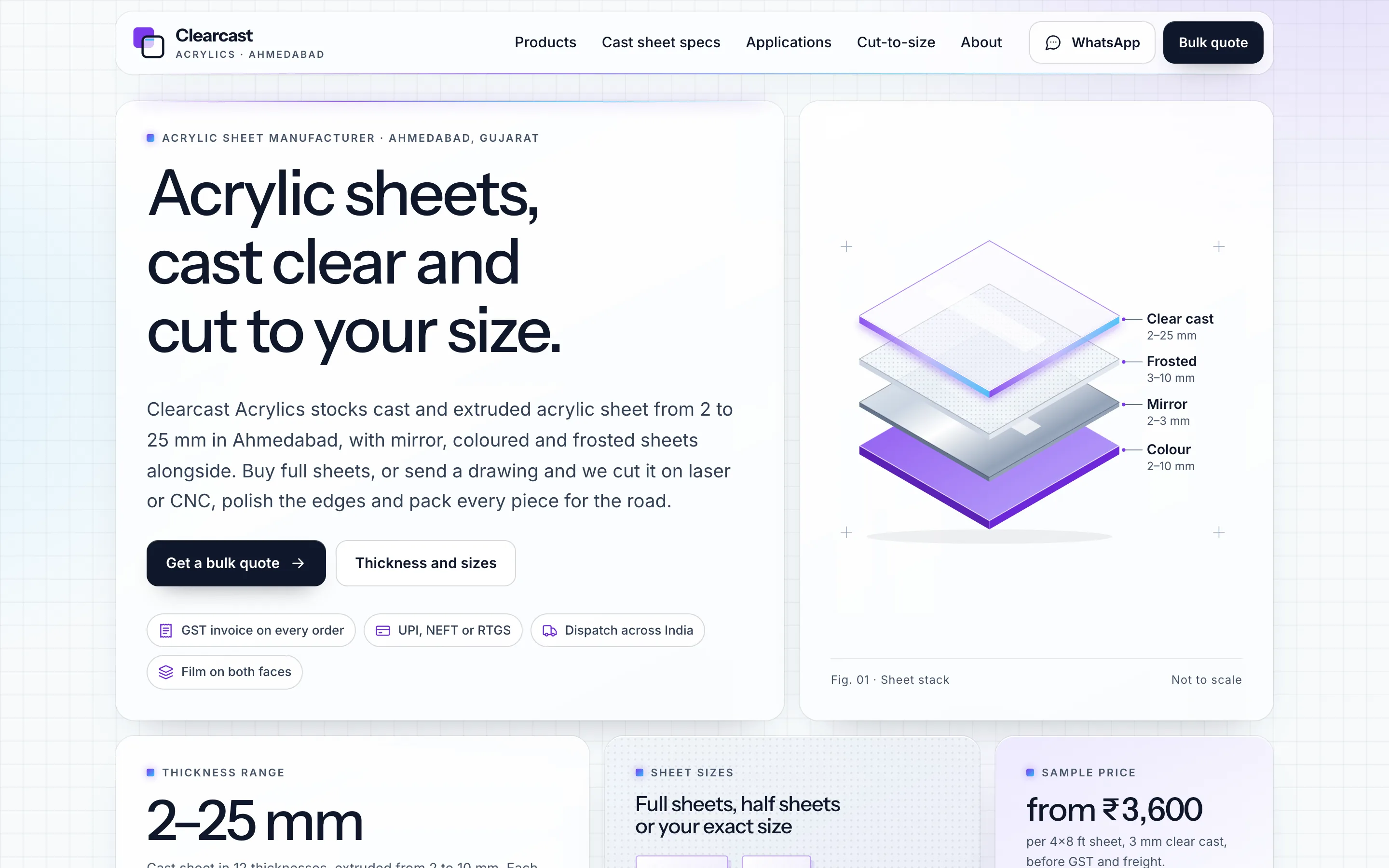
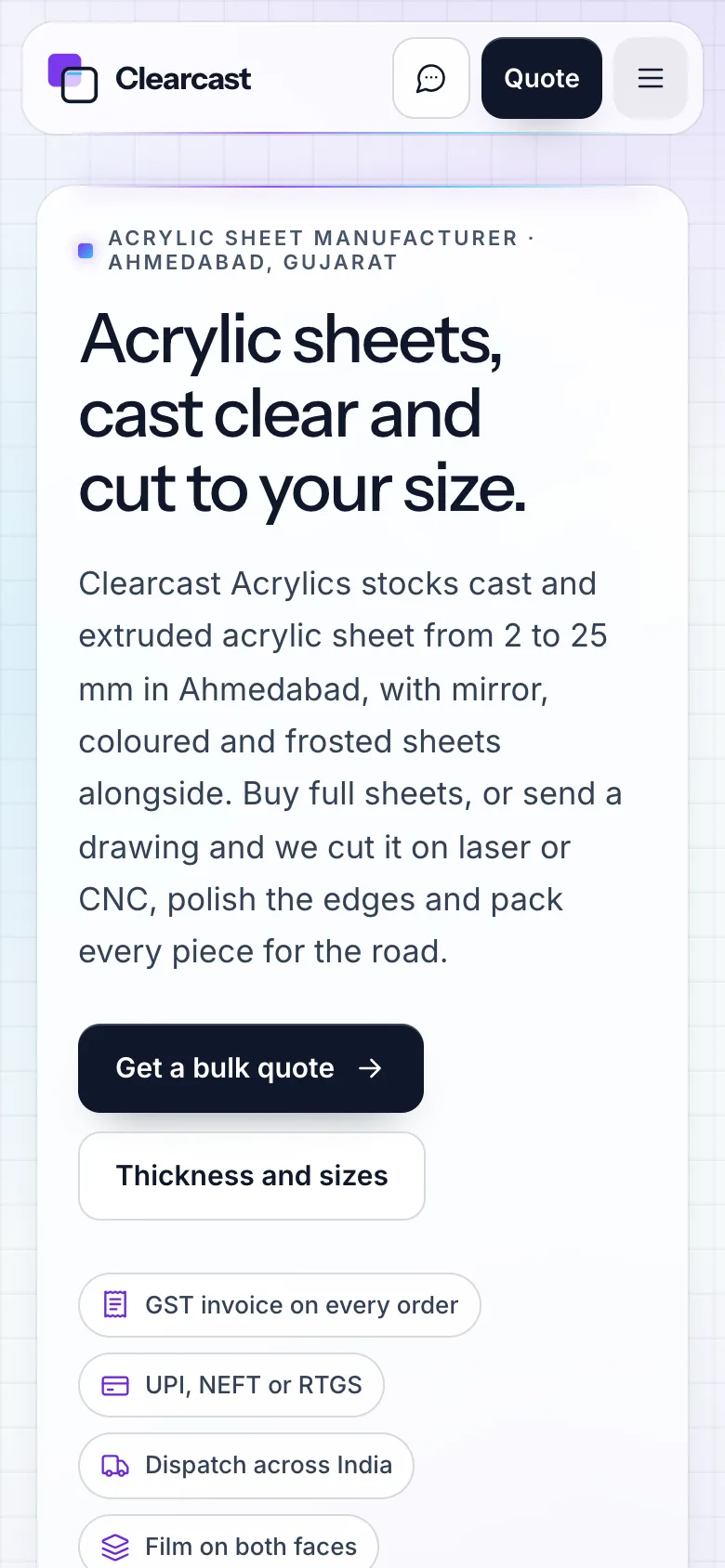
The demo is Clearcast Acrylics, a fictional supplier in Ahmedabad. Its design is a light "materials lab": translucent glass-like tiles laid out as a bento grid over graph paper, with a violet edge glow that echoes the lit edge of a clear acrylic sheet. The home page opens with an isometric stack of clear, frosted, mirror and coloured sheets, then shows the thickness range as swatches drawn to scale, the two standard sheet sizes next to a cut-to-size piece, and a sample from price. Everything is original SVG, so the site loads fast and never relies on stock photos.
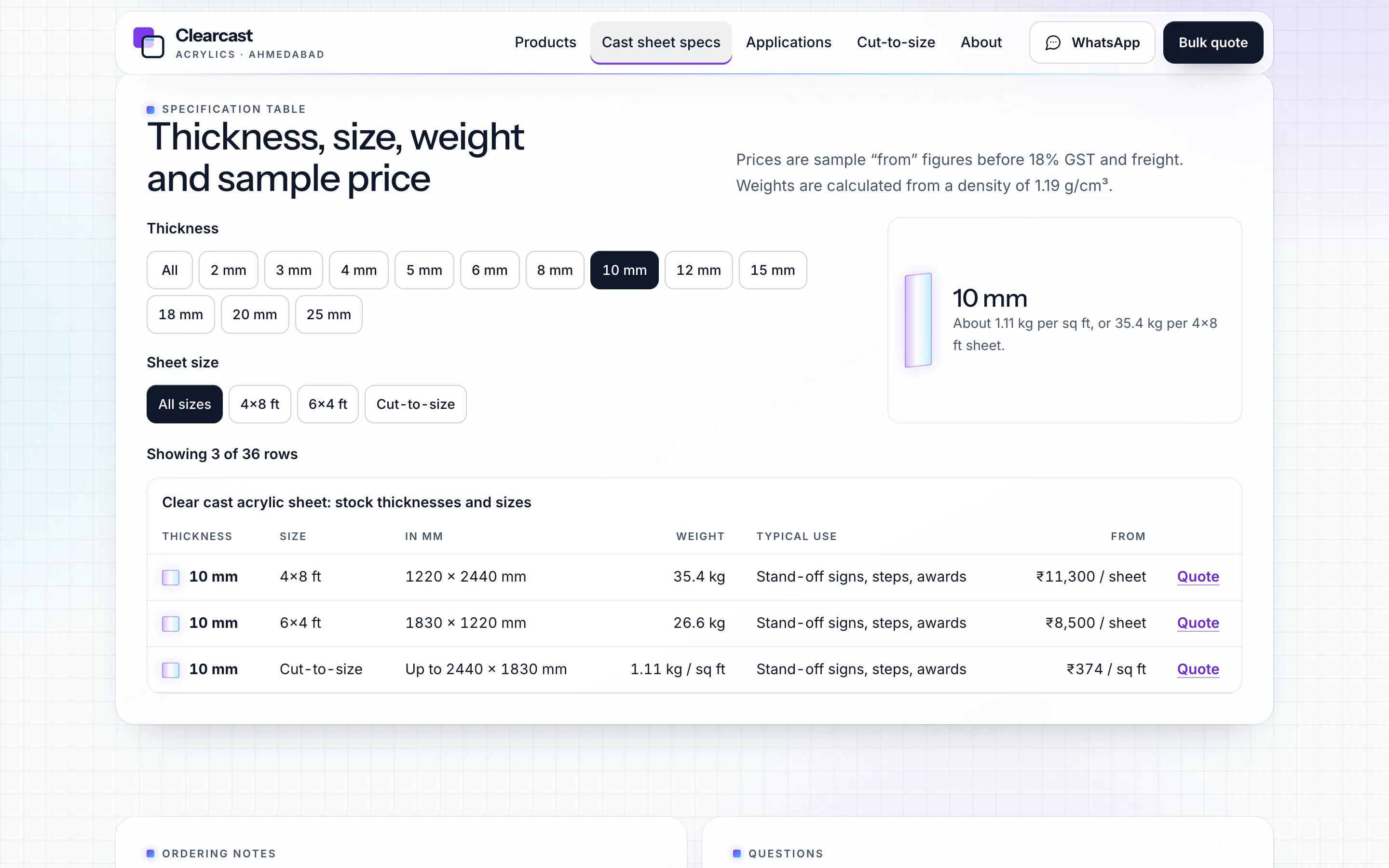
The signature feature is the specification table on the cast acrylic sheet page. Buyers filter it by thickness, from 2 to 25 mm, and by sheet size: 4×8 ft, 6×4 ft or cut-to-size. Each row shows the size in millimetres, the weight of the sheet, the typical use for that thickness and a from price per sheet or per square foot. An edge preview redraws the chosen thickness to scale and states the weight per square foot, and the filter is saved in the address, so a sales executive can send a buyer a link to exactly the rows that matter. Every row has a Quote link that opens the bulk quote form already filled in with that sheet type, thickness and size.
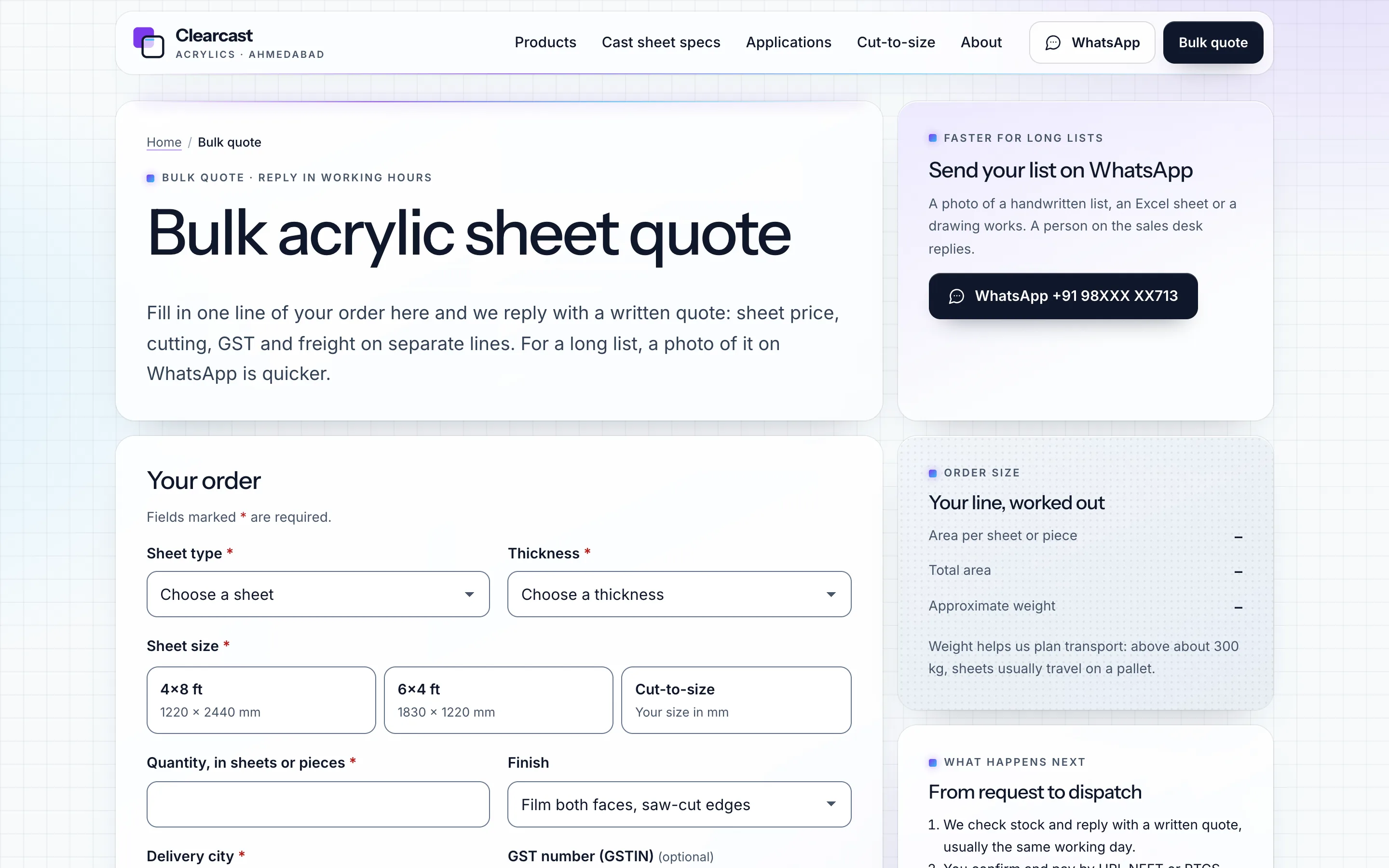
The bulk quote form asks for what a sales desk needs to price an order and nothing more: sheet type, thickness, size (with width and height for cut pieces), quantity in sheets, finish, delivery city, an optional GST number and the buyer's contact details. A summary panel works out the total area and approximate weight as the buyer types, which helps both sides plan transport. The GSTIN is checked for the right format, every error is explained in words and the first one receives focus. For long lists, a WhatsApp button sits beside the form, because many buyers would rather send a photo of a handwritten list.
The pages
- Home: the bento overview of thickness, sizes, a sample price, the four sheet families, cutting and polishing, applications, how a bulk order runs and a cast-or-extruded guide.
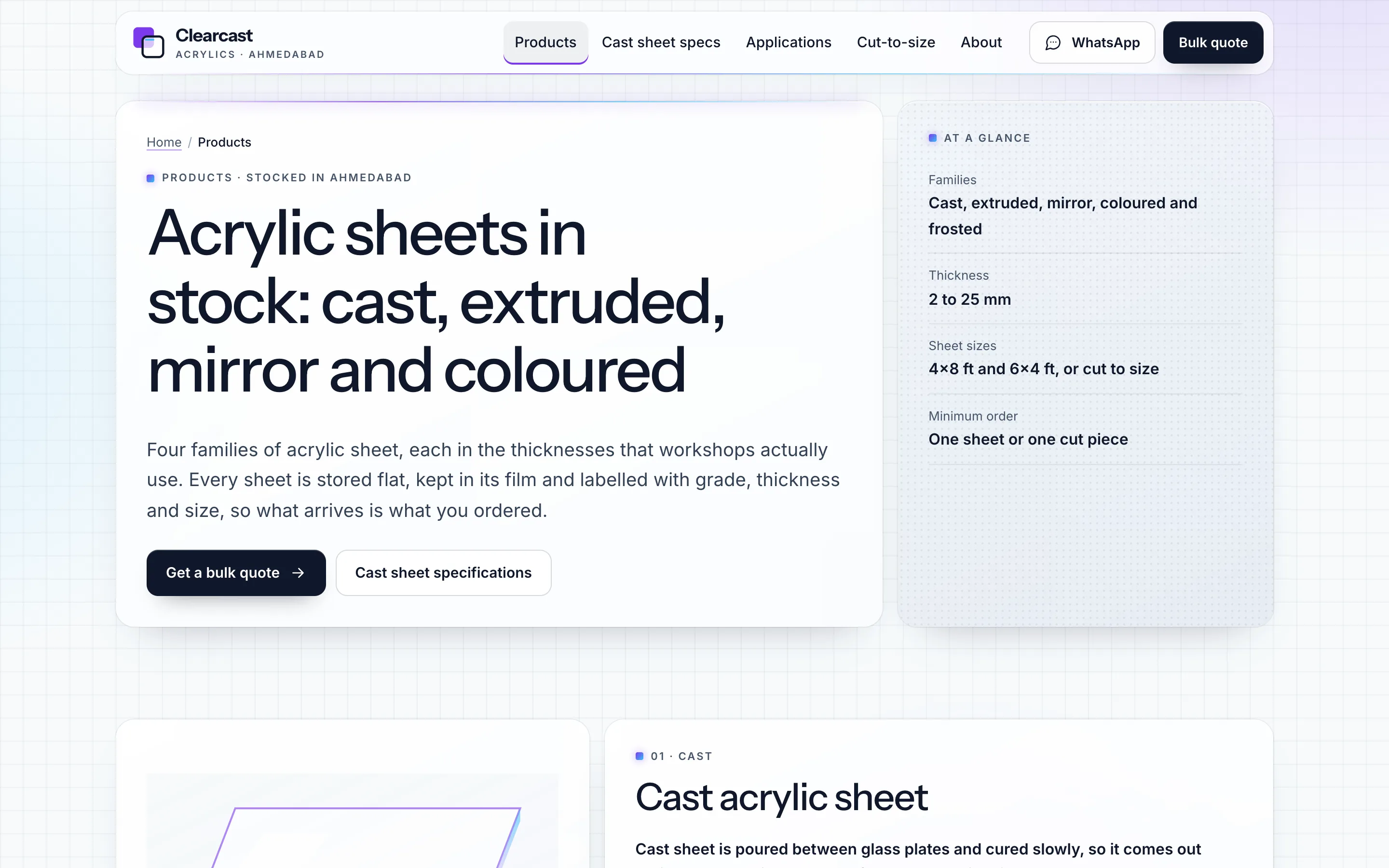
- Products: cast, extruded, mirror, and coloured and frosted sheet, each with what it is, what it suits, thickness range, sizes and a from price, plus a comparison table.
- Cast acrylic sheet: material properties and the filterable specification table with quote links and buyer FAQs.
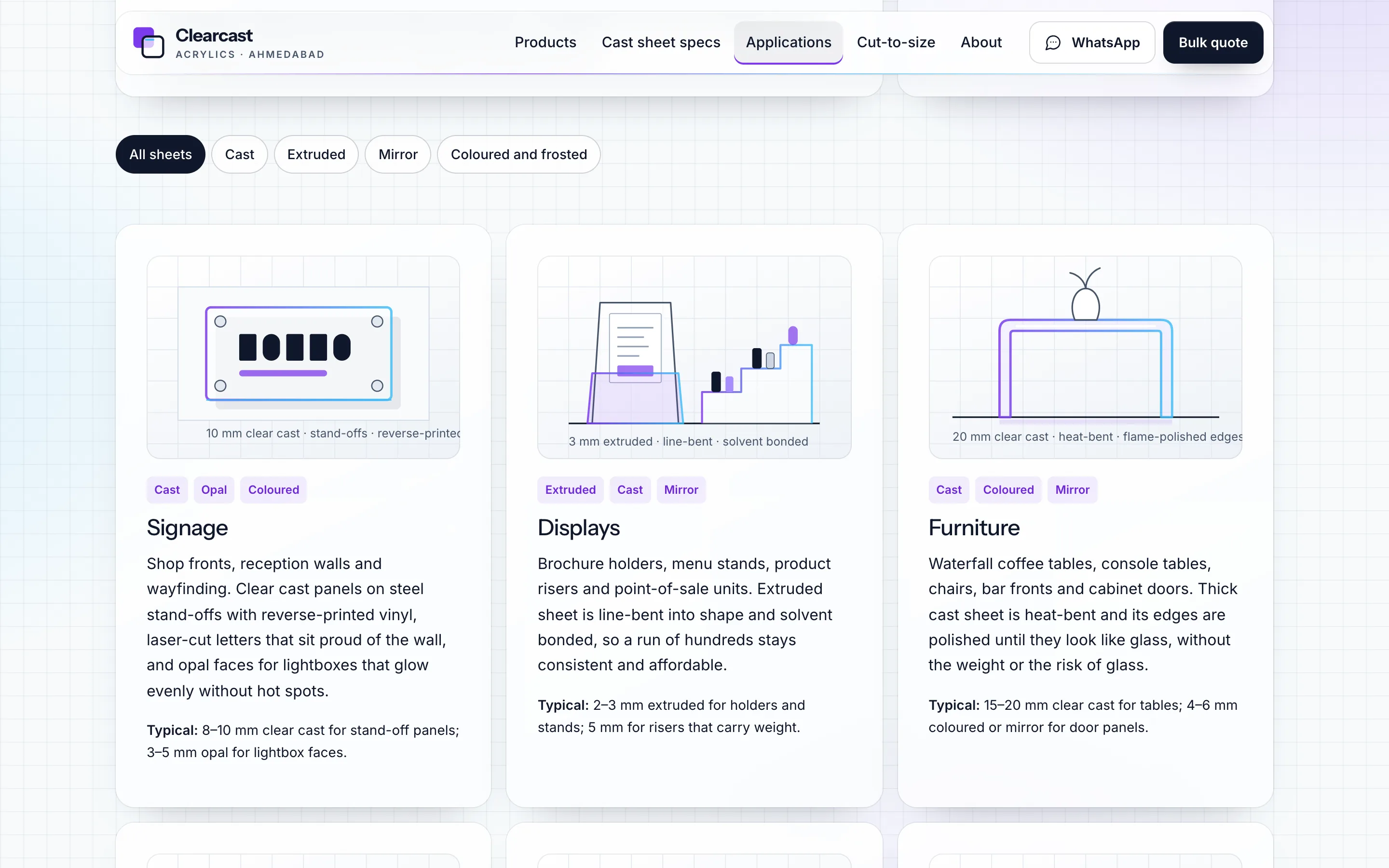
- Applications: signage, displays, furniture, architecture, aquariums and retail fixtures, each with an illustration and the usual grade and thickness, filtered by sheet type.
- Cut-to-size: laser and CNC routing compared, edge finishes explained, the files to send and how cutting is priced.
- Bulk quote and About: the quote form, and how the company works, with business details shown as labelled placeholders.
Search and structured data for a sheet manufacturer
Every page carries one JSON-LD graph with the business as an Organization and LocalBusiness, with its city, opening hours, logo and the areas it serves, plus a WebSite node. The products page lists each sheet family as a Product with a sample Offer in the local currency; the specification page adds a Product with an AggregateOffer across all thicknesses and sizes, the material properties and an FAQPage. The cut-to-size page is a Service with a price per square foot, and every inner page has breadcrumbs.
Titles name the product, the thickness range and the brand, such as "Cast Acrylic Sheet 2–25 mm: Sizes and Prices", because that is how buyers search. The website, the Google Business Profile and any marketplace listings should share the same name, phone number, hours and product categories, and the website becomes the place those listings link to for full specifications.
Country notes
India
Indian English, prices in rupees shown as "from" and marked as before 18% GST and freight, and an optional GSTIN field so B2B buyers get an invoice that allows input tax credit. WhatsApp is the main contact button, with UPI, NEFT and RTGS listed for payment and the transport receipt sent on WhatsApp after dispatch. Show the GSTIN and Udyam registration in the footer. Many buyers first find suppliers on B2B marketplaces, so the website should offer what a marketplace listing cannot: a full specification table and a quote form that captures the whole order.
USA
US English, dollars and imperial sizes first, with thicknesses in fractions of an inch (1/8", 1/4", 3/8") and millimetres alongside for cut-to-size work. Trade buyers often hold a resale certificate, so the quote form can ask whether the order is tax-exempt, and freight is usually quoted as LTL on a pallet. Use generic product names rather than other companies' trademarks. Accessibility matters legally as well as ethically, because businesses receive ADA website claims; the demo's contrast, focus states and labelled fields are built for WCAG 2.2 AA.
Canada
Canadian English with metric thicknesses and the familiar 4×8 ft sheet size, prices in Canadian dollars and a clear line on GST or HST. A supplier selling into Quebec needs a French version of the site, which the page structure supports. Cross-border buyers ask about lead times and duties, so the order steps should say how shipments are booked and who handles brokerage.
Australia
Australian English, metric sizes such as 2440 × 1220 mm, and prices clearly marked as excluding or including GST, since trade buyers compare ex-GST rates. Show the ABN in the footer. Freight to regional areas can cost more than the sheets, so the quote form's area and weight summary helps buyers understand a freight quote before they ask for it.