What drivers look for on a garage's website
Most people find a garage at an awkward moment. A light has come on, the brakes have started to squeal, the car is due for an oil change and the dealer is booked for two weeks, or they have just moved to town and need someone they can trust. They arrive on a phone, often in a parking lot, with three questions. Can this garage fix my problem? Roughly what will it cost? And how soon can I get the car in?
A good auto repair website answers those questions in that order. It names the services clearly, shows honest starting prices, explains how the shop works and makes booking or calling possible from every screen. It also has to earn trust that the trade does not always get by default. Drivers worry about being upsold, about parts being replaced that did not need replacing, and about a bill that ends up far above the quote. A website that states its shop rules plainly, shows what a job includes and promises a written estimate before any work removes most of that worry before the first call.
How the demo handles it
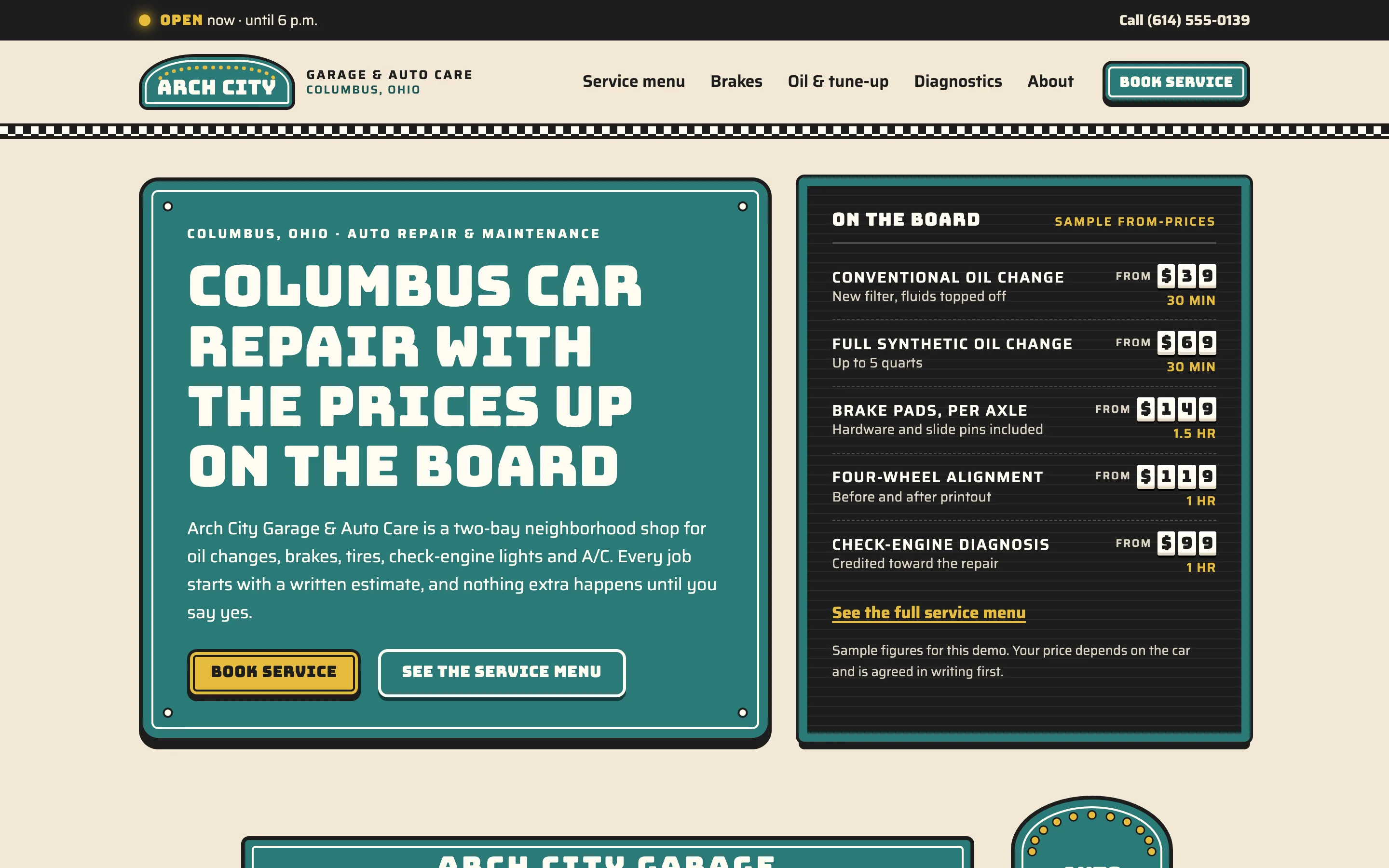
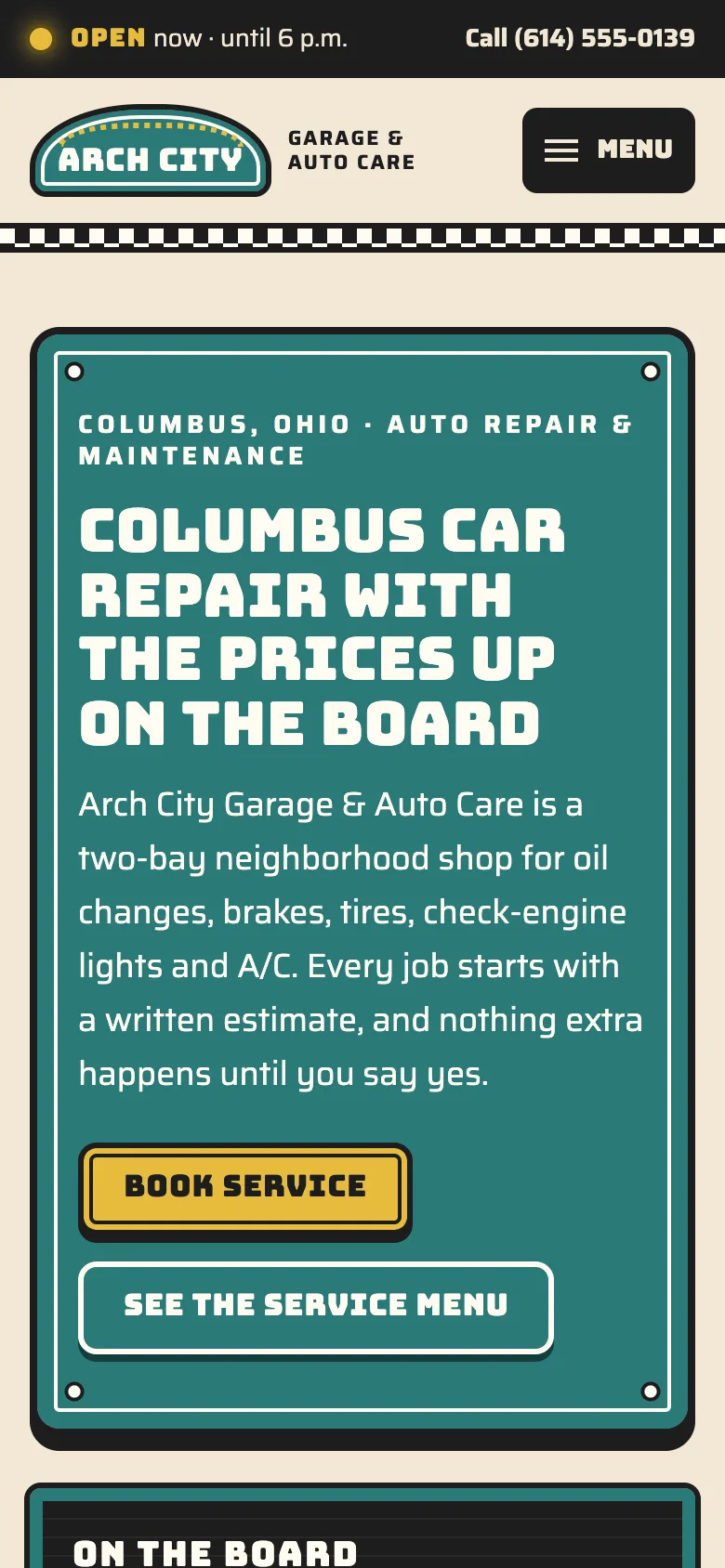
The demo is Arch City Garage & Auto Care, a fictional two-bay shop in Columbus, Ohio. Its look is a 1960s service station: Bungee signage lettering, teal and cream enamel-sign colors, a checkered-flag strip under the header, an arched pylon sign with light bulbs, a pegboard tool wall and a zigzag tire-tread road for the steps of a visit. Every illustration is drawn for the site, so there are no stock photos of smiling mechanics and no car or parts brand logos.
The home page opens with a large enamel sign carrying the headline and, beside it, a black letter board listing popular jobs with their from-prices spelled out in individual white letter strips, the way a station once posted its prices. Below come the shop rules (written estimate first, a call before anything extra, old parts returned, plain English at pickup), the services as paper key tags, the four steps of a visit from booking to pickup, the shop and its crew, sample reviews and the opening hours with a list of the neighborhoods the garage serves.
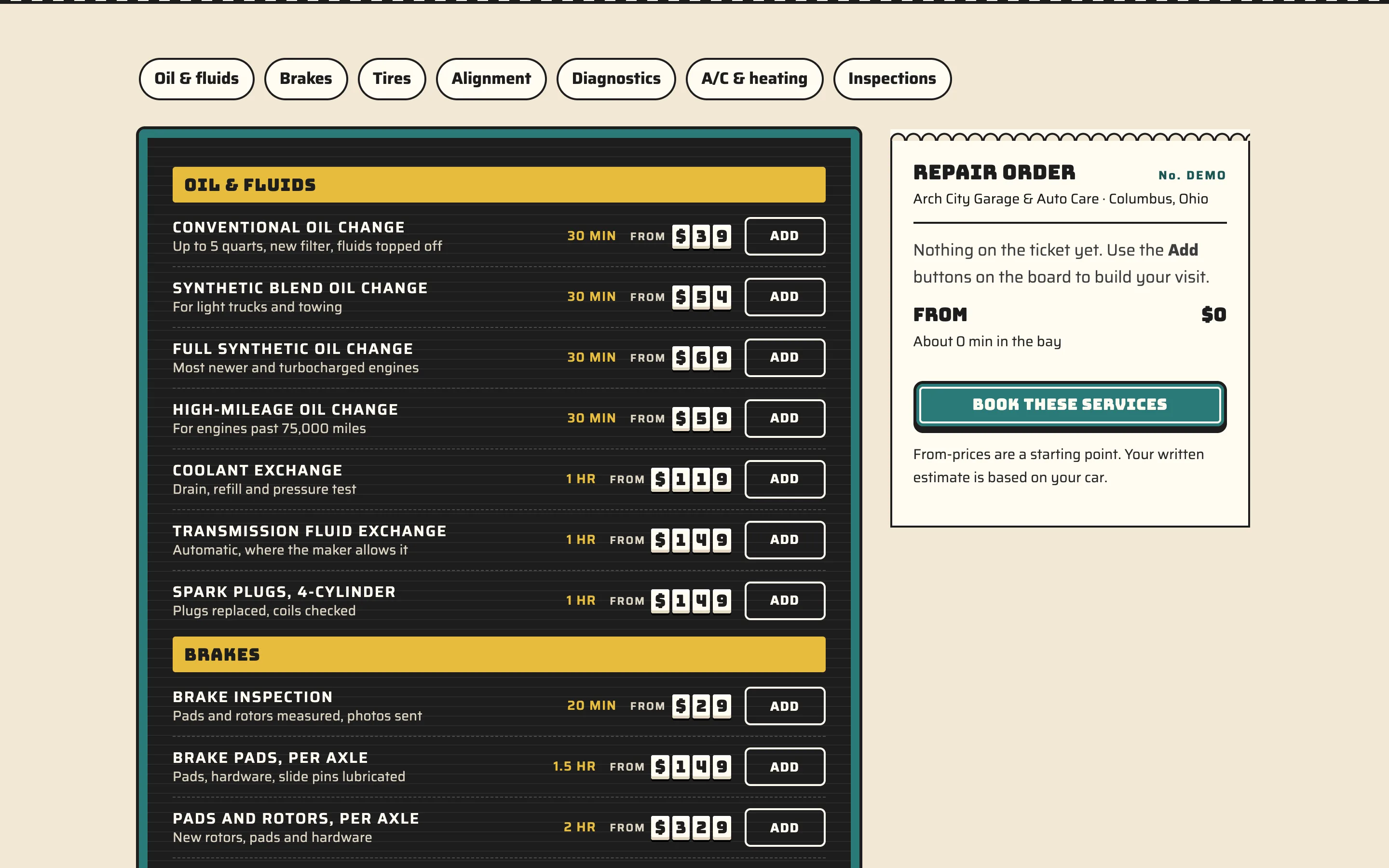
The signature feature is the service menu. Every job sits on one long letter board, grouped into oil and fluids, brakes, tires, alignment, diagnostics, A/C and heating, and inspections, each with a short description, a typical time in the bay and a from-price. An Add button on each line puts it on a repair ticket at the side, which keeps a running total and an estimate of time in the bay. One tap on Book these services opens the booking form with the right services already ticked.
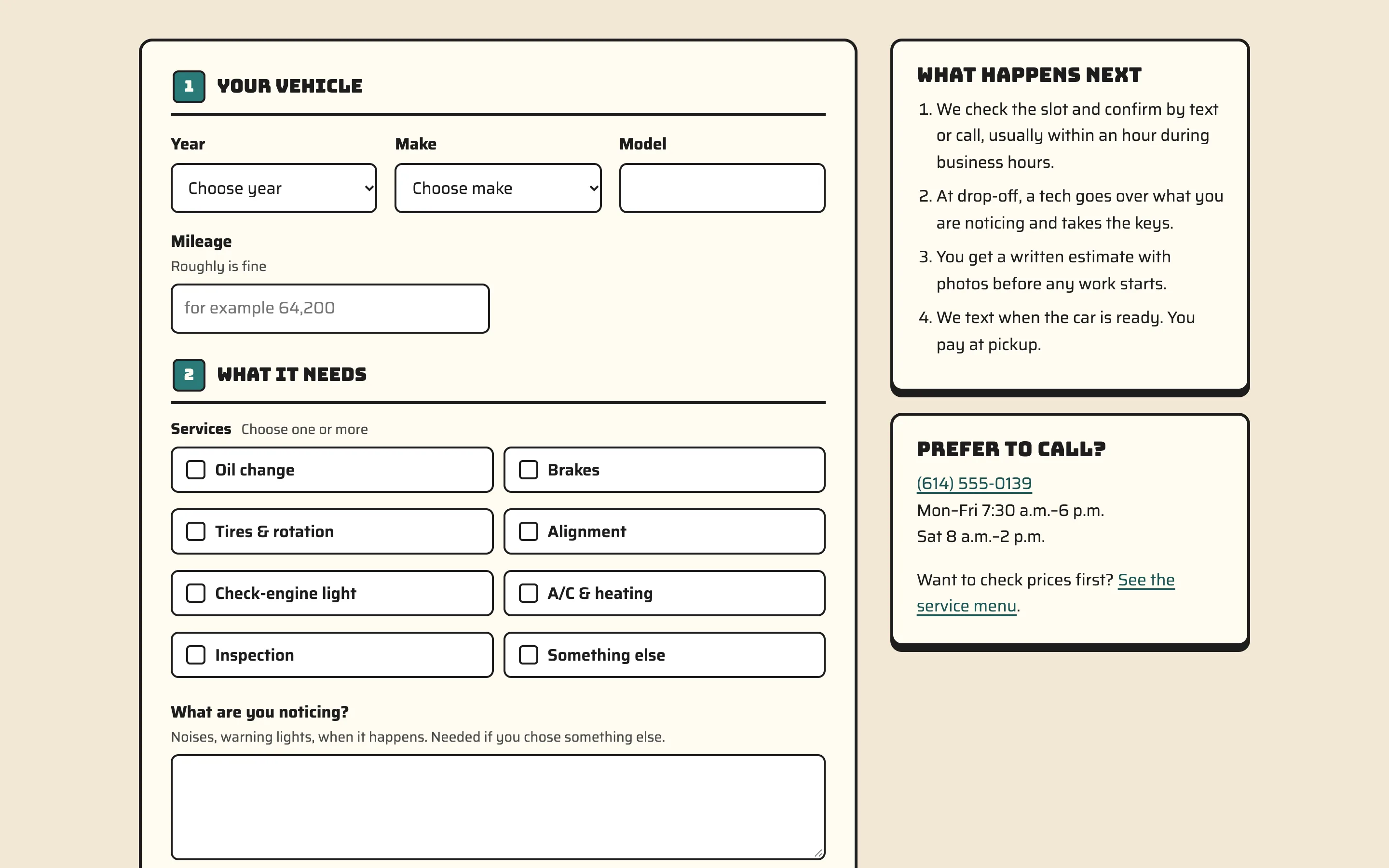
The booking form asks for the vehicle first: year, make, a model list that matches the make, and mileage. Then the services, a description of the problem, a drop-off day and time from sample availability, and whether the customer will wait or leave the car. If they plan to wait for a long job, the form suggests leaving it instead, and leaving the car offers a courtesy ride. Nothing is sent in the demo; the confirmation screen says so and shows the request as a repair order.
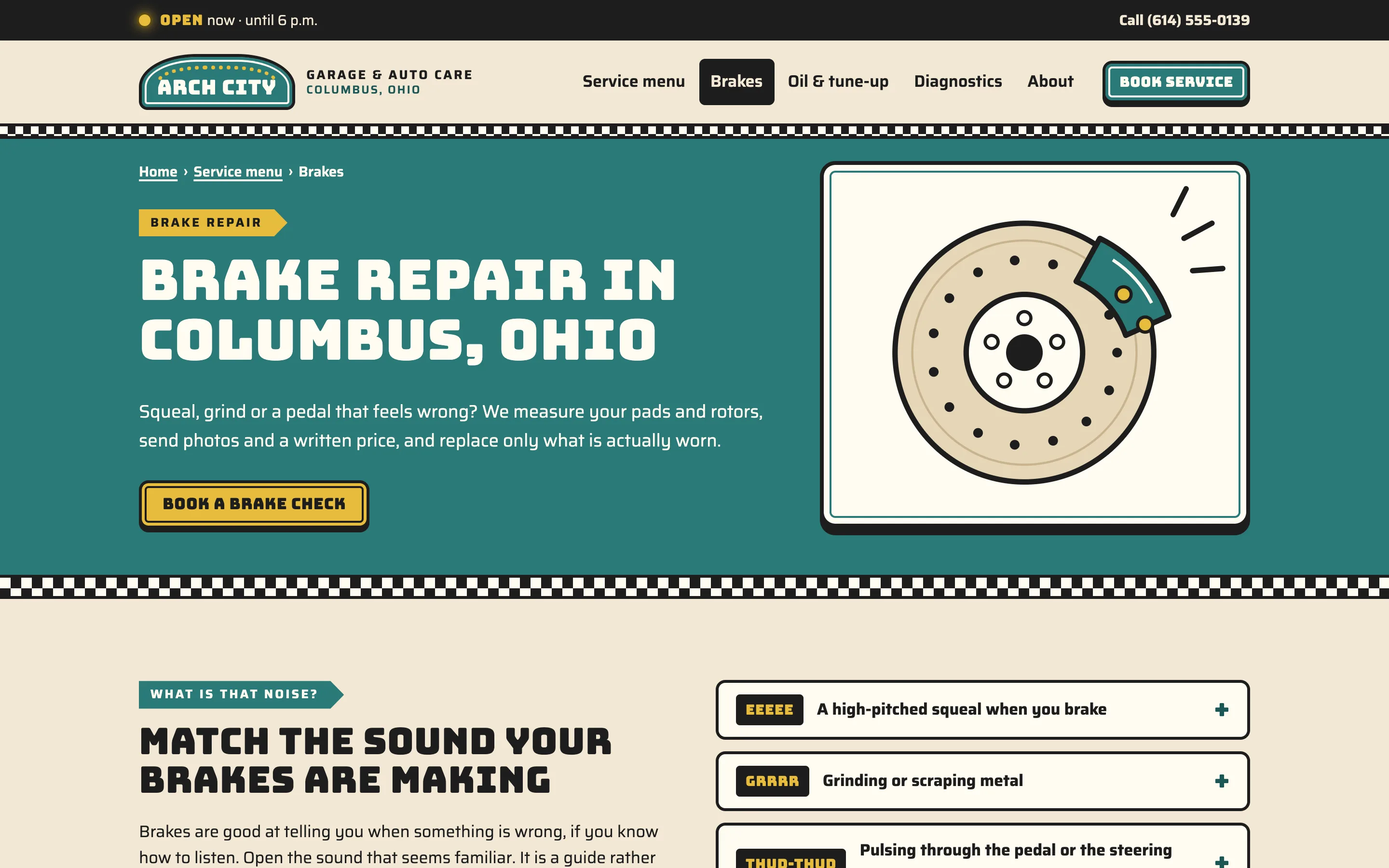
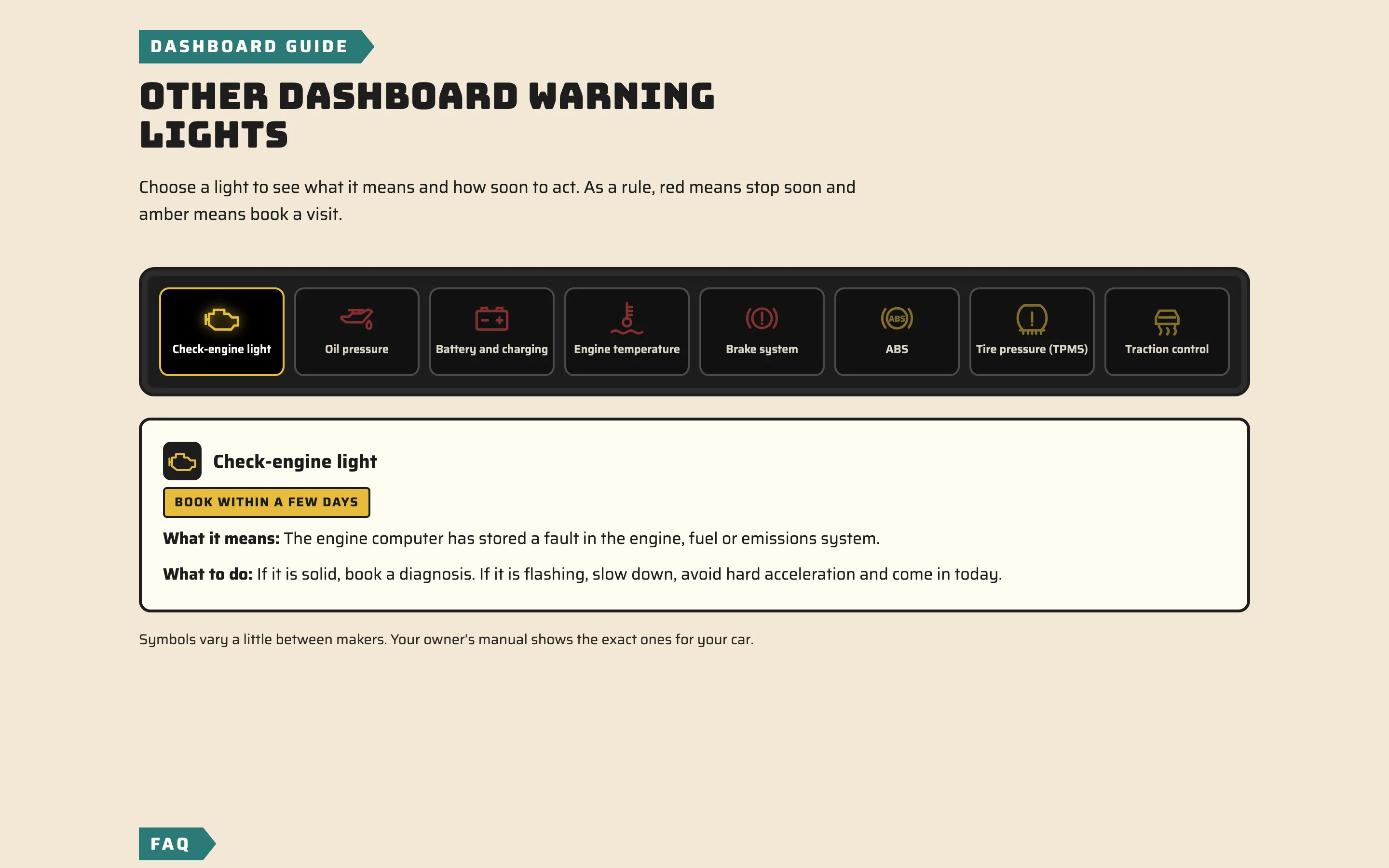
The service pages add small tools that answer the questions a service writer hears every day. The brakes page matches the noise a driver hears to its likely cause and how soon to come in. The oil page works out when the next change is due. The diagnostics page explains the difference between a solid and a flashing check-engine light and has a dashboard guide where tapping a light explains what it means and what to do.
The pages
- Home: the enamel-sign promise, the letter board, shop rules, services, how a visit works, the shop, sample reviews, hours and area.
- Service Menu: the full menu board with from-prices and typical times, the repair ticket and notes on parts and inspections.
- Brakes, Oil & Tune-Up and Diagnostics: one page each with an illustration, a tool, what the job includes, sample prices, FAQs and related services.
- Book Service: the vehicle, service and drop-off form with a demo confirmation.
- About: the shop's story, amenities, the crew drawn as name patches, placeholders for certifications and warranty, and the area served.
Local SEO set-up for an auto repair shop
Every page carries AutoRepair structured data with the shop's name, logo, phone, city-level area served and opening hours. The service menu adds an OfferCatalog of every job with its starting price, each service page adds a Service with its offers and an FAQPage built from the questions on the page, and inner pages add breadcrumbs. There is no review or rating markup, because self-published reviews do not qualify for it.
Titles follow the pattern service, city and shop name, such as "Brake Repair in Columbus, OH", because that is how drivers search. Each main service has its own page so it can rank for its own search, and the menu links them together. The Google Business Profile should use the auto repair category, list the same services and hours as the website, link its booking button to the booking page and its services to the matching pages. For a shop that serves several suburbs, short area pages with real local detail, such as typical commutes or winter driving, work far better than a list of town names.
Country notes
India
Indian English, rupees and kilometres, and WhatsApp as the main way to book and send photos of a problem. Multi-brand workshops compete with authorised service centres, so the site should explain how it handles service schedules and genuine or equivalent parts. Pick-up and drop service, two-wheeler servicing where offered, and UPI payment at delivery belong on the page, and the footer carries the GSTIN as a placeholder until the real one is added.
USA
US English, dollars and miles. Several states have consumer rules on written estimates, customer authorization and returning replaced parts, and some, such as California and Michigan, register repair facilities, so the site should show any registration number your state requires. Technician certifications belong on the about page only when they are real. Explaining that independent maintenance does not void a factory warranty helps win customers from dealers, and WCAG 2.2 AA accessibility matters for ADA claims.
Canada
Canadian English with "tire", dollars and kilometres, and French for any garage serving Quebec, where the Charter of the French Language requires it. Ontario's consumer protection law gives customers the right to a written estimate and limits how far the final bill may exceed it, which the site can turn into a selling point. Seasonal tire changeovers and tire storage drive a large share of bookings, and Quebec requires winter tires through the winter months, so a tire booking page earns its place.
Australia
Australian English with "tyres", dollars and kilometres. Logbook servicing is a key message, since new-car owners can keep their warranty while servicing outside the dealer, as the ACCC explains. Roadworthy and safety certificates vary by state (RWC in Victoria, safety certificates in Queensland, pink slips in New South Wales), and New South Wales and Western Australia license motor vehicle repairers, so the footer shows the licence number and ABN as placeholders.
Finland
Finnish and English versions, euros with Finnish number formatting and kilometres, and the Y-tunnus in the footer. Garages advertise checks before the periodic vehicle inspection (katsastus), and the autumn and spring tyre changes, with tyre hotel storage, are the busiest booking weeks of the year, since winter tyres are required in the winter months. EU accessibility rules make WCAG 2.2 AA the baseline.