What buyers look for on a fastener supplier's website
People who buy fasteners rarely browse for fun. A maintenance fitter needs twenty M12 hex bolts in stainless steel by Friday; a purchase team needs a price for three hundred sizes for a new project; a fabricator wants to know whether you can source a particular brand. All of them arrive with a specification in mind, and the website's job is to collect that specification cleanly and get it to you.
So the site has to answer three questions in the first screen: what you supply, whether you handle their order size, and how to send a requirement. Prices that change every week and stock that moves every hour usually stay off the site; what goes on it is a clear range, a clear process and an easy way to ask.
How the Bolt House site handles it
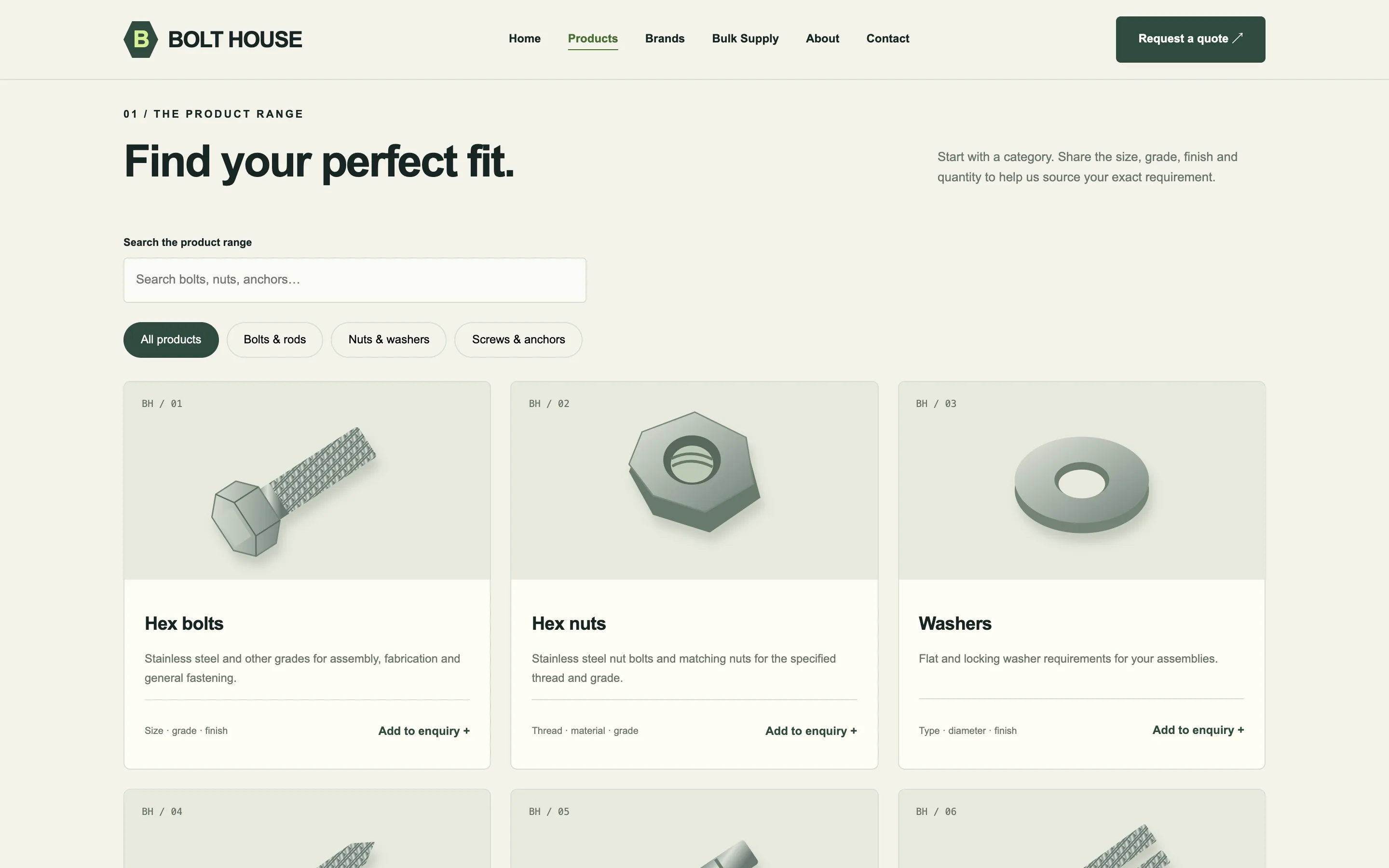
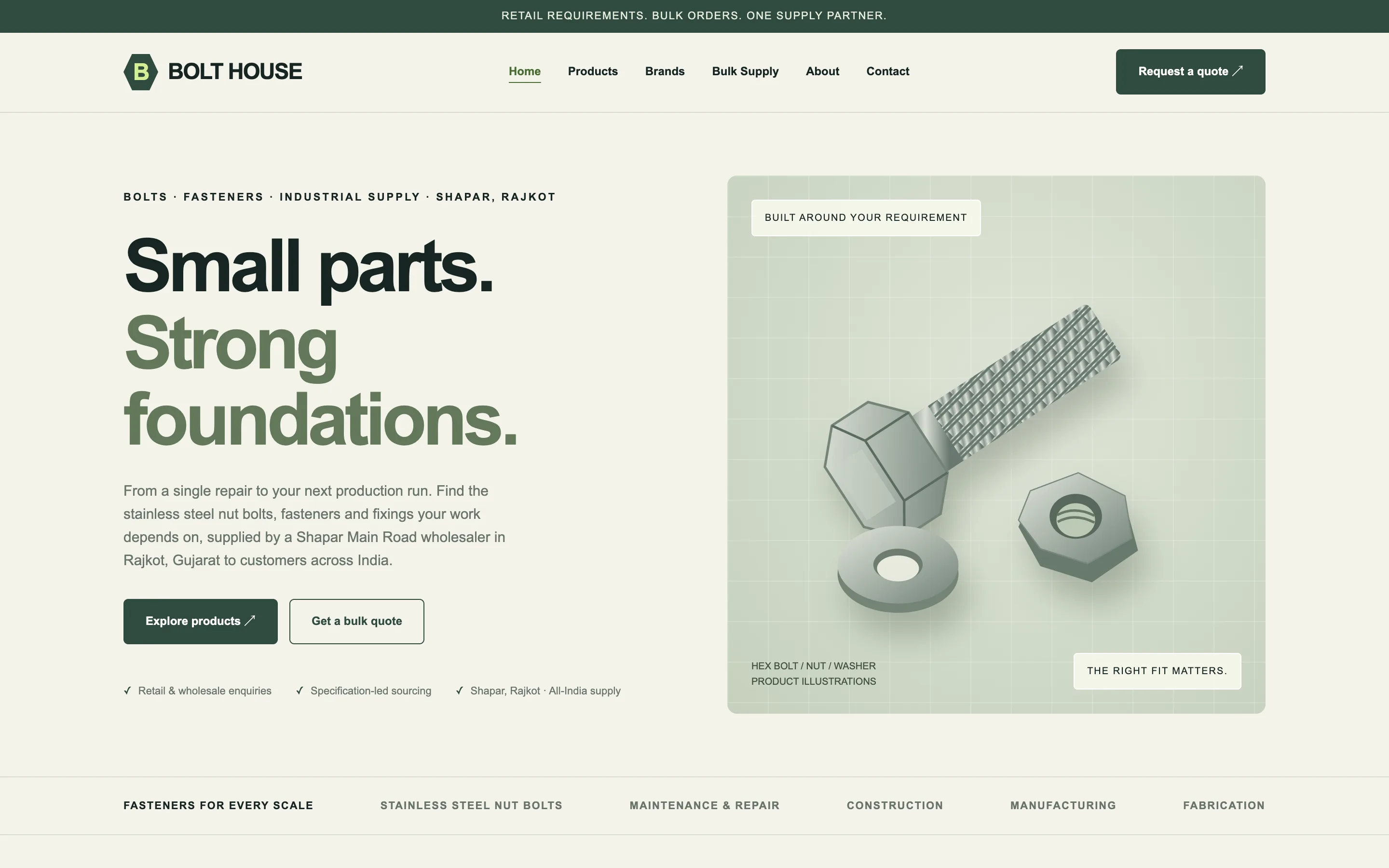
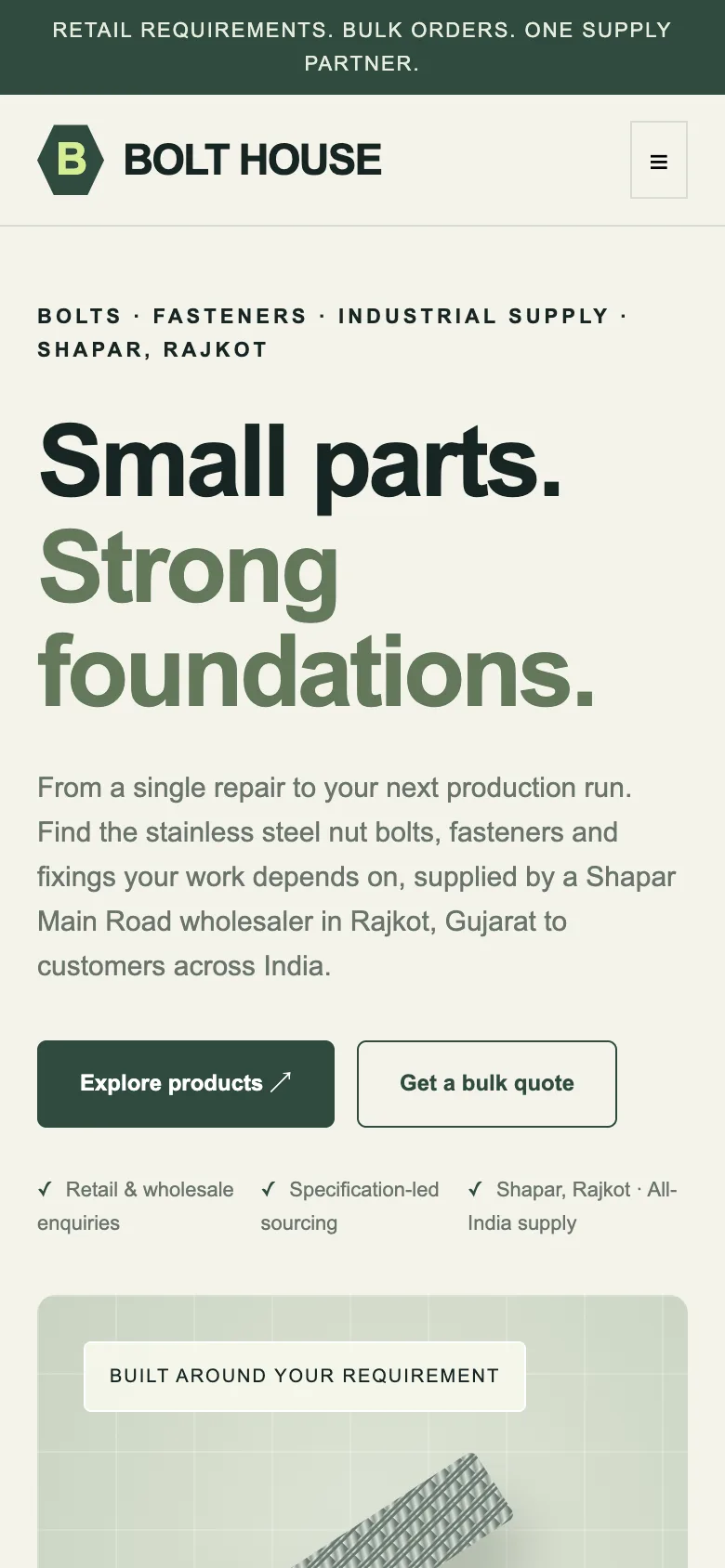
Bolt House is a real stainless steel nut bolt wholesaler on Shapar Main Road in Rajkot, and its site is the live example for this industry. The Products page lists six categories, from hex bolts to threaded rods, with filters and a search box. Every product card says which details to send for that item and has an Add to enquiry button that opens the quote form with the product already filled in.
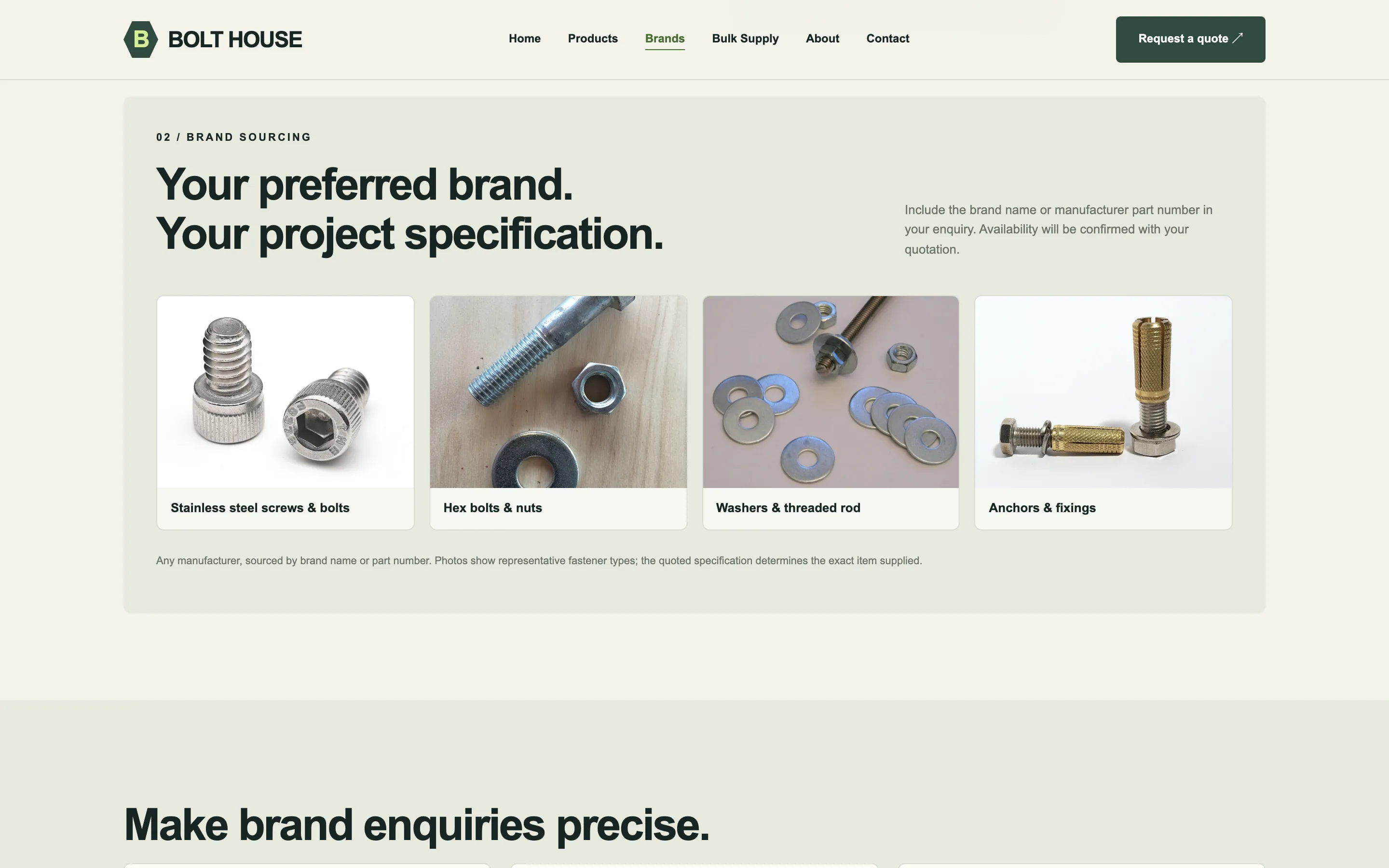
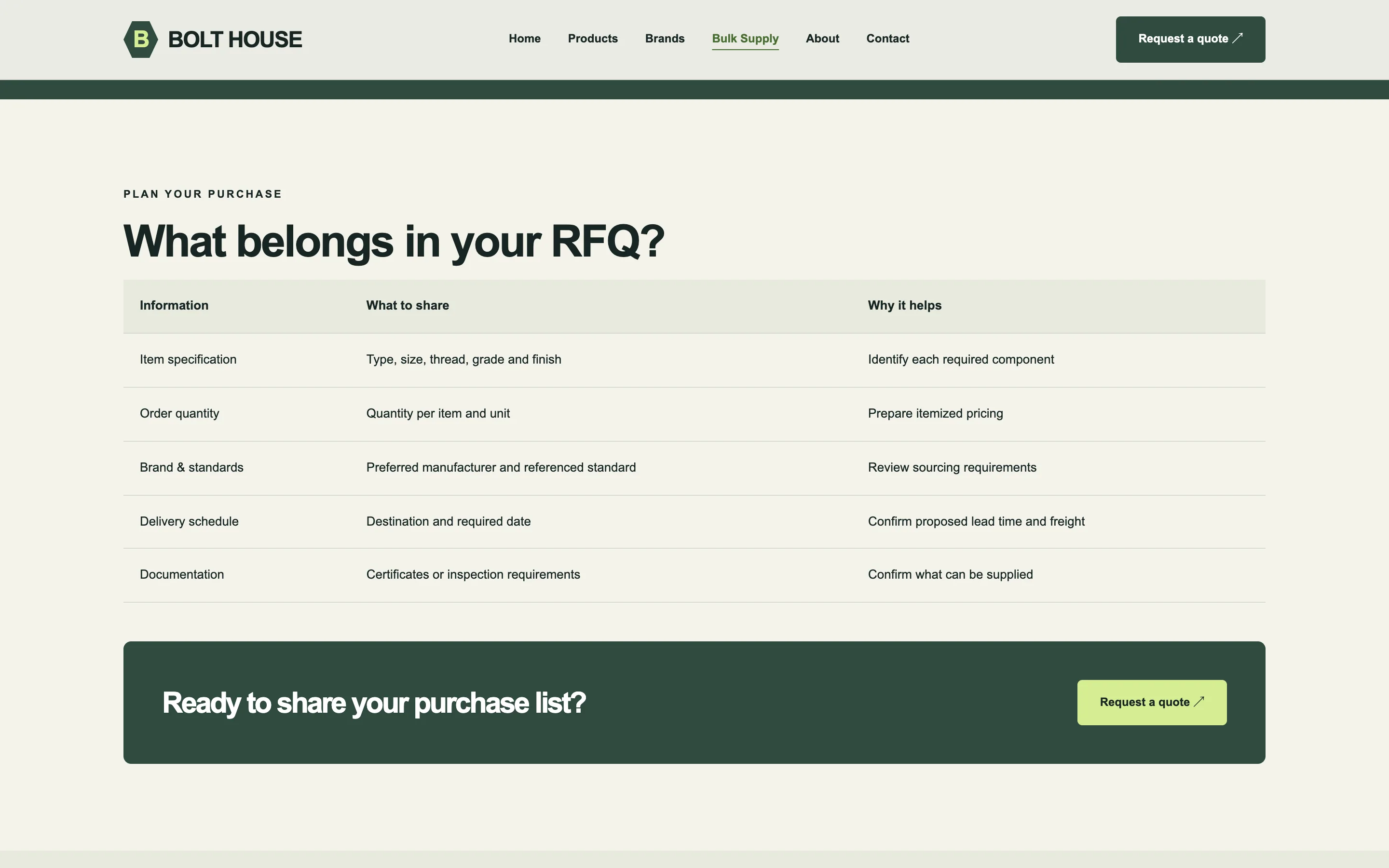
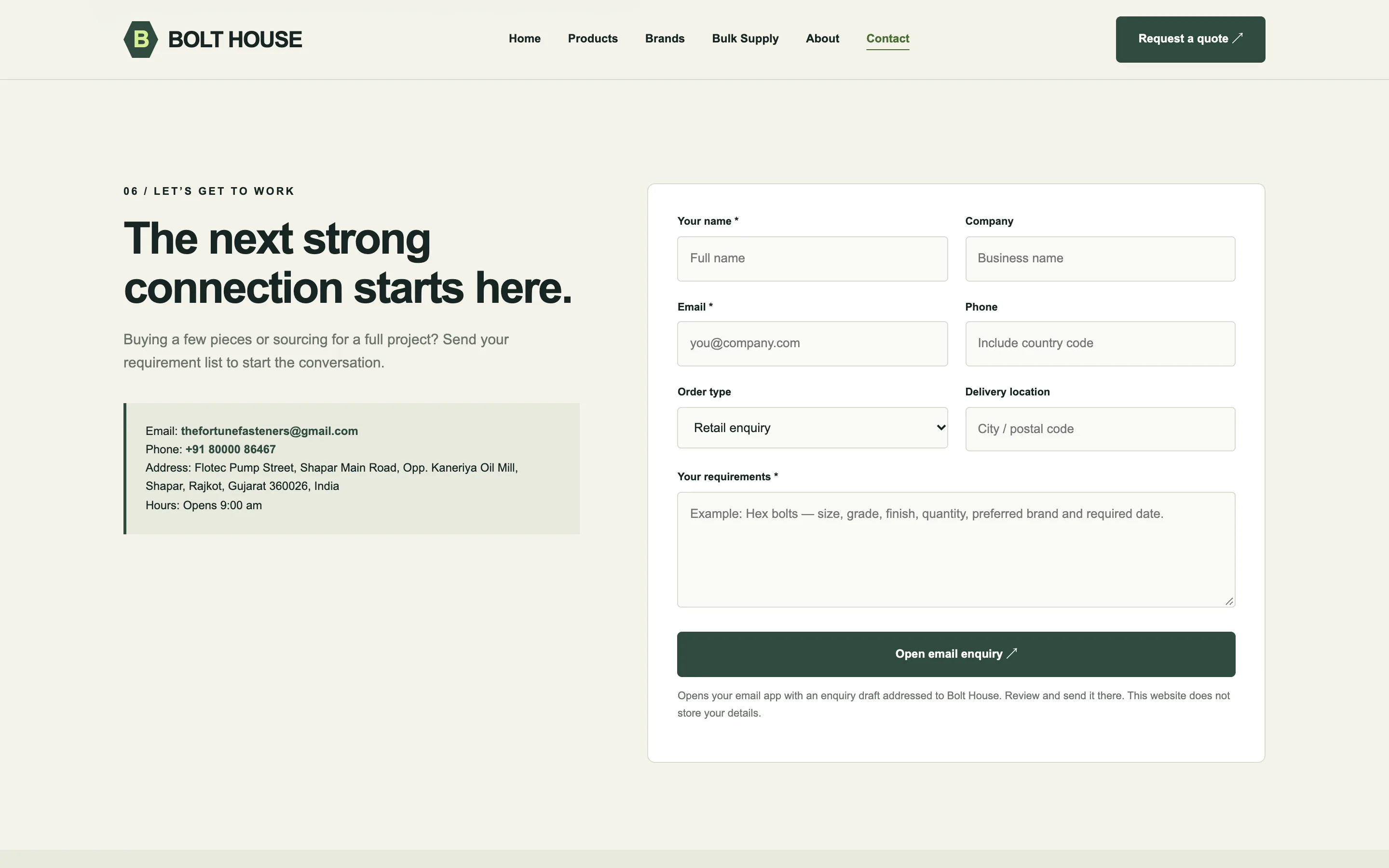
The quote form asks for the order type (retail, bulk or recurring supply), delivery location and the requirement, then writes the whole enquiry into the buyer's email app, addressed to the business. A quote checklist beside it lists what makes a request precise: type or part number, diameter, length and pitch, material and grade, finish, quantity and date. The Bulk Supply page explains how to bring a whole project into one list, and the Brands page handles buyers who need a particular manufacturer.
Pages included
Home, Products, Brands, Bulk Supply, About and Contact, plus a Photo credits page for the licensed images. Every page has its own title and description, a canonical address, a share image and breadcrumbs.
Fast on a phone in the workshop
Many fastener enquiries are sent from a phone on a shop floor or a site with a weak signal. The Bolt House site is plain HTML, CSS and JavaScript with no framework, about 18 KB of code in total, and its photos are compressed WebP files. Product illustrations are drawn in SVG inside the page, so the range appears instantly instead of waiting for dozens of product photos. The quote form works without an account or a login, and nothing has to be installed.
Because there is no database or admin panel to maintain, there is nothing to patch and nothing to break when the business is busy. When a supplier is ready for stock levels, price lists per customer or online orders, the same design moves onto a Laravel back end with an admin panel, and the pages, addresses and search set-up stay the same, so rankings carry over.
Local SEO set-up for fastener suppliers
Each page carries HardwareStore and WholesaleStore structured data with the business address, phone, email and the areas served, so search engines can match the site to searches such as a nut bolt wholesaler near a city. Page titles target the product and the city together. The site links to the business's directory listings, and the Google Business Profile points back to the site, which is what local rankings depend on most.
Country notes
India
Buyers expect WhatsApp, so the quote form can open a WhatsApp message instead of an email. Prices, when shown, are in rupees with GST mentioned, and listings on JustDial and IndiaMART should point to the site.
USA
Specifications are usually imperial (inch sizes, UNC and UNF threads) alongside metric, so the quote checklist and product pages name both. Accessibility to WCAG 2.2 AA is part of the build.
Canada
Buyers mix metric and imperial sizes, and a French version can be added for Québec customers. Prices are shown in Canadian dollars with the province's tax noted where relevant.
Australia
Metric sizes and Australian standards are the norm, and trade buyers expect an ABN on the site. Delivery areas by state help buyers outside your city know whether you ship to them.
Finland
The site is offered in Finnish and English, with prices in euros and the business ID (Y-tunnus) in the footer. EU accessibility rules make WCAG 2.2 AA part of every build.