What buyers look for on a machine shop website
People who buy machined parts are rarely browsing. An engineer has a part on screen and needs to know if your shop can make it: is the part inside your machine envelope, can you hold the tolerance on the bearing seat, do you cut 316 stainless or PEEK? A maintenance planner has a broken shaft on the bench and needs a phone number and a realistic date. A purchasing or quality lead wants to see that you issue first article reports and material certificates before adding you to the approved supplier list.
Most job shop websites answer none of this. They show a photo of a machine, a list of industries and a contact form that asks for a name and a message. The engineer cannot tell whether you have five-axis capacity, so the drawing goes to another shop. A good machine shop site does the opposite: it states capability in numbers, shows that you understand drawings, and makes it easy to send a complete request for quote.
How the demo handles it
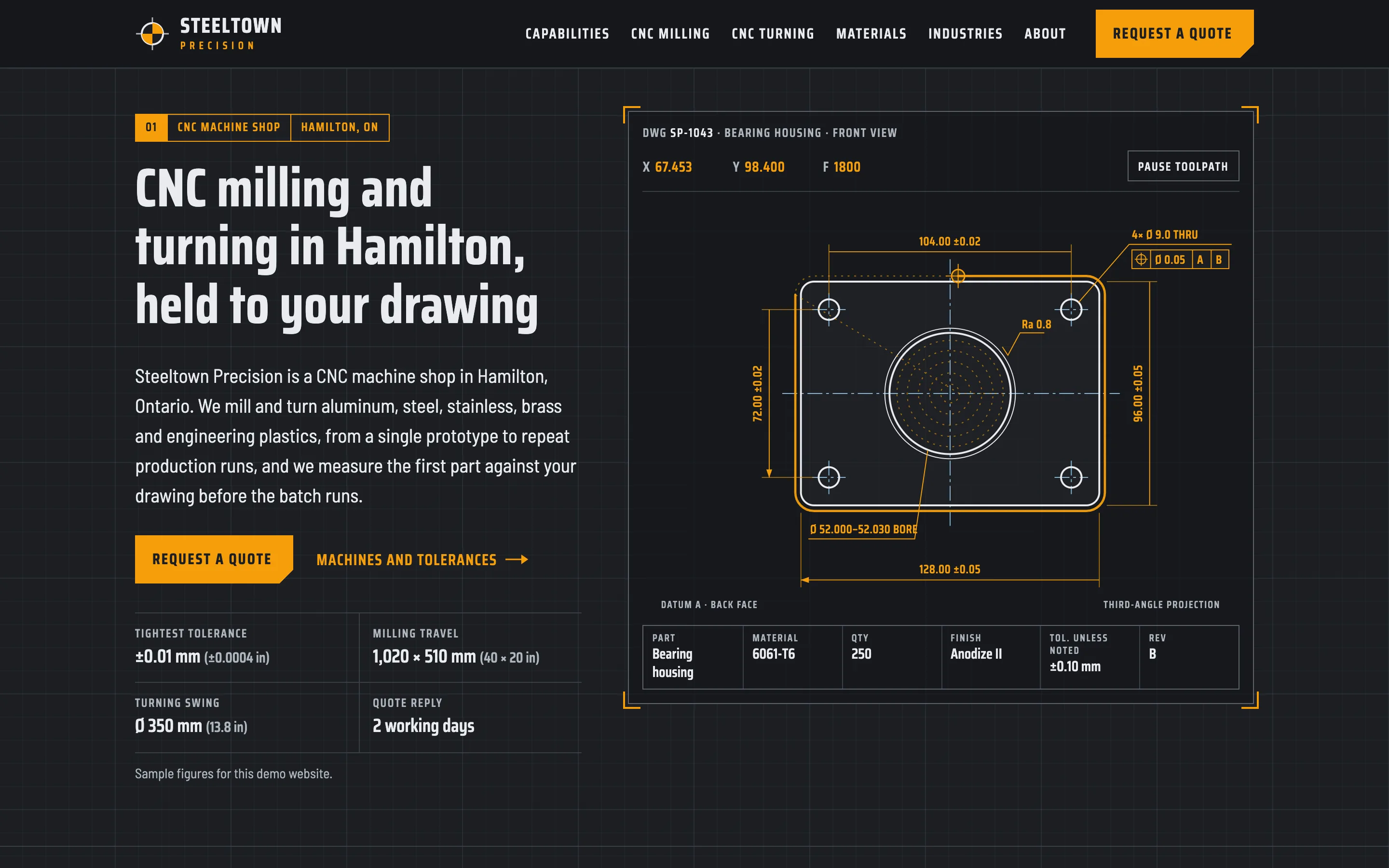
The demo is built for Steeltown Precision, a fictional CNC shop in Hamilton, Ontario. The whole site is drawn like a blueprint: a graphite background with a faint grid, amber dimension lines and tolerance labels, and original CAD-style drawings of real part types, such as a bearing housing, a motor mount plate and a drive shaft. On the home, milling and turning pages a slow toolpath animation traces the cut, with a small digital readout showing the cutter position. It can be paused, it stops for visitors who prefer reduced motion, and the drawing is complete without it.
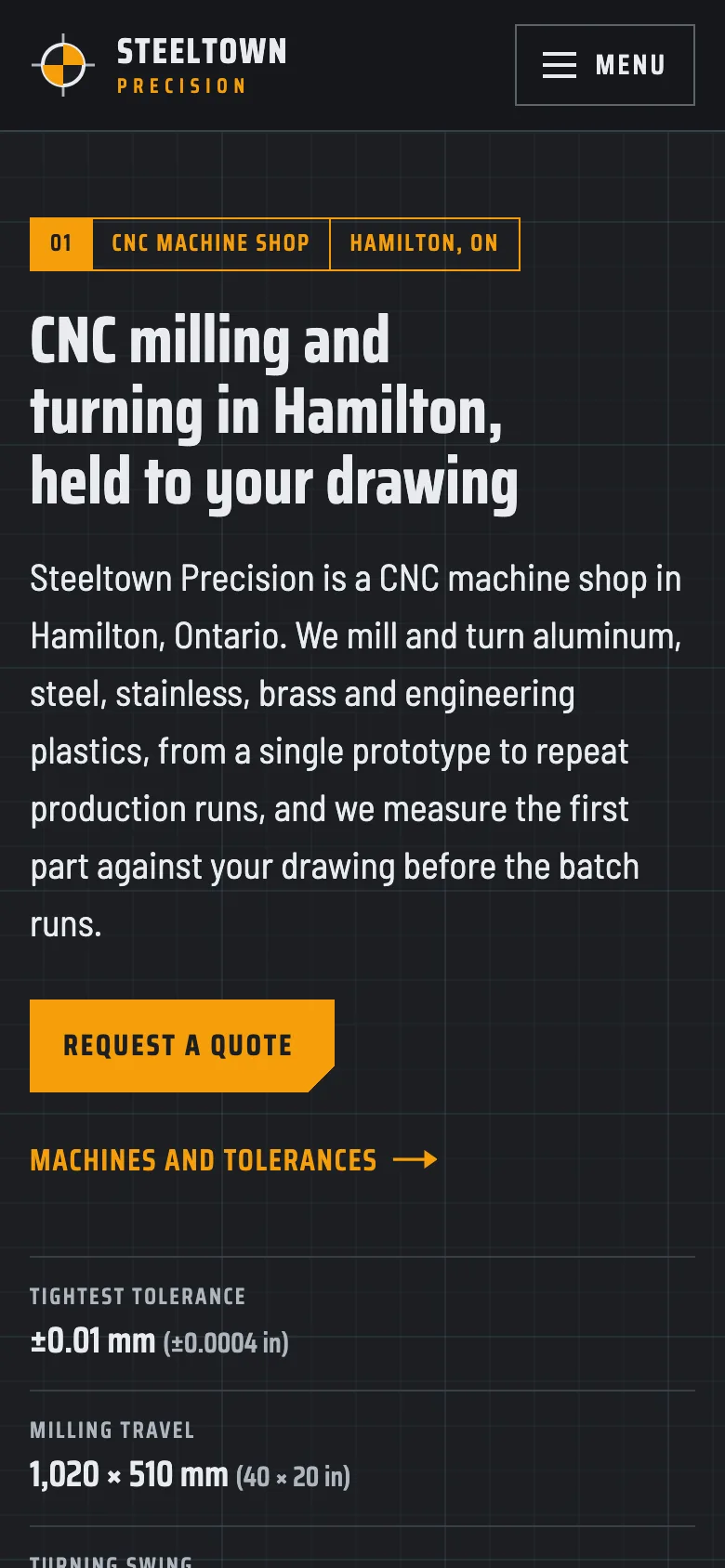
The capabilities page lists every machine in a spec table: machine type, axes, travel or bar capacity, spindle, typical tolerance and the work it suits best. On a phone, each row turns into a compact card. A second table explains the shop's tolerance grades and surface finishes in millimetres and inches, followed by inspection equipment, the documents the shop provides, and finishing done in-house or through partners.
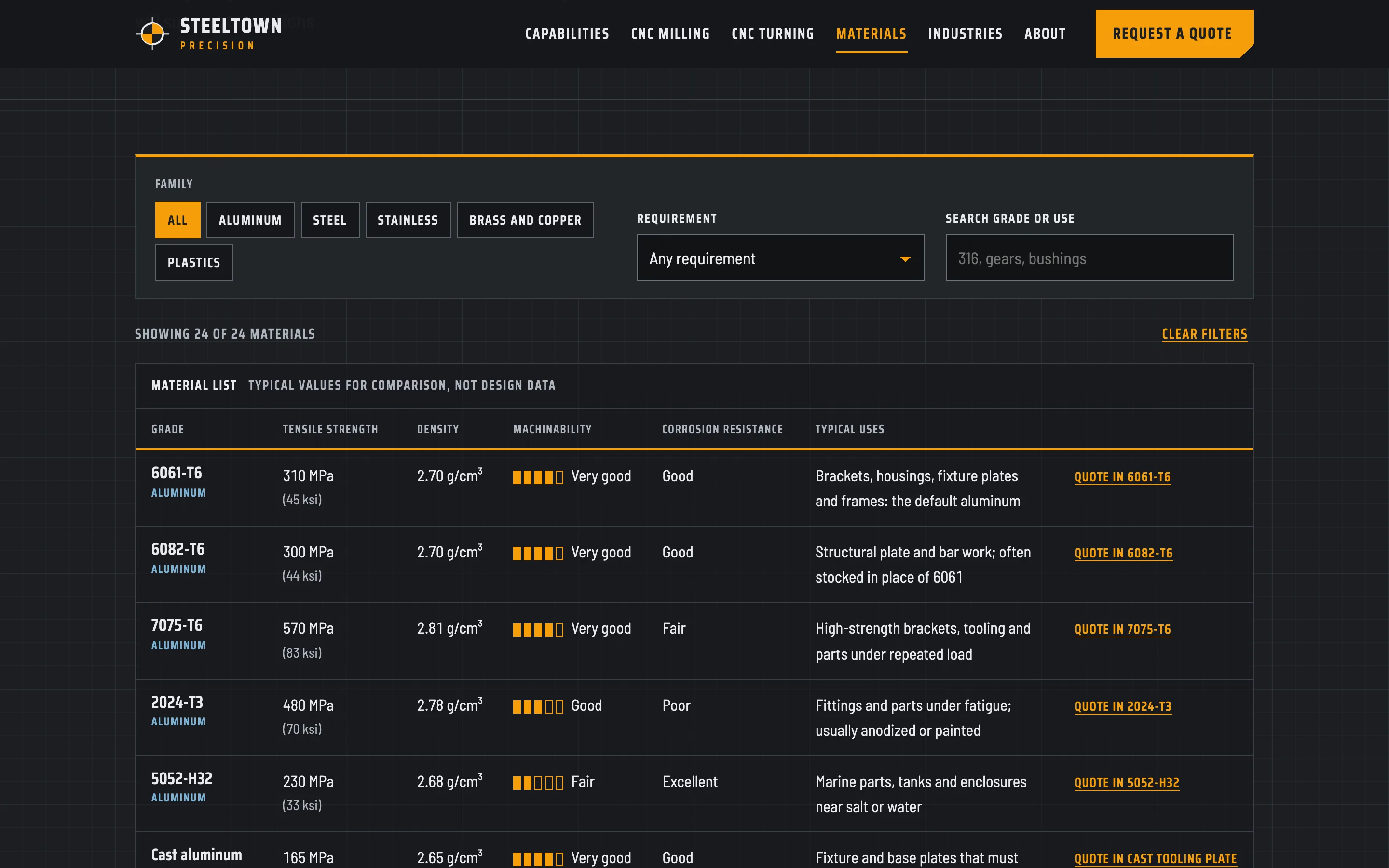
The materials page lists 24 grades of aluminum, carbon and alloy steel, stainless steel, copper alloys and plastics with tensile strength, density, a machinability rating and corrosion resistance. Visitors filter by family, by requirement (high strength, food equipment, weldable, wear and low friction) or by typing a grade or a use. The filter is written into the address, so a link from the home page can open the list on stainless steel only. Every row has a link that opens the quote form with that grade already selected.
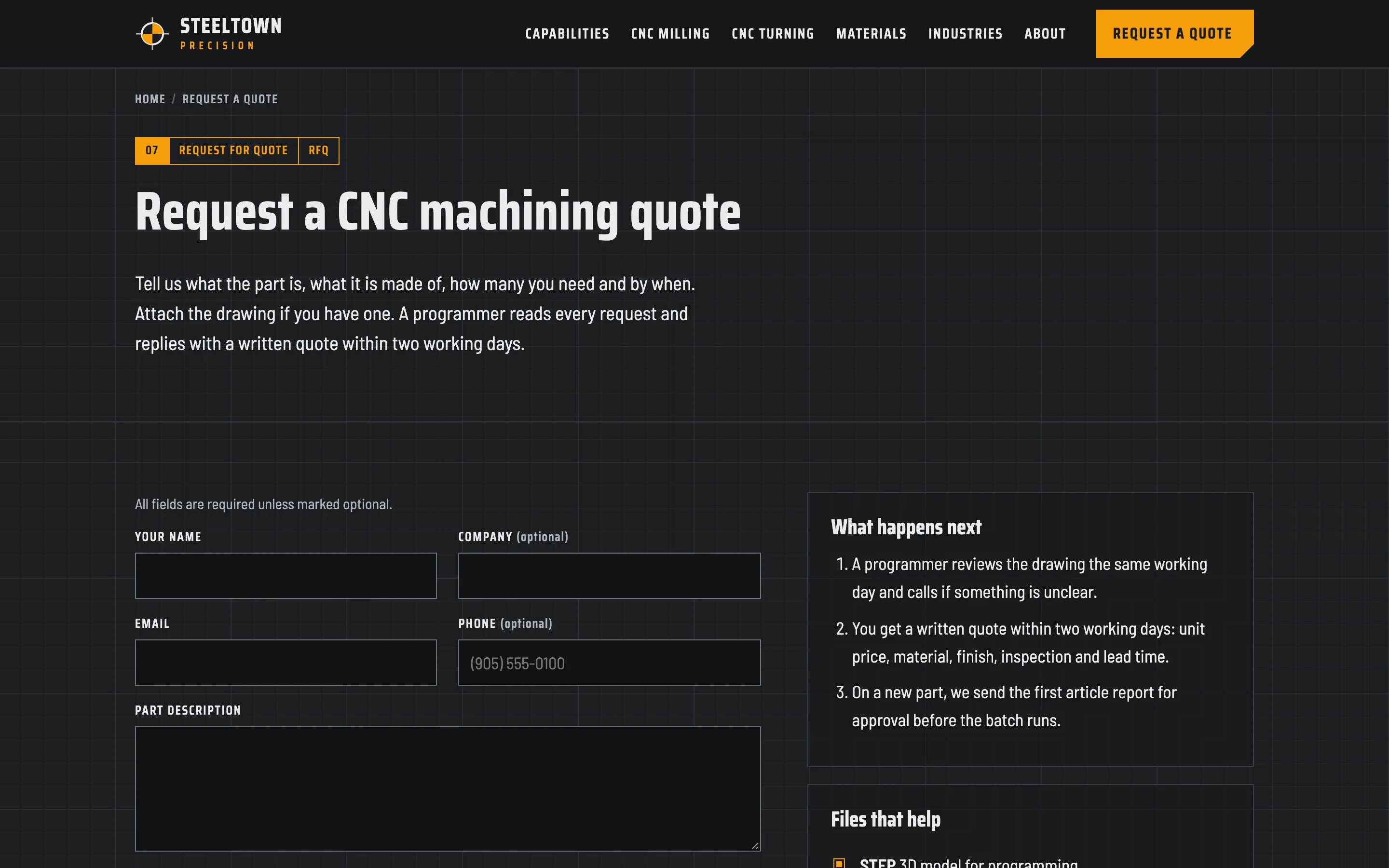
The request for quote collects what a shop needs to price a part: description, material, quantity, tightest tolerance, finish, a needed-by date and the drawings. The file picker accepts STEP, DXF and PDF and shows the chosen file names; in the demo nothing is uploaded or sent. If the date is less than five working days away, the form says it is a rush job. After validation the visitor sees a summary of the request and the demo notice.
Pages included
- Home: what the shop machines, key capability figures, materials by family, the job routing from drawing review to delivery, industries, sample reviews and a quote call to action.
- Capabilities: machine spec table, tolerance and finish grades, inspection and paperwork, finishing and secondary operations.
- CNC Milling and CNC Turning: typical parts, the machines involved, design tips that lower the price, and sample lead times.
- Materials: the filterable list and notes on choosing between common grades.
- Industries: automotive tooling, agricultural equipment, food machinery and energy, each with a drawing, typical parts, materials and what buyers ask for, without client names.
- Request a Quote and About, with a shop-floor plan drawing, the team as initials, hours and the area served.
Local SEO set-up
Every page carries one JSON-LD graph: the shop as an Organization and LocalBusiness with its city, service area, opening hours, logo and share image; the WebSite with the developer credit; a BreadcrumbList on inner pages; and Service nodes for CNC milling, CNC turning, inspection and each industry. Titles pair the process with the city ("CNC Milling Services in Hamilton, ON"), which matches how buyers search. For a real shop, the next steps are a Google Business Profile in the machine shop category, a page per process or material you want to be found for, and links from distributors, industry associations and customers who are happy to be named.
Machine shop websites by country
Canada
Canadian buyers expect metric first with imperial in brackets, because many drawings still arrive in inches from US customers. The demo uses Canadian English, Canadian dollars and a 905 area code from the fictional range. Quality programs such as ISO 9001 and sector registrations are shown as placeholders until the real numbers are added, and shops that ship to the US can mention cross-border shipping on the quote page.
USA
American shops usually work in inches, so the same tables can lead with inch values and show metric in brackets. Buyers in defence and aerospace supply chains look for registrations and quality systems, which the site shows only when the shop holds them. Accessibility at WCAG 2.2 AA also lowers the risk of ADA complaints for a business website.
India
Indian machine shops often serve OEMs and export customers at the same time, so the site works in metric with a clear list of standards. WhatsApp is the contact most buyers prefer for quick questions and photos of a part, and the footer has room for the GST number. Prices, when shown, are in rupees as "from" figures.
Australia
Australian shops work in metric and serve mining, agriculture and food processing, which matches the demo's industries page closely. The ABN belongs in the footer, and quote forms often ask about delivery to regional sites. Phone numbers on the demo would use the ACMA range reserved for fiction.
Finland
Finnish manufacturers usually need the site in Finnish and English, with euro prices in the Finnish format and the business ID (Y-tunnus) in the footer. Many Finnish shops supply export customers in Sweden and Germany, so clear capability tables help buyers who do not read Finnish. EU accessibility rules make WCAG 2.2 AA the right target.