What clients look for on a law firm's website
Nobody browses law firm websites for fun. A visitor arrives because something has happened or is about to: a business partner wants out, an offer on a house has just been accepted, a parent has died, a contract has landed in the inbox with a deadline. They want to know three things quickly. Does this firm handle my kind of problem? Who would I actually be dealing with? And what happens, and roughly what does it cost, if I get in touch?
A good law firm website answers those questions in plain language and then gets out of the way. It names the practice areas precisely instead of listing forty services, introduces the attorneys as people with a clear focus, explains the first steps of a matter and makes contact easy from every page. It also has to be careful. A firm's website is attorney advertising in most places, so it cannot promise outcomes, invent results or call a lawyer a specialist without the right certification. And an enquiry form is not a safe place for confidential facts, because the firm has not yet checked for conflicts or agreed to act. The website has to say that clearly, without sounding cold.
How the demo handles it
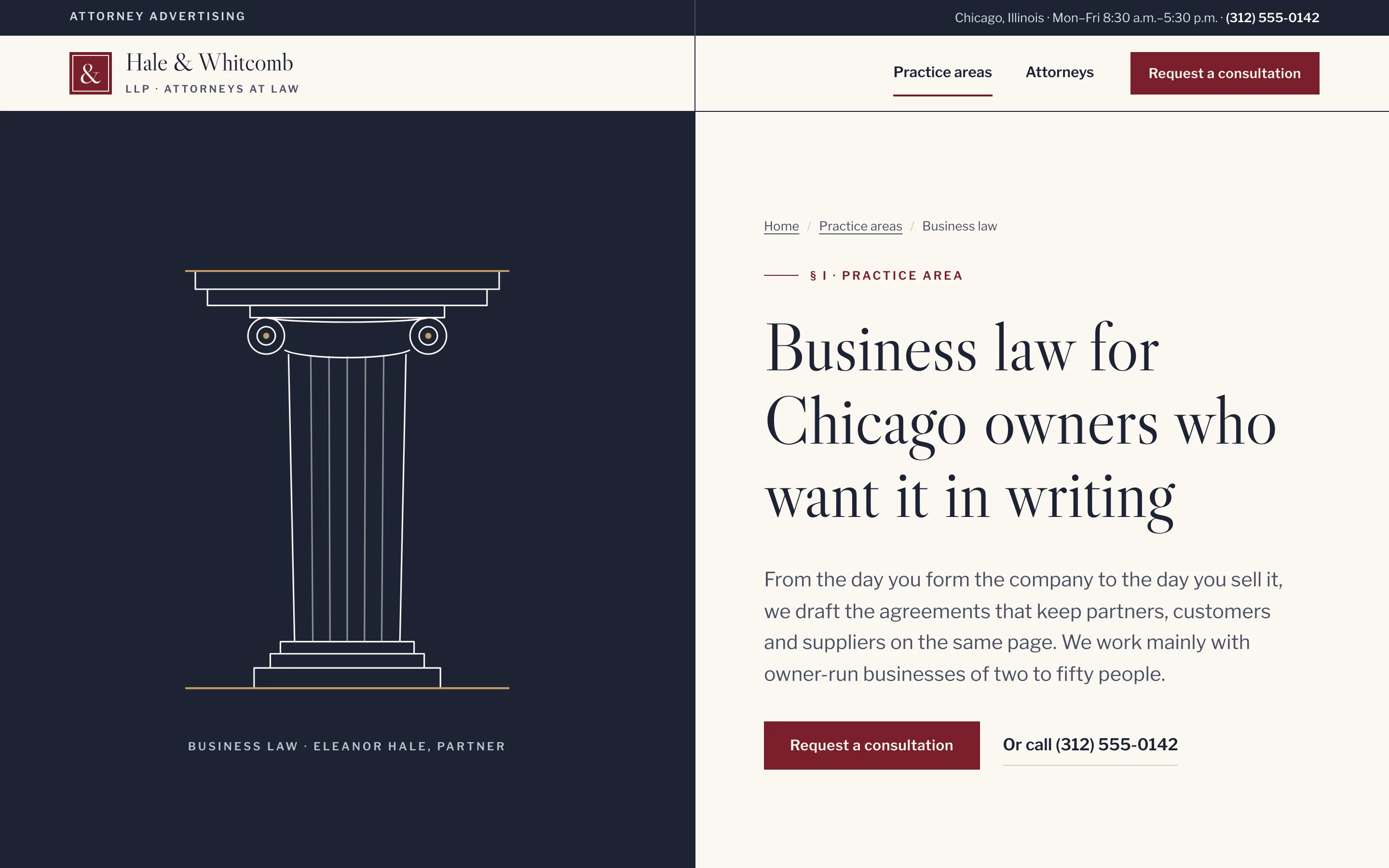
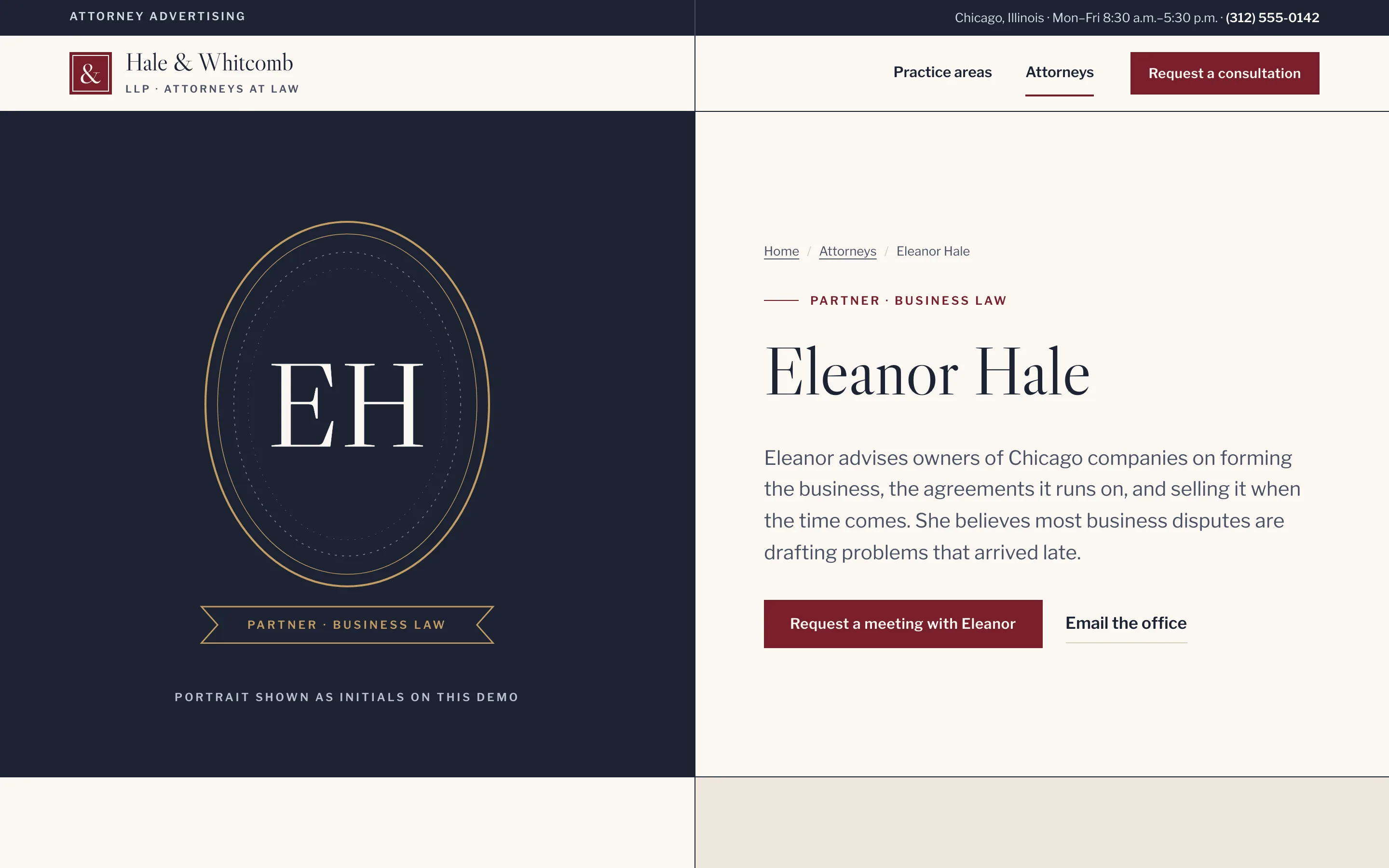
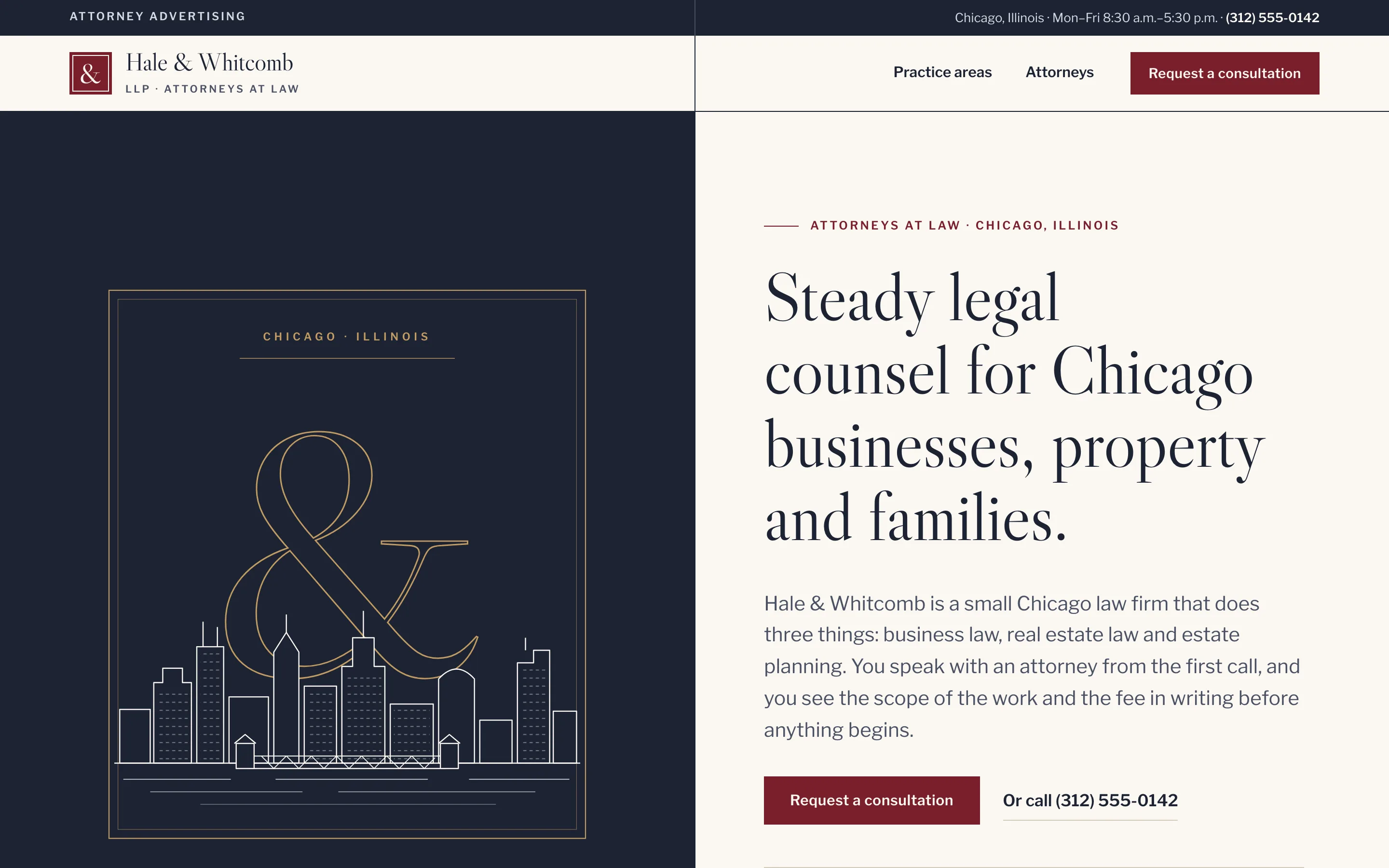
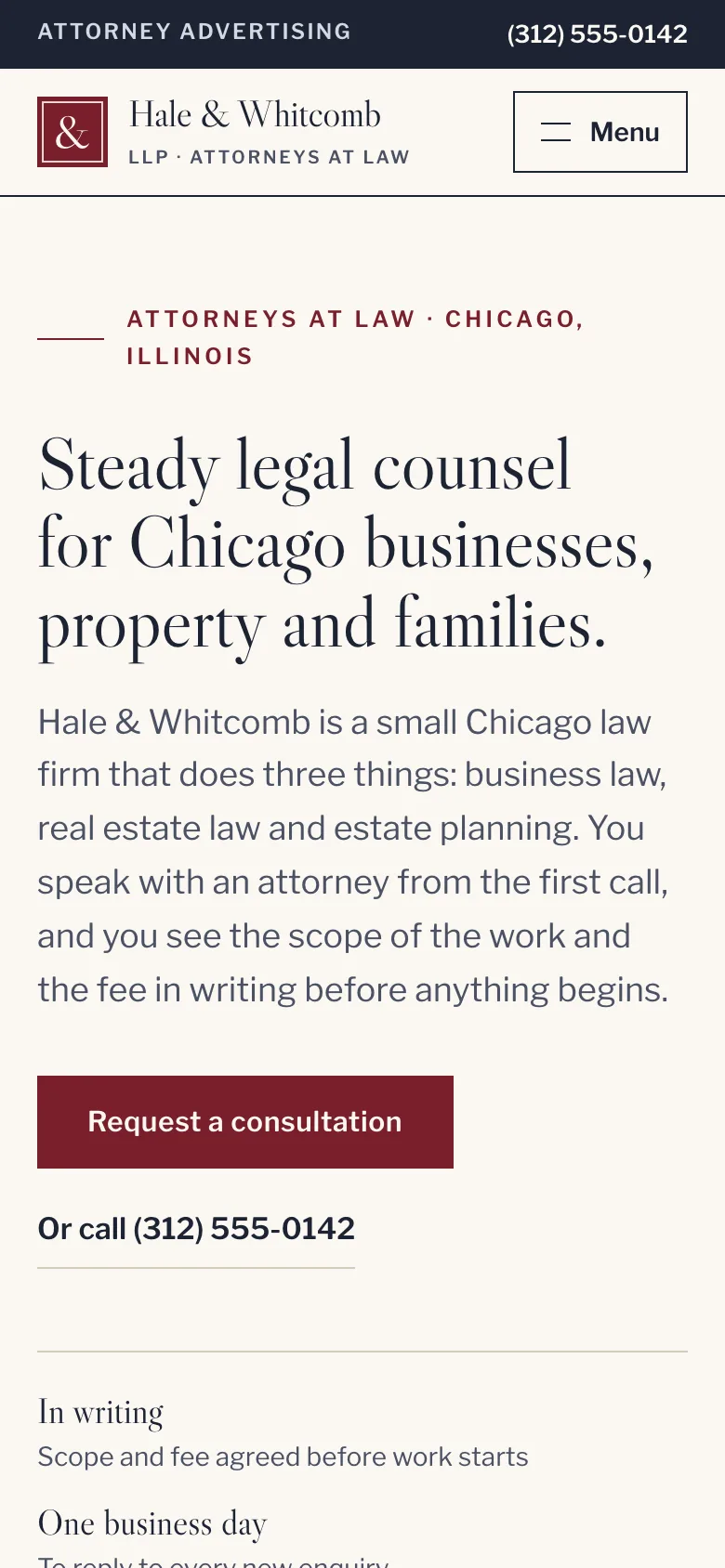
The demo is Hale & Whitcomb LLP, a fictional three-practice firm in Chicago. Its design is a split screen: every key section is divided down the middle, with a strong typographic or illustrated panel on one side and the text on the other, and a hairline rule that runs through the header, the sections and the footer. The type is Libre Caslon Display for headings and Libre Franklin for text, on warm paper with deep navy and an oxblood accent. Instead of stock photos of models in suits, it uses line drawings made for the site: the Chicago skyline in front of a large ampersand, an Ionic column for business law, a greystone two-flat for real estate and an oak tree for estate planning. Attorneys appear as initials in oval portrait frames, which keeps the site honest and leaves room for real photos later.
The home page leads with what the firm does and how it works, then a numbered index of the three practice areas, the four steps of how a matter begins (outline, conflict check, consultation, engagement letter), the attorneys, sample flat fees and a closing contact panel. Every practice-area page follows the same pattern: the matters handled, how a typical matter runs step by step, sample fees, four FAQs and links to related practice areas.
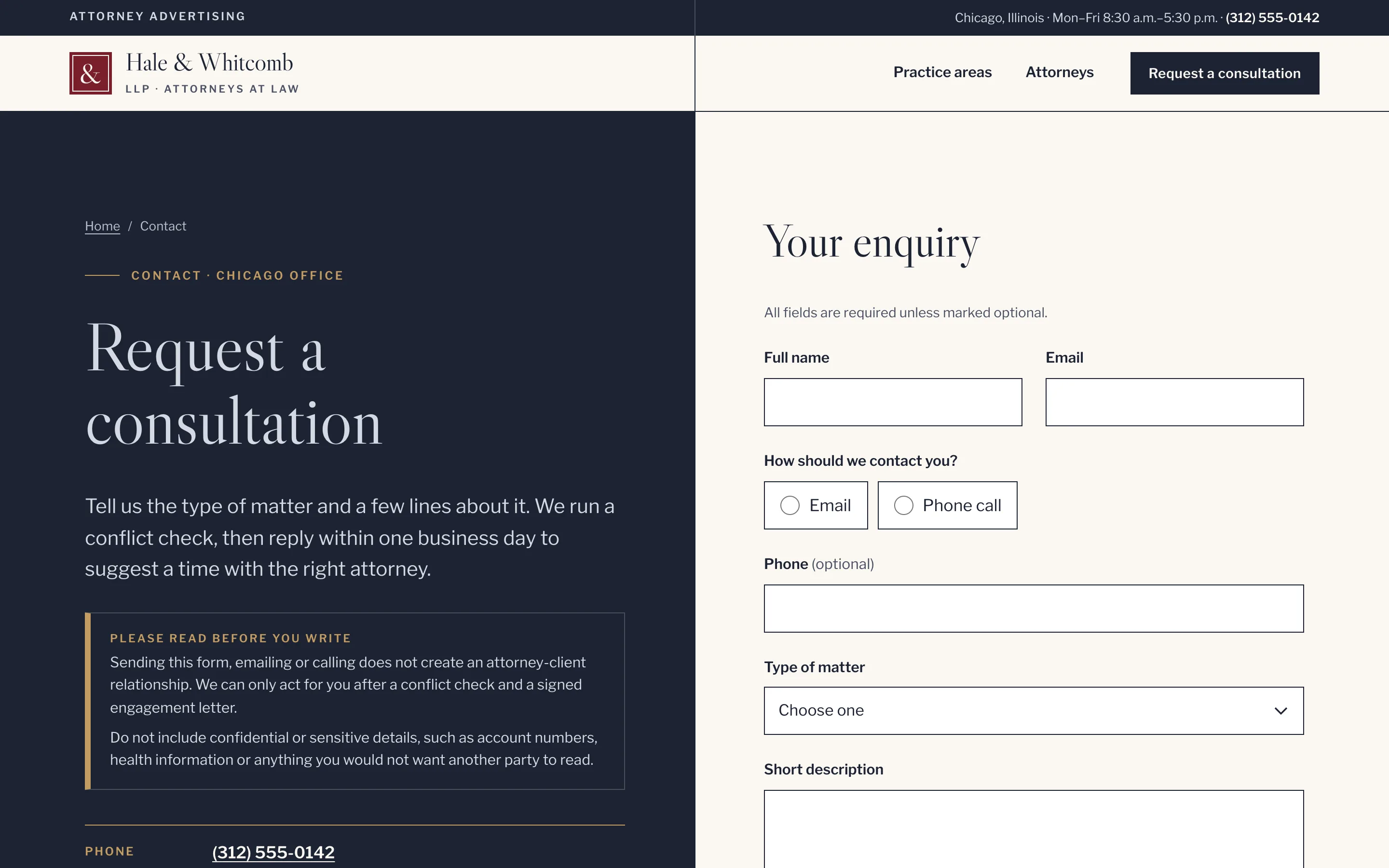
The signature feature is the enquiry form. It asks for the type of matter, a short description with a character counter, the preferred way to be contacted and, separately, the names of other people or companies involved so the firm can run a conflict check. When the visitor picks a matter type, a note tells them what to have ready and reminds them that account numbers and sensitive details can wait. A notice beside the form, and a required tick box, make clear that sending the form does not create an attorney-client relationship. The practice-areas page adds a small picker ("What brings you here?") that points visitors to the right page, or tells them politely when their matter is outside the firm's practice.
The pages
- Home: the firm's promise, the practice-area index, how a matter begins, the attorneys, sample fees and contact details.
- Practice Areas: an overview of all three areas with the picker, a short summary of each, and a section on what the firm does not handle.
- Business Law, Real Estate Law and Estate Planning: a page each with matters handled, the steps of a typical matter, sample fees, FAQs and related areas.
- Attorneys: four profiles with focus areas and placeholders for admissions.
- Attorney Profile: a full page for one partner with how she works, her focus, credentials placeholders and a direct route to request a meeting.
- Contact: the enquiry form, the confidentiality notice, hours and how to reach the office.
Local SEO set-up for a law firm
Every page carries LegalService structured data with the firm's name, logo, city-level area served, phone, email and opening hours. Practice-area pages add a Service node and an FAQPage built from the questions on the page, attorney pages add a Person linked to the firm, and inner pages add breadcrumbs. There is no review or rating markup, because self-published reviews do not qualify for it and many bars restrict testimonials anyway.
Titles follow the pattern practice area, city and firm name, such as "Real Estate Lawyer in Chicago, IL", because that is how people search. Each page has its own description written to be clicked. For a firm with more than one office, each office gets its own page with its address and hours, and the Google Business Profile for that office links to it. The profile's categories, practice areas, phone number and hours should match the website exactly, and the appointment link should open the enquiry form rather than the home page.
Country notes
India
Indian English and a much more restrained site. The Bar Council of India's rules prohibit advocates from advertising or soliciting work, and websites are allowed to carry only factual details such as names, contact details, enrolment details, qualifications and areas of practice. Most Indian firms therefore show a disclaimer that visitors must accept before entering, and avoid fees, client lists and anything that reads as a pitch. WhatsApp is still the contact most clients prefer, and fees, where they are discussed at all, are in rupees and agreed after a first meeting.
USA
US English, dollars and the attorney advertising rules of each state bar, which are based on the ABA Model Rules: no false or misleading statements, no implied guarantees, and the name and office of at least one responsible lawyer on the advertisement, which the demo's footer shows. Some states require an "Attorney Advertising" label on certain communications or ask firms to file advertisements with the bar, and many restrict past results and the word specialist. Law firms also receive website accessibility claims under the ADA, so the demo is built to WCAG 2.2 AA.
Canada
Canadian English, with French for any firm serving clients in Quebec, where the Charter of the French Language requires it. Each provincial law society regulates marketing: it must be accurate and not misleading, and claims of specialization are limited to lawyers certified under the society's own program. In Ontario, licensed paralegals are also regulated by the Law Society, so a firm that employs them should say clearly who does what. Fees, if shown, are in Canadian dollars, plus the applicable sales tax.
Australia
Australian English and dollars, with each practitioner's details checked against the local regulator's register. In New South Wales, Victoria and Western Australia the Legal Profession Uniform Law applies, and several states restrict advertising of personal injury services. Firms that belong to a professional standards scheme must show the line "Liability limited by a scheme approved under Professional Standards Legislation", and the footer also carries the firm's ABN placeholder.
Finland
Finnish and English versions, and often Swedish as well, with fees in euros and the business ID (Y-tunnus) in the footer. Only members of the Finnish Bar Association may use the title asianajaja (attorney-at-law); others practise as licensed legal counsel, and the website must use the right title for each person. The Bar's code of conduct expects marketing to be truthful and dignified, which suits this demo's quiet tone. EU accessibility rules make WCAG 2.2 AA the baseline.