What students and parents look for on a coaching institute's website
Choosing a coaching institute is a family decision, usually made by a student in Class 9 or 10 and one or two parents who will pay for it, often from another city. They arrive with the same questions every season. Which batch is right for my class and exam? Is it in the morning or the evening, in a classroom or online? When does it start, and are there still seats? What does it cost, and can we pay in parts? Who actually teaches, and can we see a class before we commit?
Most institute websites answer these questions badly. The batch list is a PDF from last year, the fees are hidden behind a phone call, and the home page is a wall of topper photos and rank claims that parents have learnt to discount. The family calls, gets a hard sell, and either joins under pressure or goes to the next institute in the lane.
A better website does the counsellor's first conversation for them. It lets the family narrow down the options at home, shows honest sample fees, and makes the next step small and free: come and sit in on one real class.
How the demo handles it
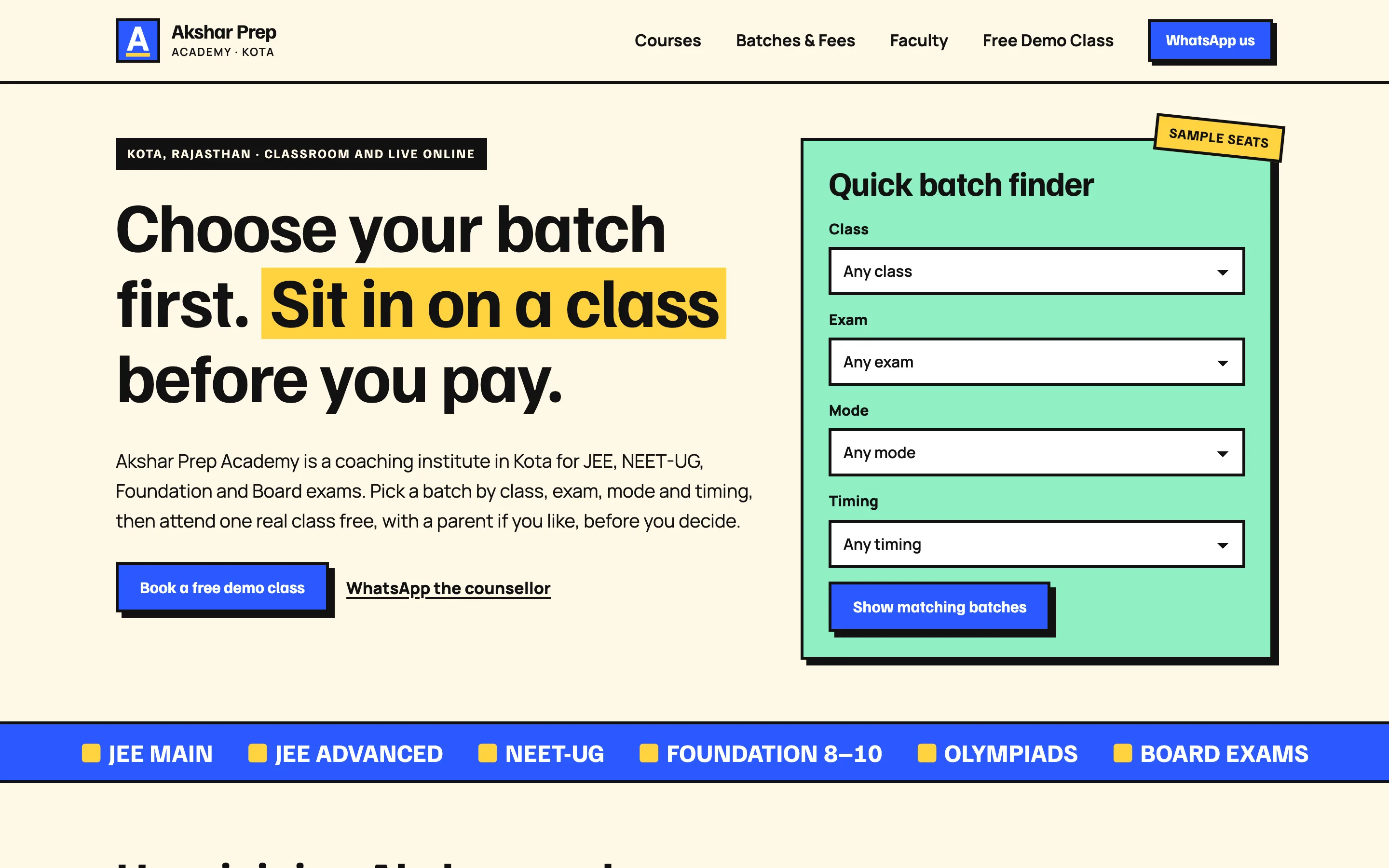
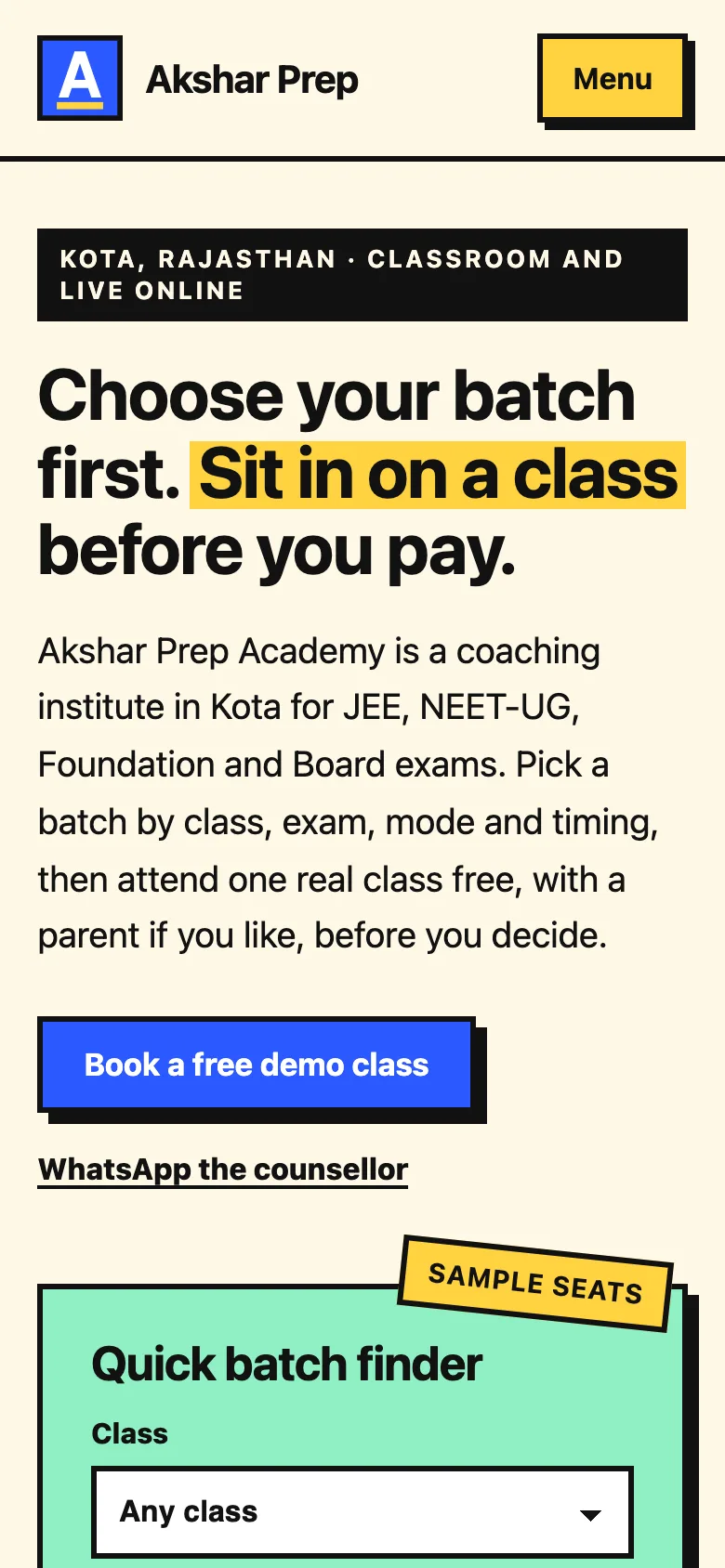
Akshar Prep Academy is a fictional coaching institute in Kota for JEE, NEET-UG, Foundation and Board exams. Its design is deliberately bold, with thick black borders, flat bright blocks and large labels, so that the important controls look like controls and stay readable on a cheap phone in bright sunlight.
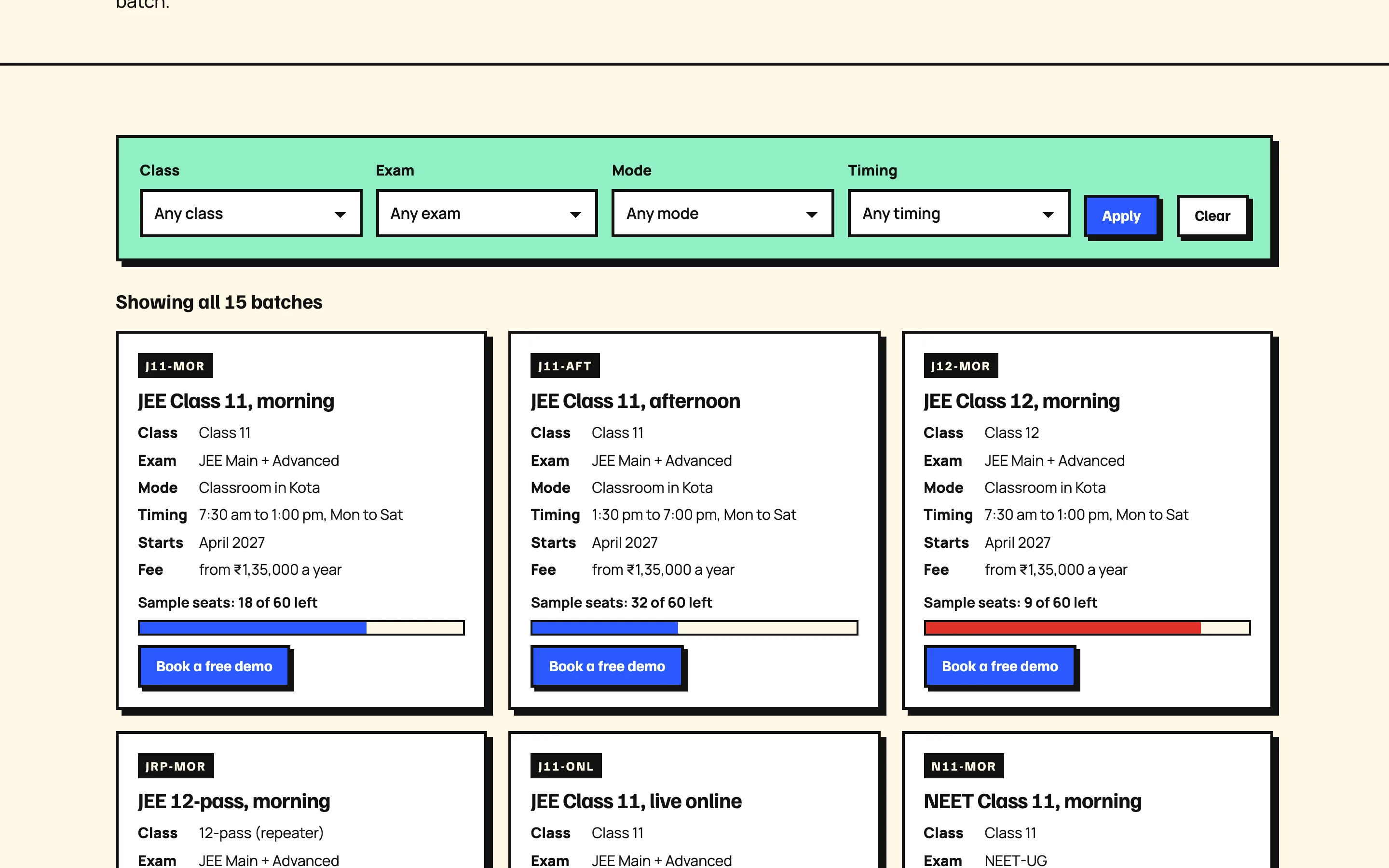
The centre of the site is the batch finder. A quick version sits in the home page hero: choose a class, an exam, a mode and a timing, and it opens the Batches and Fees page with those filters already applied. There, fifteen sample batches show their code, timing, start month, sample seats left with a filling bar, and a from fee. Change any filter and the list updates at once, with a live count for screen readers. The filters are also written into the page address, so a counsellor can send a parent a WhatsApp link that opens only the Class 11 NEET morning batches.
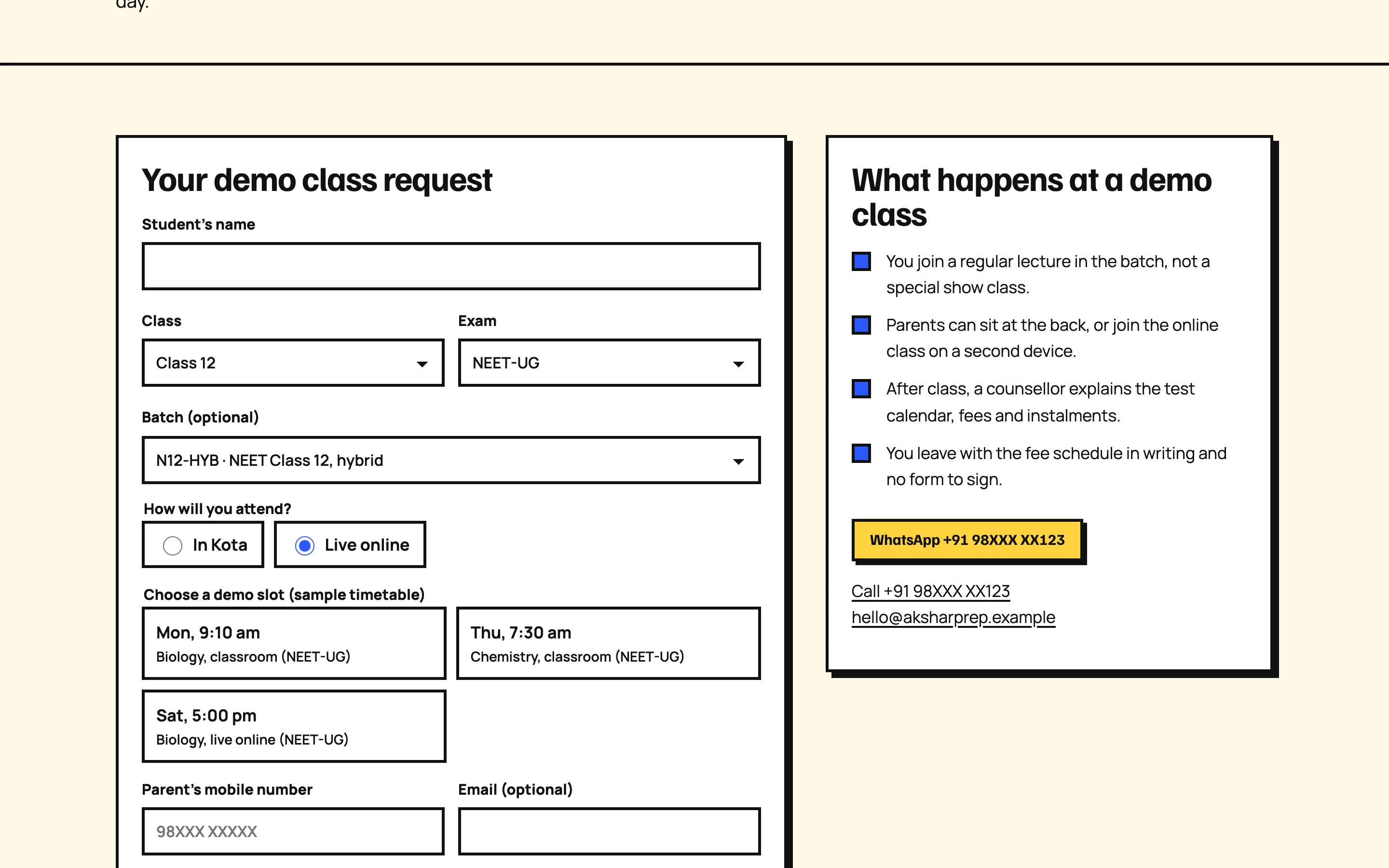
Every batch card ends in one button: book a free demo. The demo-class form opens with that batch selected and the class, exam and mode already filled in, and it shows only the demo slots that match the exam. The form checks each field, moves the cursor to the first problem, and asks for a parent's mobile number rather than an account or a password. In the demo, submitting shows a message that nothing was sent; on a live site the request goes to the counsellor's email or WhatsApp.
The home page also explains how joining works in four plain steps, shows a sample day in a morning batch, and has a section written for parents: weekly attendance and test marks on WhatsApp, a monthly parent-teacher meeting, a counsellor on campus, a fixed day off, help finding a hostel or PG, and fees in instalments with the schedule in writing. These are the things parents worry about in a coaching city, and saying them clearly does more than any rank banner.
The demo makes no claims about selections, ranks or results, and invents no numbers. Faculty profiles use initials instead of photos and show a labelled place where real qualifications go. Reviews appear only under a heading that says they are samples.
The pages
- Home: what the institute teaches, the quick batch finder, how joining works, a sample day, the parent section, sample reviews and a demo-class call to action.
- Courses: JEE Main and Advanced, NEET-UG, Foundation and Olympiad for Class 8 to 10, and Board exam support, each with who it suits, duration, weekly hours, modes, a from fee and a link to the matching batches.
- Batches and Fees: the full batch finder and a fee table by programme and mode, with instalment notes.
- Faculty: subject teachers and mentors with initials avatars, their teaching approach and batches, and the doubt desk routine.
- Free Demo Class: the booking form with sample slots, and what happens at a demo class.
Local SEO set-up for a coaching institute
Each page targets one clear search: coaching institute in your city on the home page, course names on the Courses page, batches and fees on the batch page, and free demo class on the booking page. Titles and descriptions are written to fit search results without being cut off.
The structured data describes the institute as an educational organisation with its city, area served and opening hours, lists each programme as a Course with a from price in rupees, marks the free demo class as an offer, and adds breadcrumbs on inner pages. There is no review markup, because self-written reviews break search guidelines.
For a real institute I connect the Google Business Profile, use the same name, area and phone number on every page, and add a page per centre if you run more than one. Batch pages stay at stable addresses from season to season, so links shared in parent groups keep working.
Country notes
India
The demo is written in Indian English for families across India, with fees in rupees and Indian digit grouping such as ₹1,35,000. Phone numbers are shown masked, and the main contact buttons are WhatsApp and call, because that is how most parents reach an institute. The site works on slow mobile data: fonts are self-hosted, there are no photos to download, and every page is plain HTML. Exam names follow common usage (JEE Main, JEE Advanced, NEET-UG, CBSE and state boards), and the copy avoids rank and selection claims, which coaching advertising guidelines in India now restrict. A Hindi version of key pages can be added for families who prefer it.