What students look for on a language school's website
Someone looking for a language course is usually trying to answer four questions in under a minute: is there a course for my level, does it fit my week, what does it cost, and can I try it before I pay? A language school's website wins or loses the student on those four answers. Long welcome texts, a PDF timetable and a "contact us for prices" page lose them to the school whose site answers straight away.
Different visitors arrive with different worries. A newcomer learning the local language needs to read the site before they can speak the language, so the course pages must exist in a language they already know. A working adult wants evening or online options and a clear start date. A parent booking classes for a teenager wants to see who the teacher is. An HR manager wants a company course, an invoice and someone to talk to. Each of these people should find their path from the home page in one or two taps.
Trust matters too. Students are about to spend months with a teacher and a group, so they want to see real teacher profiles, a sense of the classroom, small group sizes and honest notes about exams. A school that says "prepares for the exam" when it is not an official test centre keeps that trust; a school that blurs the difference loses it the first time a student asks.
How the demo handles it
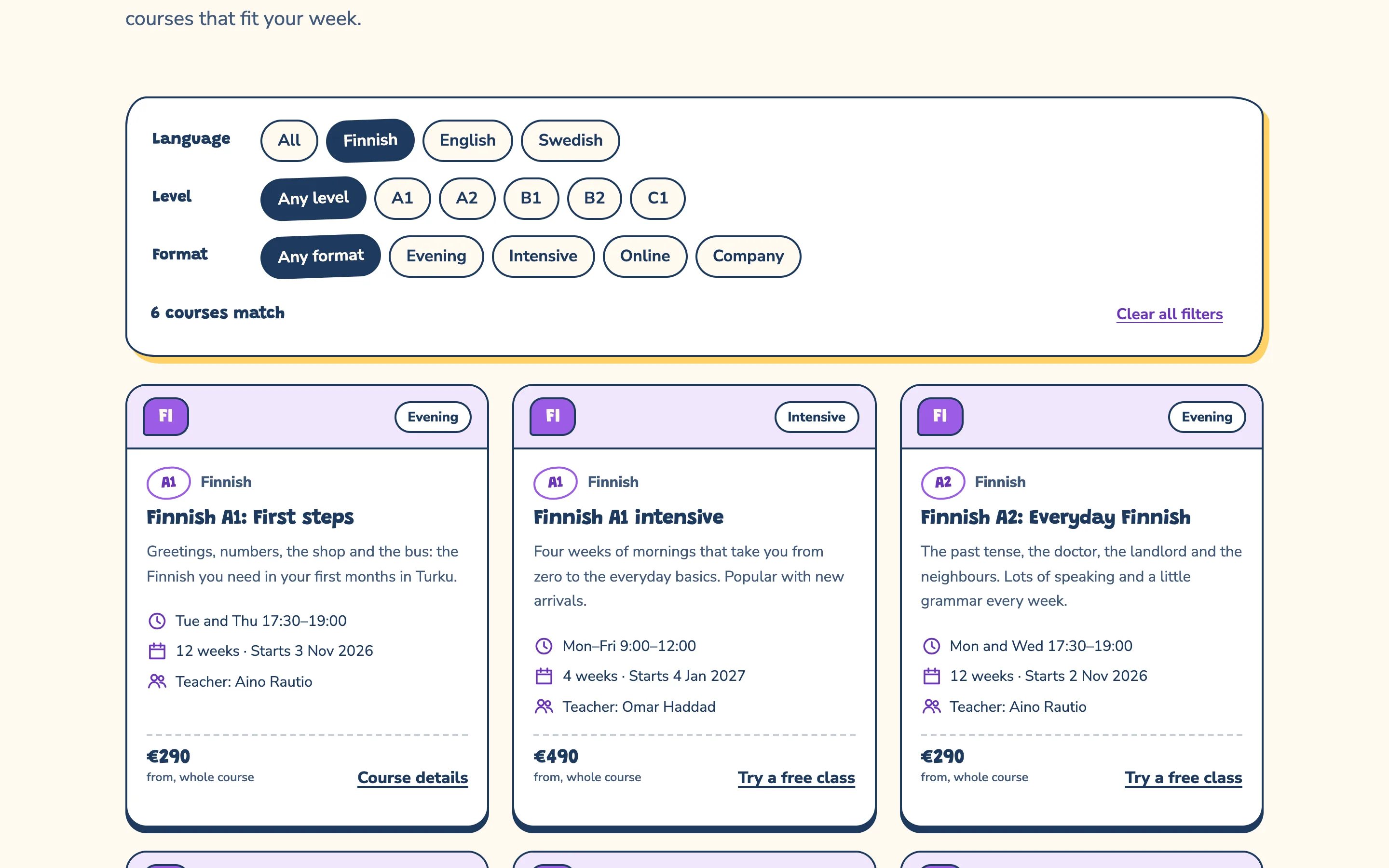
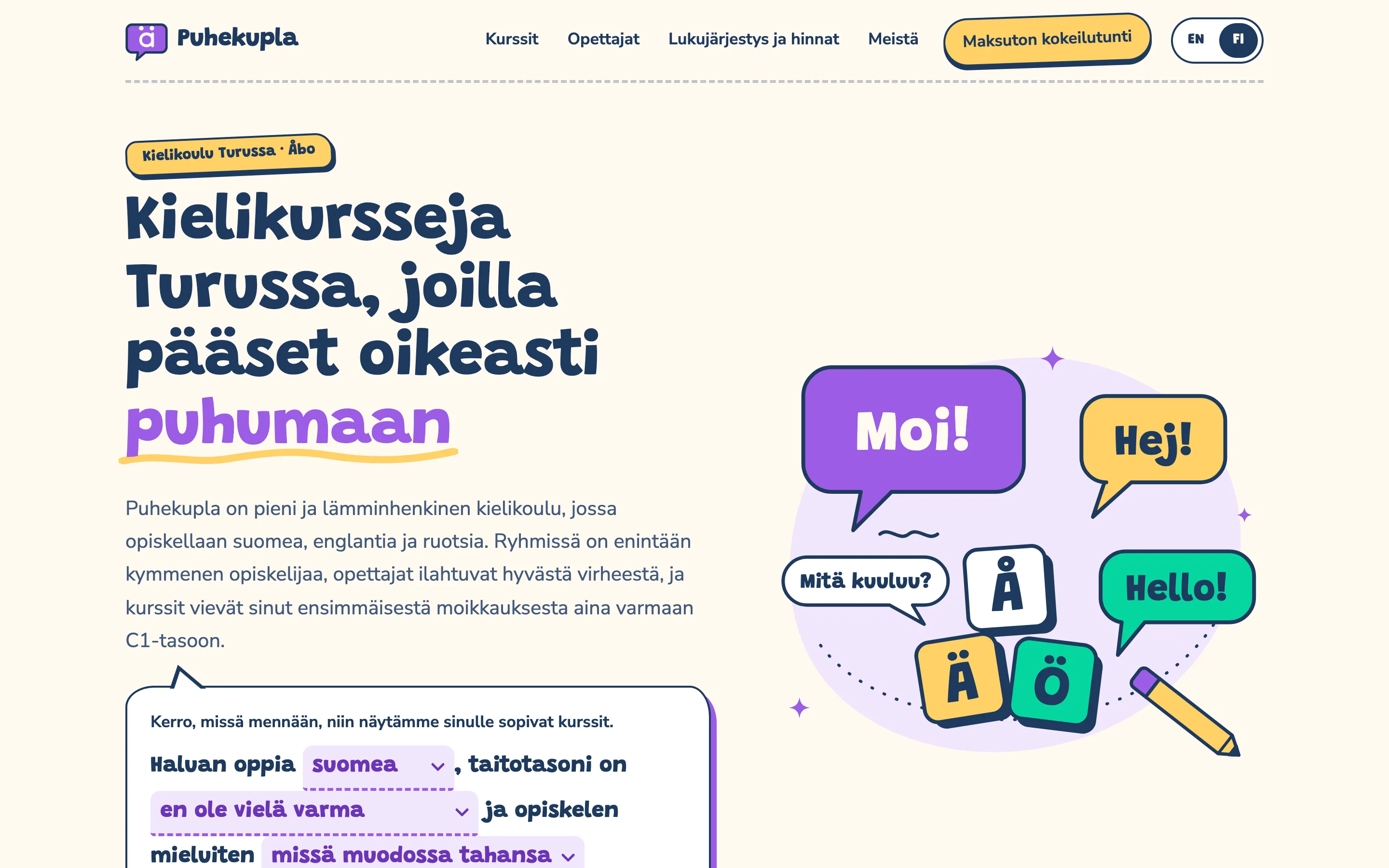
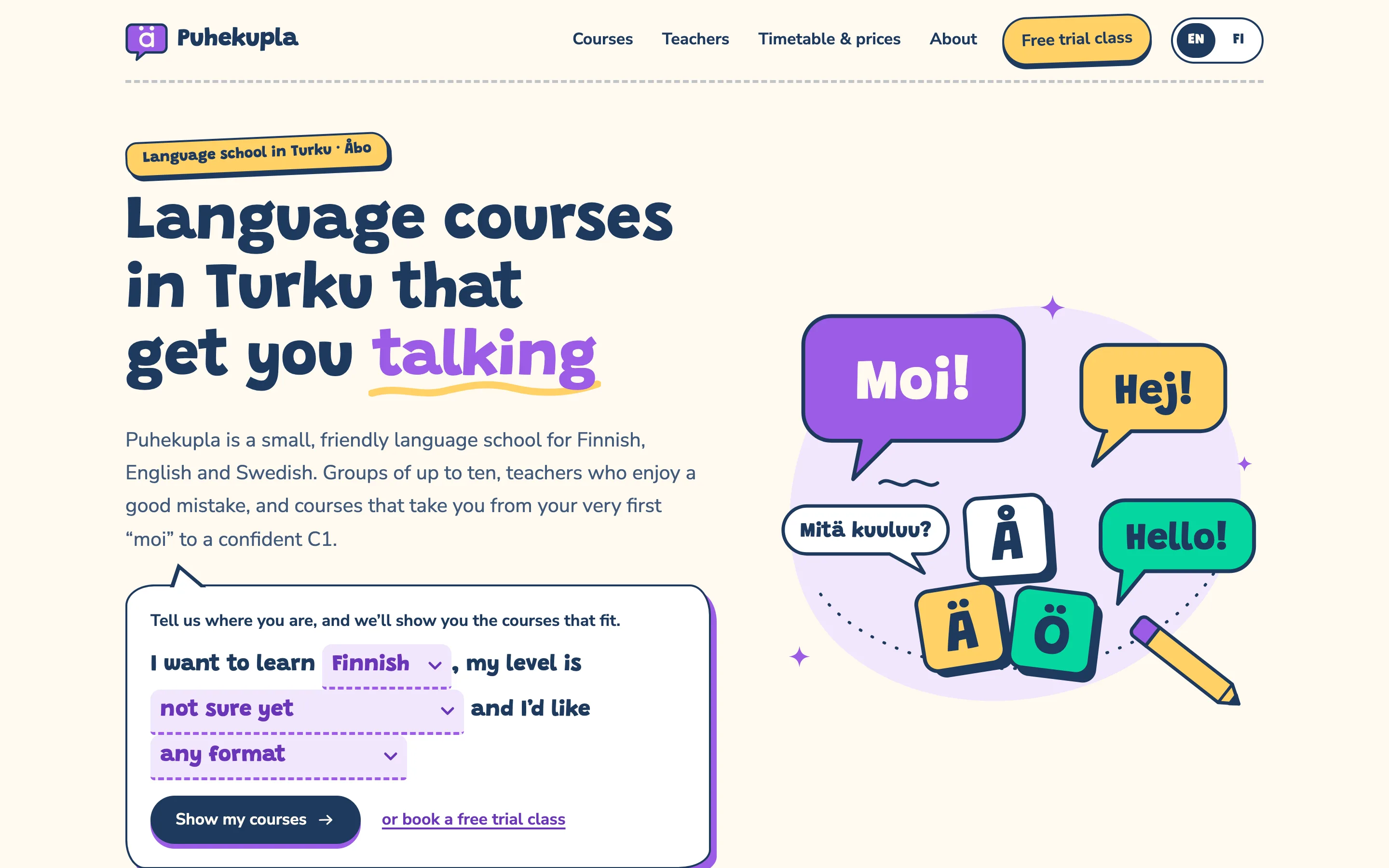
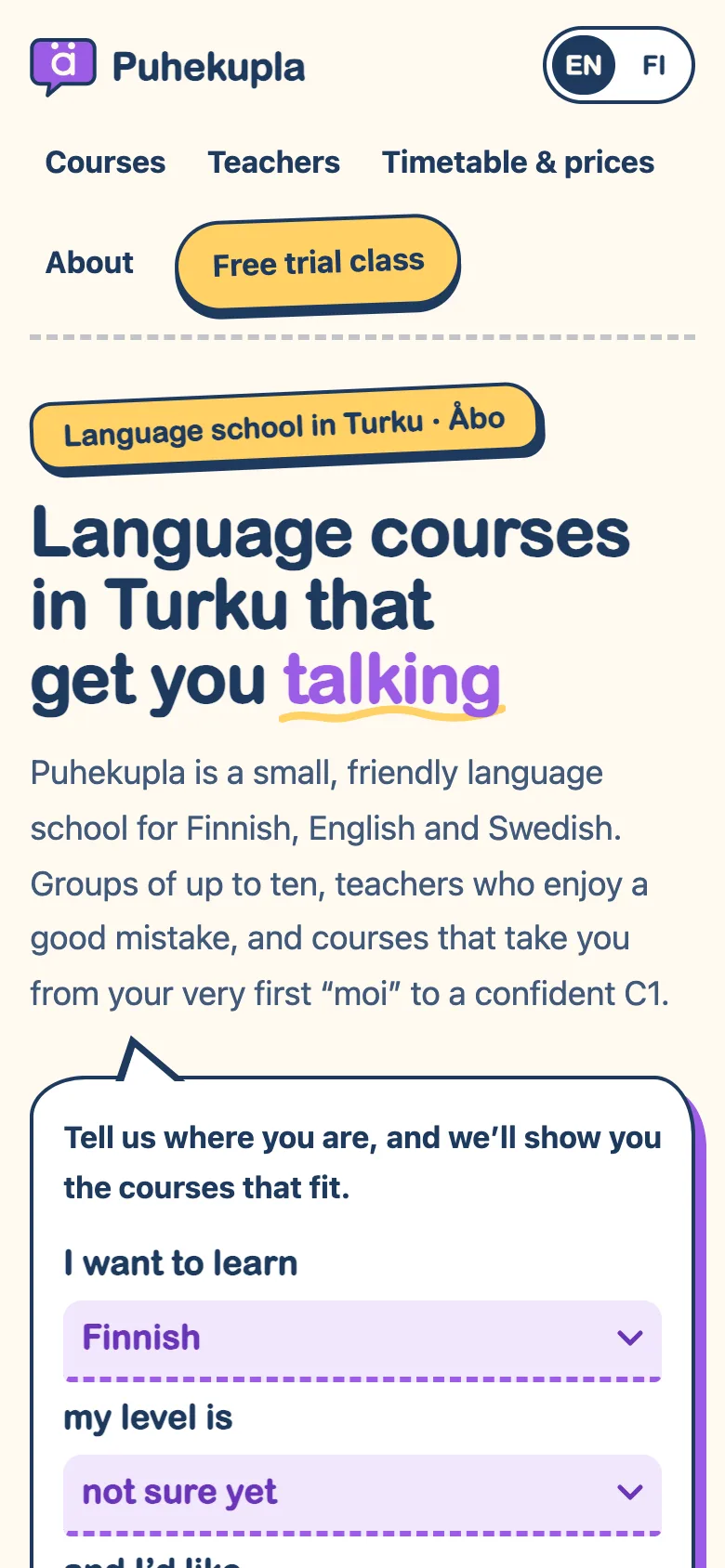
The demo is Puhekupla Language School, a fictional school in Turku, Finland, that teaches Finnish for foreigners, English and Swedish. The home page opens with a course finder that reads like a sentence: "I want to learn Finnish, my level is A1 and I'd like evening classes." One tap opens the course list already filtered to match. The full course finder filters by language, CEFR level and format at the same time, shows how many courses match and suggests a free trial class when nothing does.
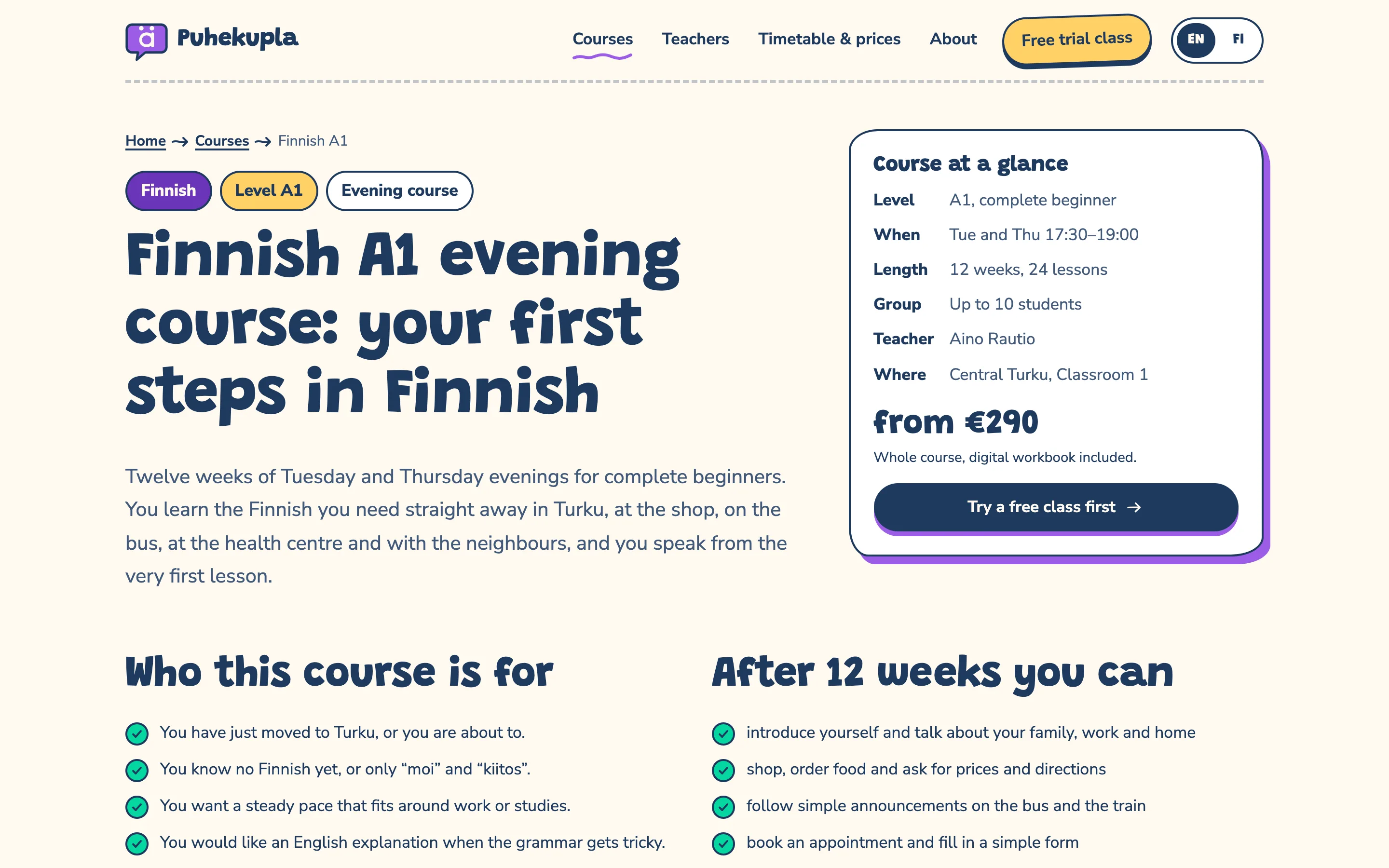
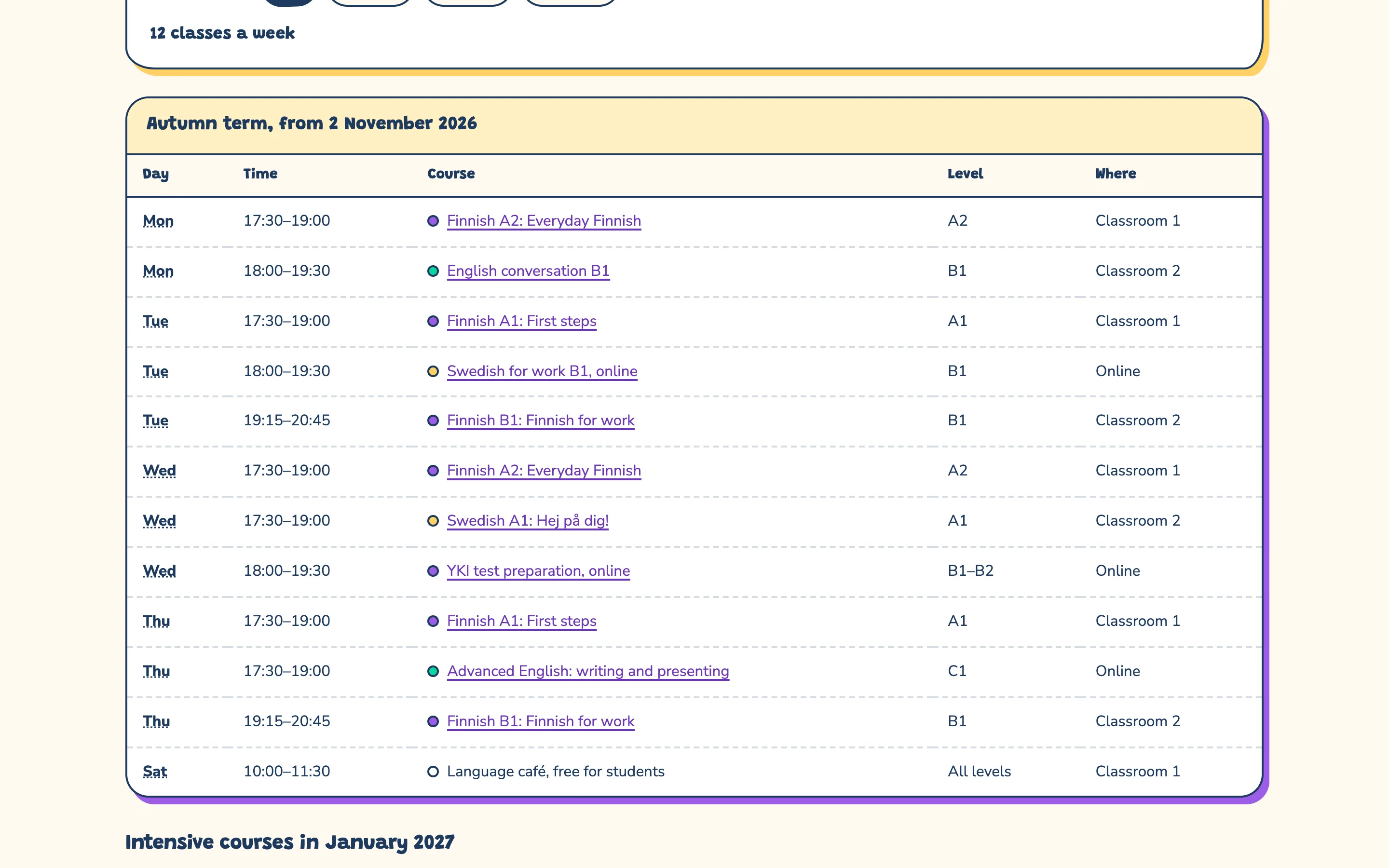
Every course card shows the level, the weekly schedule, the length, the start date, the teacher and a "from" price, so the student never has to email to ask. The course page goes deeper, with a week-by-week syllabus, upcoming groups (sample data in the demo), a fact card and a short FAQ. The weekly timetable is a real HTML table that turns into readable cards on a phone, and the prices sit right below it.
The free trial class form is the main call to action on every page. It asks for the course, the student's level (with a "not sure yet" option), preferred days and time, and contact details, and it is pre-filled when the student arrives from a course link. Because it is a demo, the form checks the fields and then explains that nothing was sent; on a real site the booking goes straight to your email, WhatsApp or CRM.
The design is deliberately playful: hand-drawn speech bubbles, letter blocks with Ä, Ö and Å, illustrated teacher avatars and bouncy buttons. Learning a language is a little scary, and a friendly site lowers the barrier. Under the illustrations it is still built to WCAG 2.2 AA, with keyboard support, visible focus and reduced motion respected.
Bilingual set-up and hreflang
Puhekupla is fully bilingual: English at the root of the site and Finnish under /fi, with the same page names in both. Every page has its own translated title, description and headings, a language switcher that goes to the same page in the other language, and hreflang links for English, Finnish and an x-default. Prices follow each language's format (€290 in English, 290 € in Finnish), and times use the local style. The same set-up works for any pair of languages, such as French and English in Canada or Hindi and English in India.
Pages included
The demo has seven pages in each language: Home, Courses with the course finder, a Course page, Teachers, Timetable and Prices, Free Trial Class, and About, plus its own bilingual "page not found" page. A real school usually adds one page per course, a page per exam you prepare for, and a page for company courses.
Local SEO set-up
Each page has a unique title with the language, level and city, a meta description with a clear next step, one H1 and a canonical URL. The structured data describes the school as an EducationalOrganization with its city and opening hours, lists every course as a Course with a level, language and "from" price, and marks the course page with CourseInstance entries for upcoming groups, plus FAQPage and BreadcrumbList. Your Google Business Profile should link to the home page and use the same name, phone number and city as the site. People search for "Finnish course Turku", "IELTS coaching near me" or "Spanish tutor online", so each course page targets one of those searches instead of one generic page trying to rank for everything.
Language school websites by country
India
Indian English, prices in ₹, and a WhatsApp button as the main contact, because most enquiries start there. Many students prepare for IELTS, TOEFL, PTE or a foreign language for study abroad, so exam pages and batch timings (morning, evening, weekend) matter more than anything else. Mention UPI for fee payments and show a GST number placeholder until you add your own.
USA
US English and prices in USD. Adult ESL classes, Spanish for professionals, and test preparation for the TOEFL and SAT are common. Accessibility to WCAG 2.2 AA matters for ADA claims, and community colleges often compete on price, so a clear "what you get" list and a free trial lesson help a private school stand out.
Canada
Canadian English (colour, centre) and prices in CAD. English and French are both in demand, and newcomers prepare for CELPIP, IELTS and the TEF or TCF. A school in Québec needs a French version of the site, usually French first, and a bilingual set-up like the demo's handles that from day one.
Australia
Australian English and prices in AUD. Many students are on study or work visas and look for IELTS and PTE preparation or general English with flexible hours. Show an ABN placeholder until you add your own, and keep any provider or accreditation details accurate and up to date.
Finland
Finnish and English, prices in euros in the Finnish format (290 €), and a Y-tunnus placeholder. Newcomers learn Finnish for work and citizenship and many prepare for the YKI test, so be precise: say your courses prepare for YKI unless you are an official test centre. Swedish has its own place in bilingual cities such as Turku and Helsinki, and EU accessibility rules mean WCAG 2.2 AA.