What customers look for on an electrician's website
Most people looking for an electrician are not in an emergency. A safety switch keeps tripping, a renovation needs new lighting, the smoke alarms need upgrading or a new EV needs a charger. What they want to know is simple: can you come at a time that suits me, roughly what will it cost, and are you properly licensed? Many of them are booking around work, so the ability to choose a time online, at ten at night, is often what decides who gets the job.
Electrical work is also invisible once it is finished, which makes trust harder to earn. Visitors look for evidence: photos of tidy switchboards and finished installs, clear explanations of what a job involves, a licence number they can check and a promise about paperwork. Business customers add their own questions: can you work after hours, handle emergency lighting tests and send the reports their building manager needs?
How the demo handles it
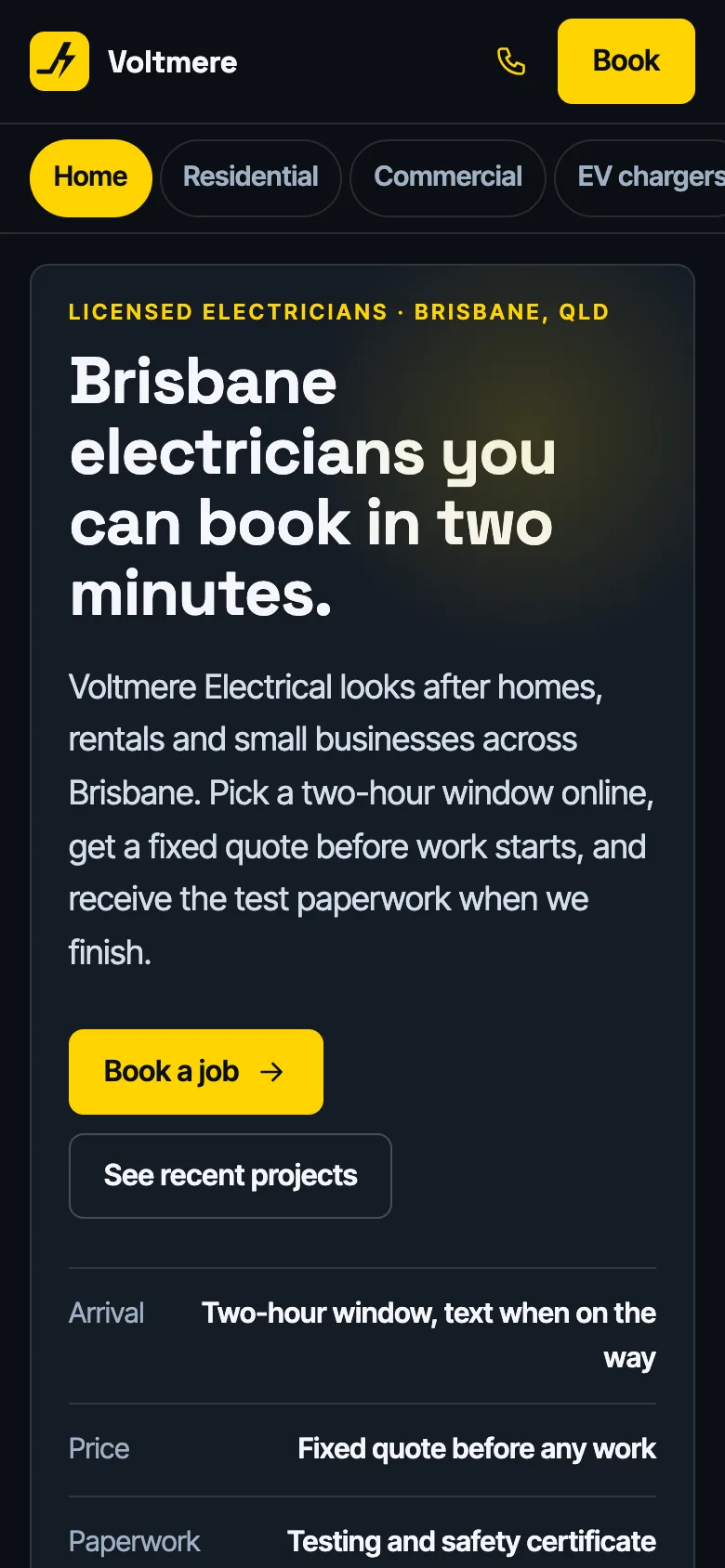
The demo, Voltmere Electrical, is a fictional Brisbane contractor designed like a modern app: a dark interface, a sidebar on desktop, swipeable tabs on a phone, and status rows instead of marketing slogans. It feels organised before the customer has even spoken to anyone, which is exactly the impression an electrician wants to give.
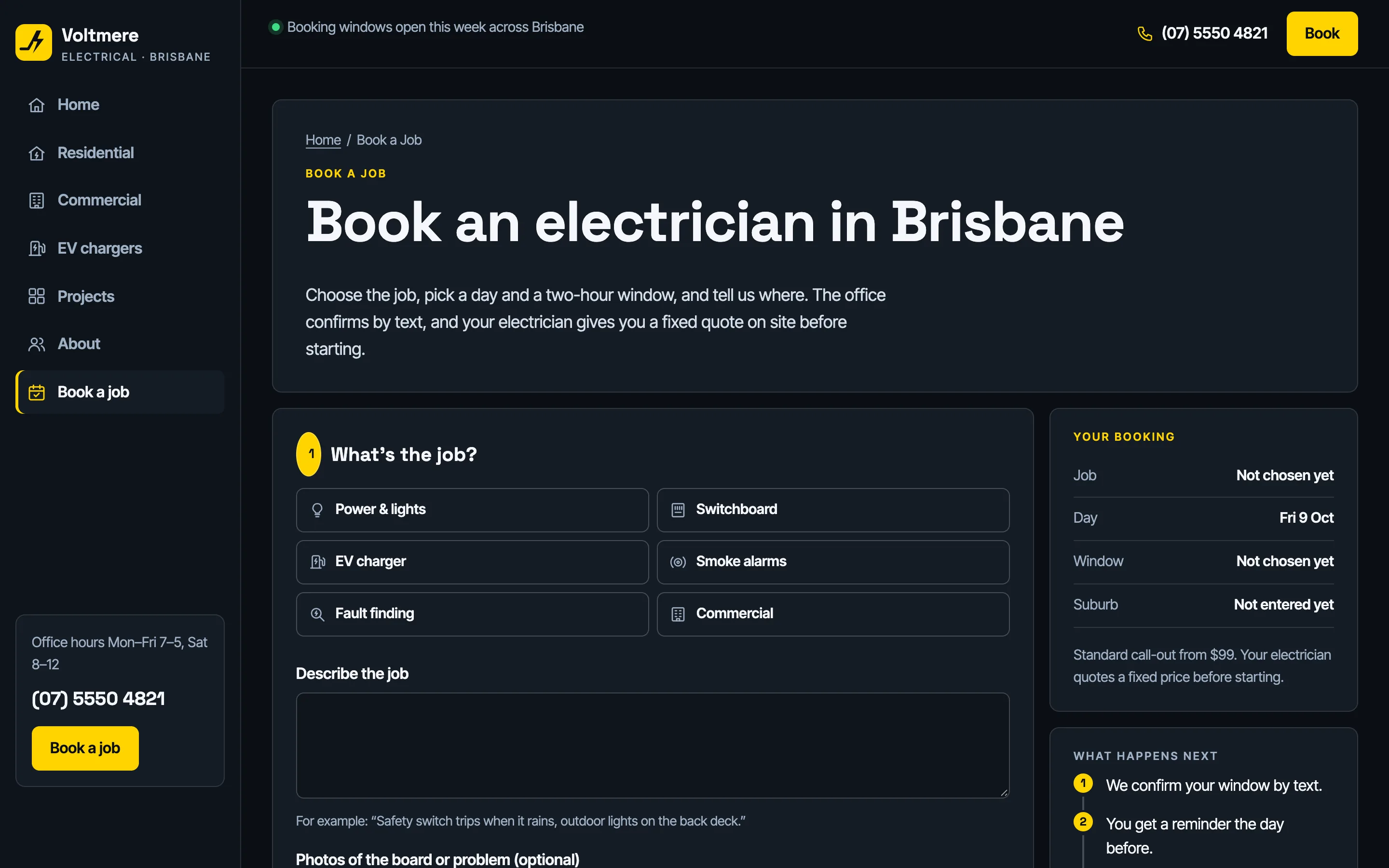
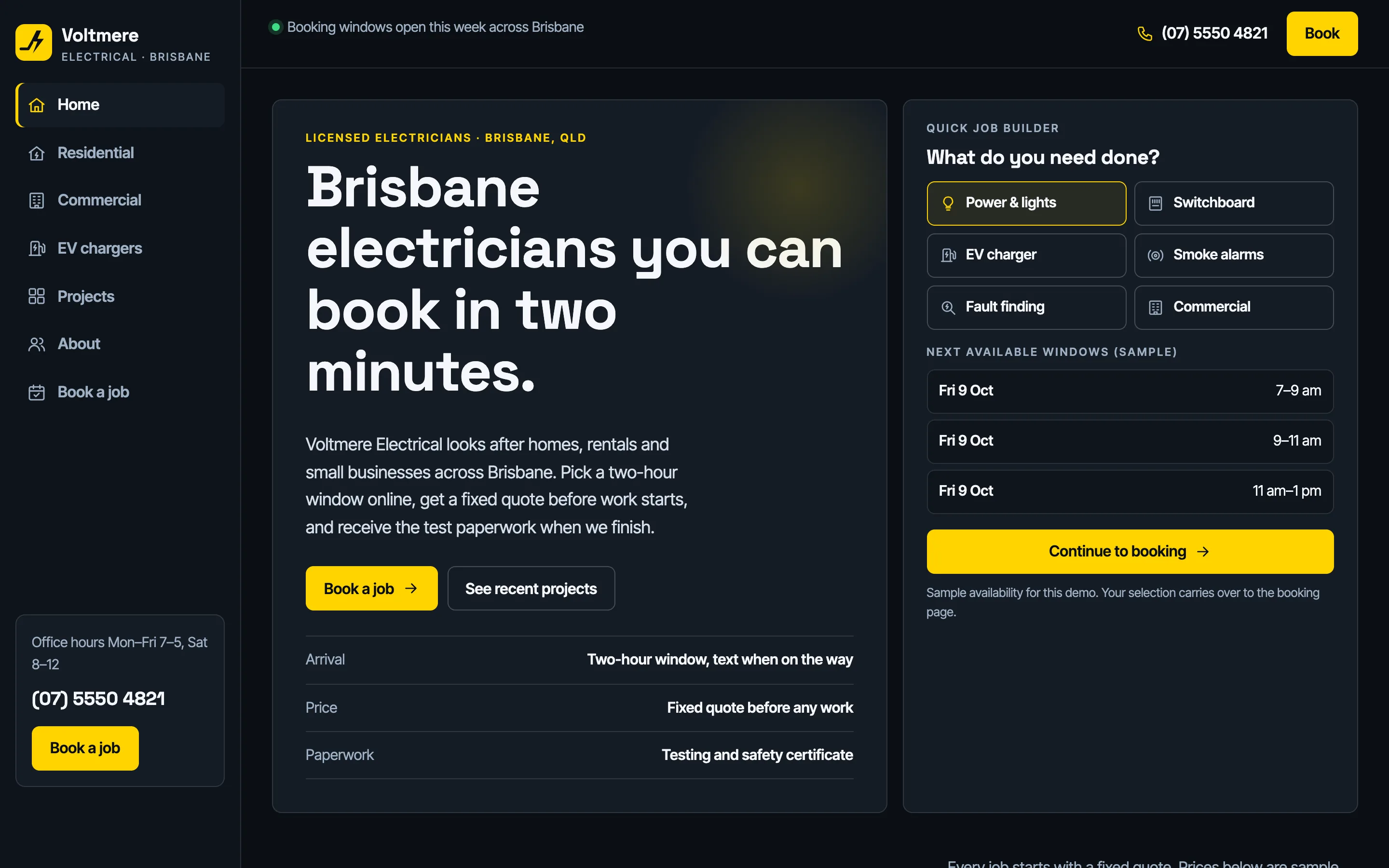
The home page opens with a quick job builder: the visitor taps the type of job, sees the next available windows and continues to booking with that choice already filled in. The booking page then shows the next ten working days and the two-hour windows on each, with some marked as booked, and a summary panel that updates as the visitor fills in the job, suburb and contact details. When it is sent, the office has everything needed to confirm the visit by text.
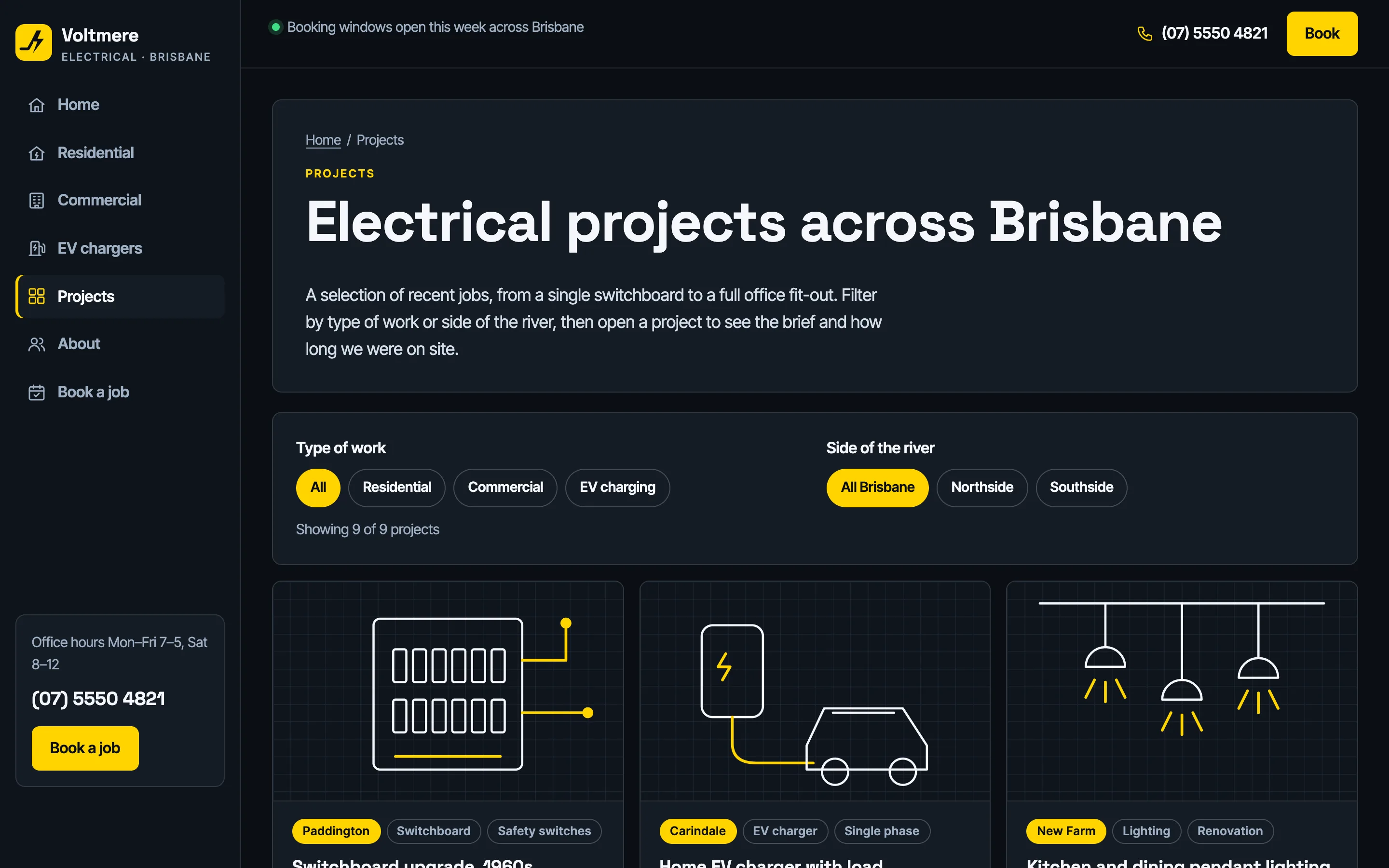
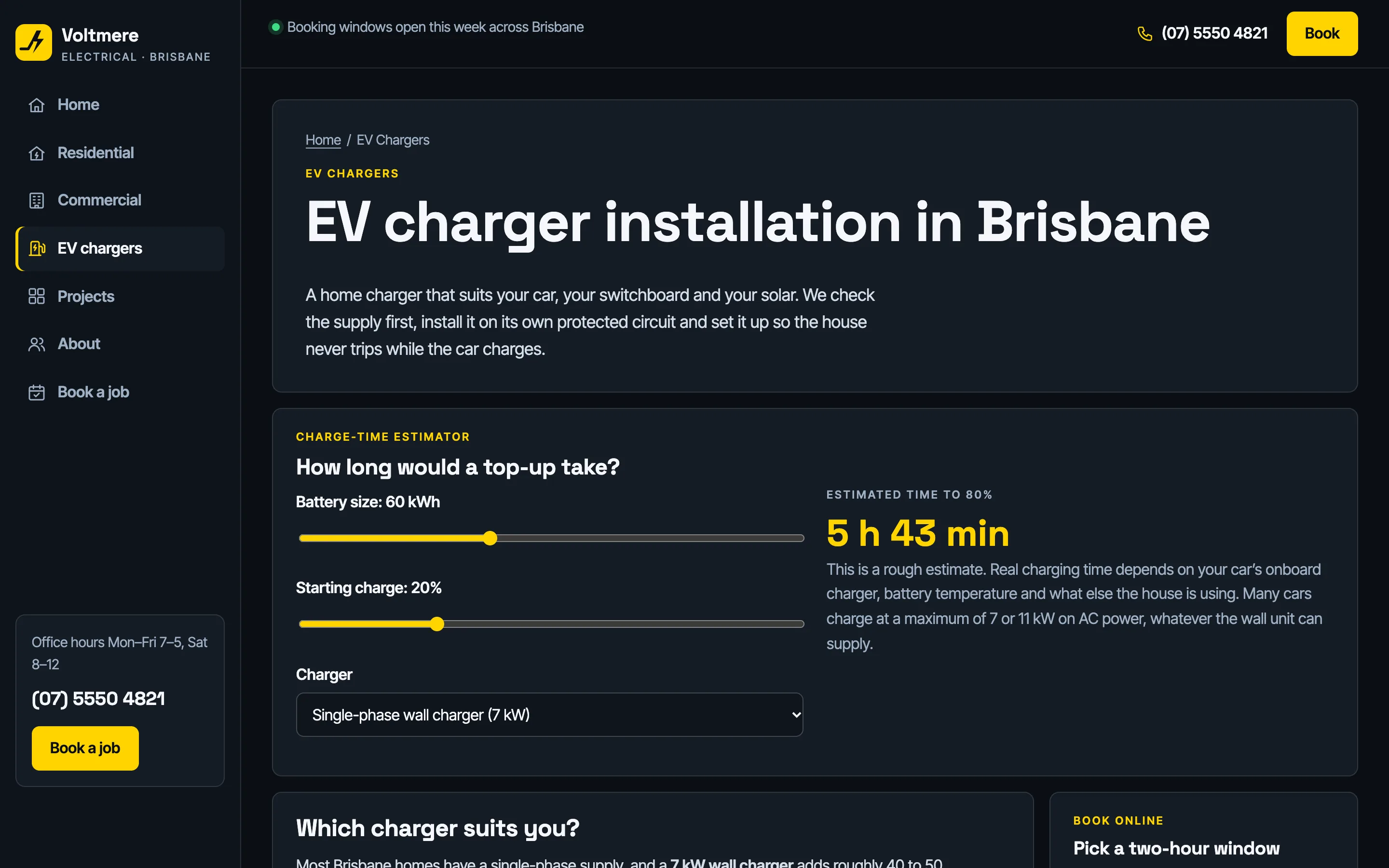
The project gallery is the proof. Each project shows the suburb, the type of work and a short description, and the visitor can filter by residential, commercial or EV charging and by area, then open a detail panel with the brief and how long the team was on site. The EV charger page includes a charge-time estimator so owners can compare a portable cable with a 7 kW or 11 kW wall charger before they book a site check.
Pages included
- Home: hero with status rows, quick job builder, service tiles with sample prices, the smoke alarm deadline, recent projects, booking steps, sample reviews and the service area.
- Residential: switchboards and safety switches, smoke alarms, lighting and ceiling fans, power points, fault finding and storm season.
- Commercial: fit-outs, maintenance, emergency and exit lighting tests, test and tag, data cabling and what to send for a quote.
- EV Chargers: the estimator, choosing a charger, switchboard checks and load management, solar charging and apartments.
- Projects: the filterable gallery with detail panels.
- About: how the company works, the team as illustrated profiles, and licence, ABN and insurance placeholders.
- Book a Job: the time-window booking request with a live summary.
Local SEO set-up
Each page has one JSON-LD graph with an Electrician node: name, phone, email, logo, share image, opening hours and the cities served. Service pages add Service nodes, with Offer and a sample starting price where one is shown, the gallery is a CollectionPage with an ItemList, and inner pages carry a BreadcrumbList. Titles follow service plus city plus brand, such as "EV Charger Installation in Brisbane", so each page targets one search people actually make.
Project entries name the suburb, which gives the site natural local relevance without thin suburb pages. For a live client we connect the site to the Google Business Profile with the same name, phone and service area, choose Electrician as the primary category, add services that mirror the site's pages, and encourage posting the same project photos to the profile.
Electrician websites by country
India
Indian customers usually prefer to call or message on WhatsApp, so a WhatsApp button sits beside the booking form, and booking confirmations can go out on WhatsApp. Content is in Indian English with prices in rupees. Typical services include house wiring and rewiring, inverter and UPS installation, MCB and distribution board upgrades and earthing, and for businesses, annual maintenance contracts. A GST number placeholder and the electrical contractor licence from the state go in the footer.
USA
US sites use US English, dollars and US electrical terms: breaker panels, panel upgrades, GFCI and AFCI protection, Level 2 EV chargers and permits. Licensing is handled by states and sometimes cities, so the license number belongs in the footer. Service areas are described by city and ZIP code. Accessibility matters, because local business websites are often the target of ADA claims; the demo meets WCAG 2.2 AA.
Canada
Canadian sites use Canadian English and dollars, with permits and inspections handled by provincial safety authorities, so explaining who pulls the permit is useful content. Panel upgrades for heat pumps and EV chargers, and winter topics such as block heater outlets and generator hook-ups, deserve their own sections. In Québec, the site needs a full French version.
Australia
Australian sites use Australian English, dollars and local terms: switchboards, safety switches (RCDs), power points and test and tag. Electrical contractor licence numbers and an ABN are expected on the site and on quotes. State rules create real content: the demo's Queensland smoke alarm deadline is a good example of a regulation that gives homeowners a reason to book now.
Finland
Finnish electricians need the site in Finnish and English, with Finnish at its own address and a language switcher on every page. Prices are shown in euros with the Finnish number format, and the business ID (Y-tunnus) goes in the footer. Common topics include EV charging at home and in housing companies, electric heating and heat pump connections, and inspections of older installations. EU accessibility rules make WCAG 2.2 AA the baseline.