What overseas buyers look for on a spice exporter's website
An importer in Rotterdam, Dubai or Houston who finds your website has usually never been to Unjha, Kochi or Guntur. They have a specification sheet, a target landed cost and a quality manager who will ask hard questions. Before they write to you, they want to know three things: that you really handle the spice yourself, that you can hold a grade from one container to the next, and that the paperwork will clear their customs without delays.
Most spice export websites answer none of this. They show a product grid of stock photos, a list of countries "served" and a contact form. Buyers then send the same questions by email, and the first two weeks of every new relationship are spent explaining things the website could have shown on day one.
Price is the other difficulty. Seed spice rates follow the market yard every day, so a published price is out of date by the evening. Buyers know this. What they want instead is enough information to decide whether you are worth a sample request: grades, typical specifications, pack options, how much fits in a container and how quickly you reply.
How the demo handles it
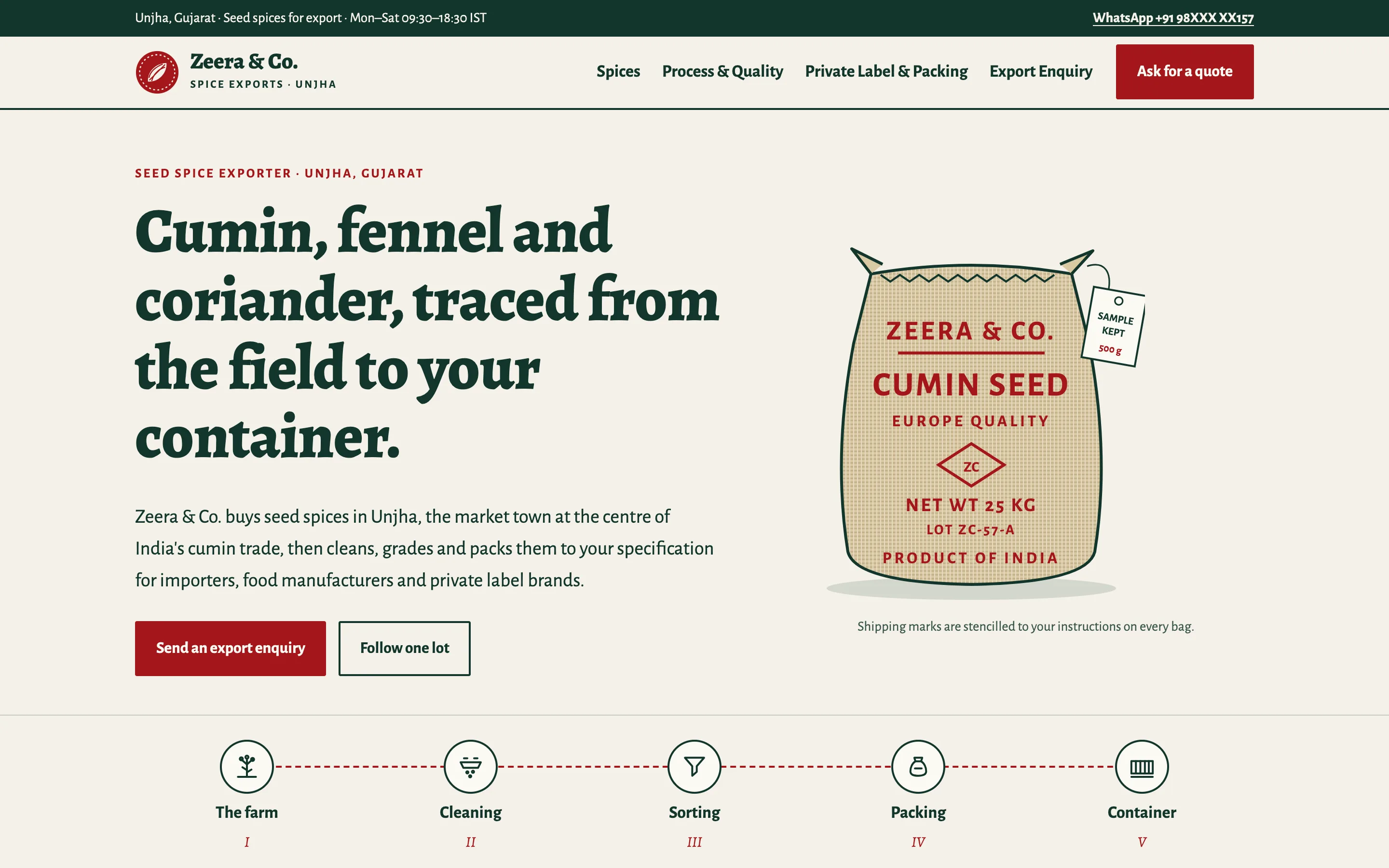
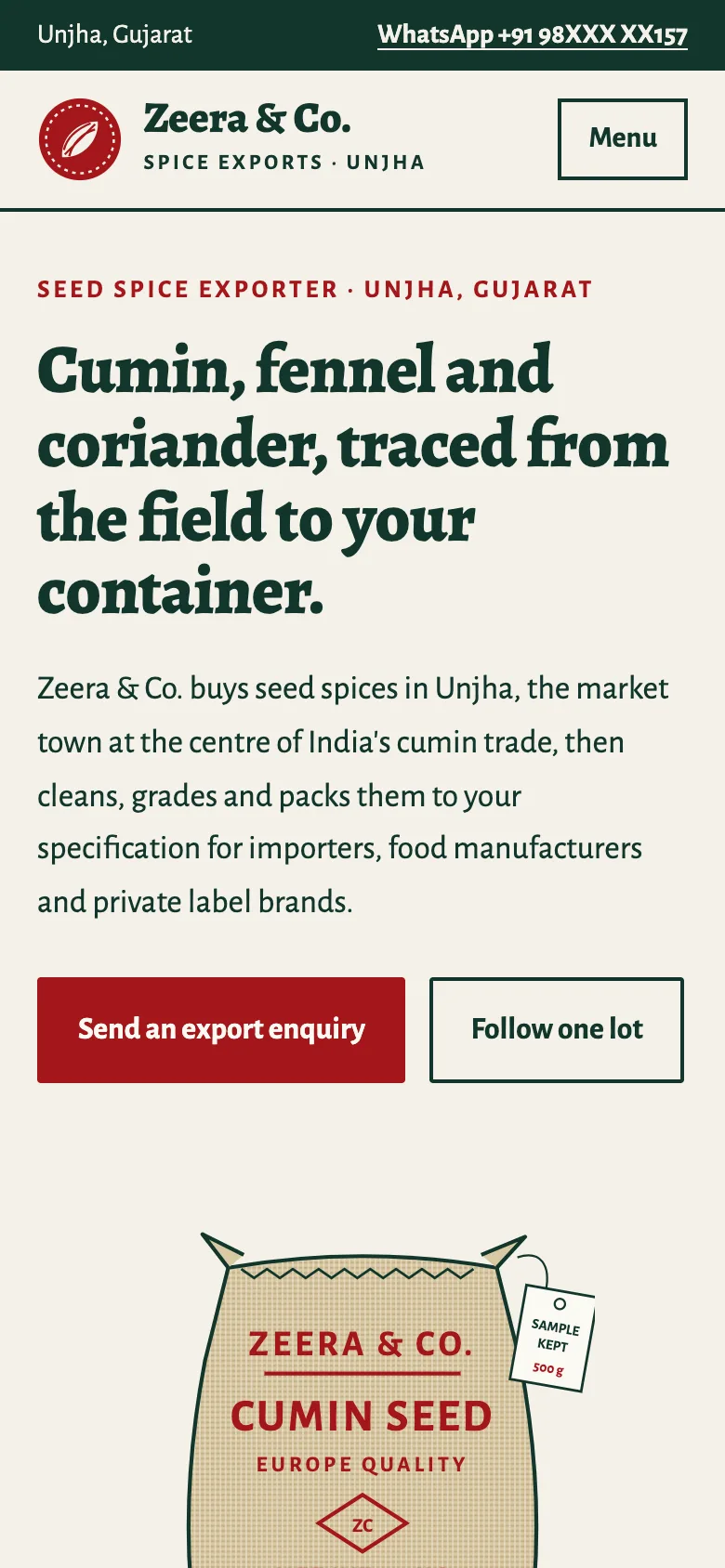
Zeera & Co. is a fictional seed-spice exporter in Unjha, the market town at the heart of India's cumin trade. The home page tells the story of one lot, ZC-57-A, in five stages: the farm, machine cleaning, grading, packing and the sealed container. Each stage has its own drawing, a short explanation and the facts that go on the lot docket, such as the moisture on arrival, the grade and the seal number.
On a desktop screen a sticky docket sits beside the story and ticks off each stage as the buyer scrolls, with a container that fills as the lot moves towards the port. On a phone the docket becomes a slim bar under the header. The story itself is plain HTML and drawings, so every stage is readable with JavaScript turned off, on a slow connection or by a search engine.
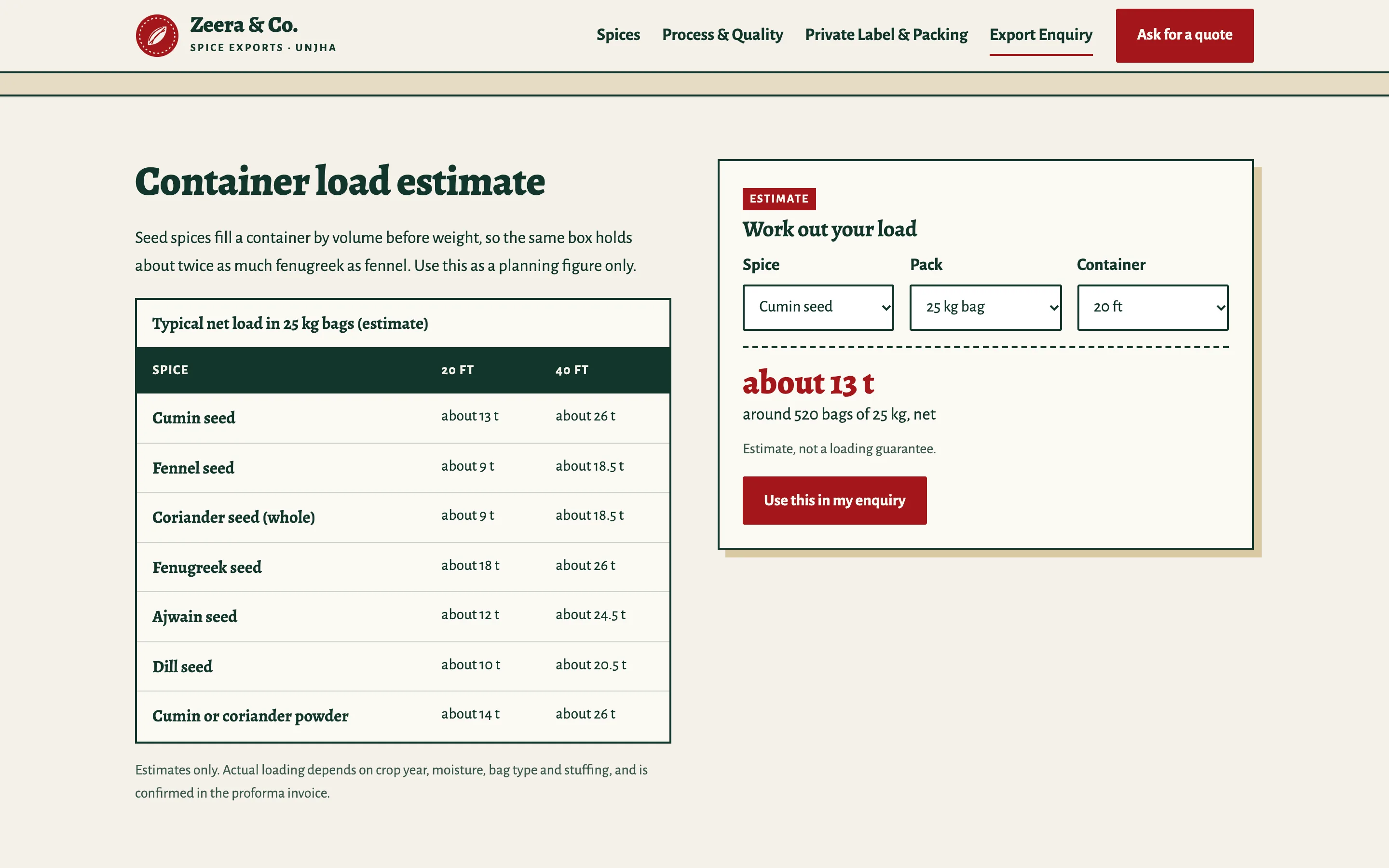
The export enquiry page answers the question every first-time buyer asks: how much fits in a 20 ft or 40 ft container? A table shows typical net loads per spice in 25 kg bags, and a small estimator lets the buyer change the spice, the pack and the container. The result is always labelled as an estimate, and one button copies it into the enquiry form, together with the spice, pack and container, so the first email you receive already contains a quantity.
There are no prices anywhere on the site, and the copy says why. Registration numbers for IEC, FSSAI, the Spices Board and APEDA have clearly labelled places, and the site never claims a certificate or lab result the business does not hold.
The pages
- Home: the farm-to-container story, the six spices, three types of buyer, the container estimate link and registration placeholders.
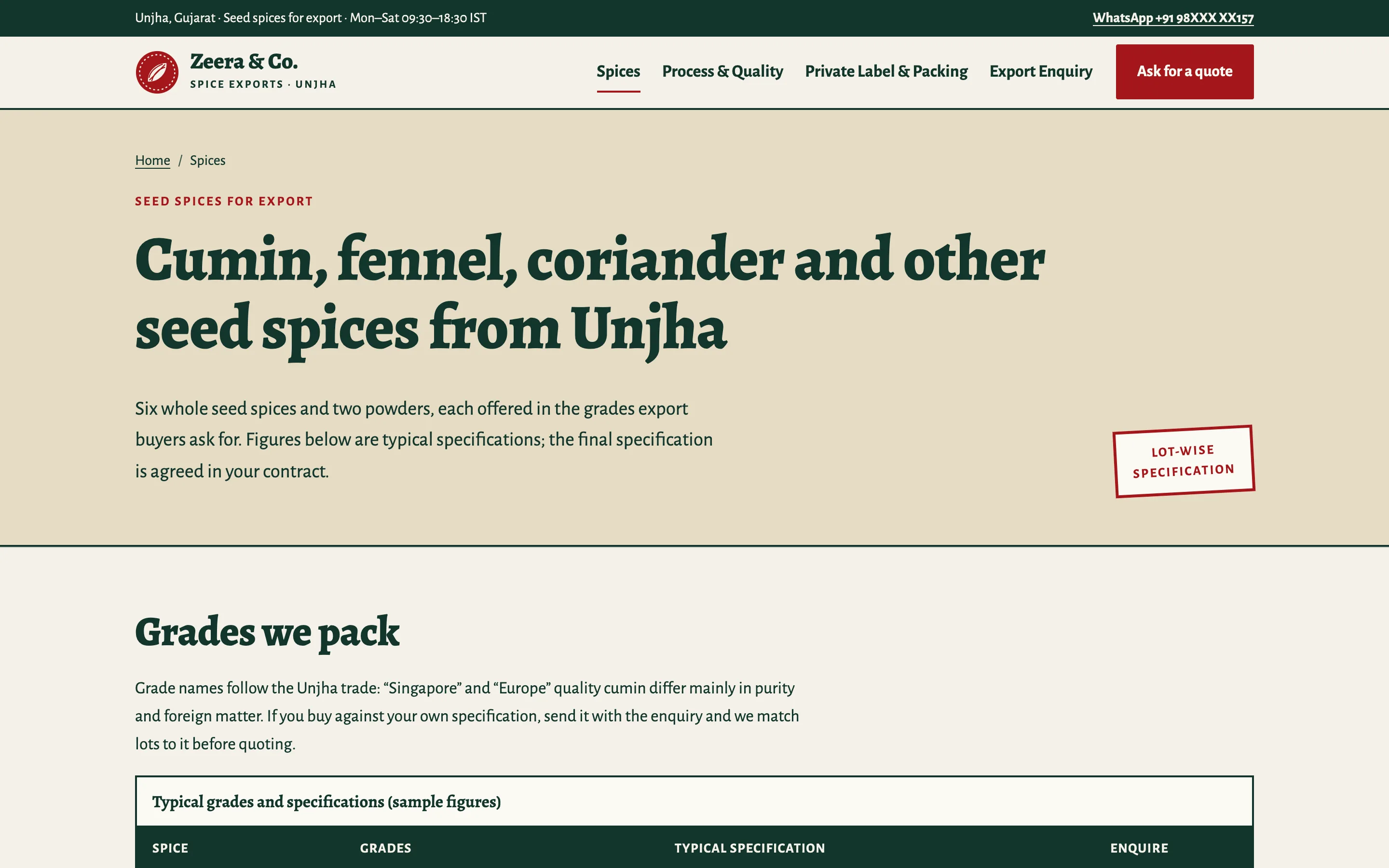
- Spices: a grade and specification table for cumin, fennel, coriander, fenugreek, ajwain and dill seed, with local names, typical purity and moisture, harvest seasons and an enquiry link per spice that preselects it in the form.
- Process & Quality: what happens to every lot, the checks a buyer can ask for (pre-shipment samples, third-party lab reports, their own surveyor) and the documents that travel with each shipment.
- Private Label & Packing: pack formats from 25 kg bags to retail pouches, how a private label run works and what goes on the label.
- Export Enquiry: the container load estimate and an enquiry form with company, country, spice, pack, container, quantity, Incoterm and destination port.
Search set-up for a spice exporter
Export buyers search differently from local customers. They type "cumin seed exporter India", "Europe quality cumin supplier" or "private label spices India", and often search from their own country. The demo gives each of those searches its own page: the title and description of the Spices page name the spices and grades, the Process page targets cleaning, sorting and quality checks, and the Private Label page targets packing under the buyer's brand.
Behind the pages, every page carries Organization structured data with the town, the export desk's languages and hours, and the Spices page lists each spice as a Product with its grades and country of origin. Breadcrumbs, fast self-hosted fonts and drawings instead of heavy photos help buyers on slower connections. When the site goes live, I also set up a Google Business Profile for the office, verify the site in Search Console and create directory listings that link back to the website rather than to a marketplace profile.
Country notes
India
The demo is written in Indian English with metric units and tonnes, and the export desk's hours are shown in IST. Contact is by WhatsApp first, then phone and email, because that is how most overseas buyers reach Indian exporters today. Ports are named as Mundra and Kandla, the usual gateways for north Gujarat, and Incoterms in the form are FOB Mundra, CIF and CFR.
Indian exporters need to show their Importer Exporter Code, FSSAI licence and, depending on the products, Spices Board registration and APEDA membership. The demo has a labelled place for each so they can be filled with real numbers before launch. For buyers in the European Union, the Gulf or the United States, the same site can add pages on residue testing, labelling or the documents their customs ask for, in English or in the buyer's language.