What families look for on a wedding planner's website
An Indian wedding is not one event. It is a haldi in the morning, a mehendi that runs all afternoon, a sangeet with family performances, the pheras at a muhurat that may fall close to midnight, and a reception for guests who could not come to the rest. When a family starts looking for a planner, they are trying to answer three questions: will this team understand our functions and customs, roughly how much will it cost, and can we trust them with our guests?
Most planner websites answer none of these. They open with a gallery of décor, a phone number and a form that says "Tell us about your dream wedding". Families then call five planners to hear the same first conversation five times. A good website does part of that conversation for them, and sends the planner an enquiry that already contains the guest count, the city and the functions.
How the Shubh Saat Weddings demo handles it
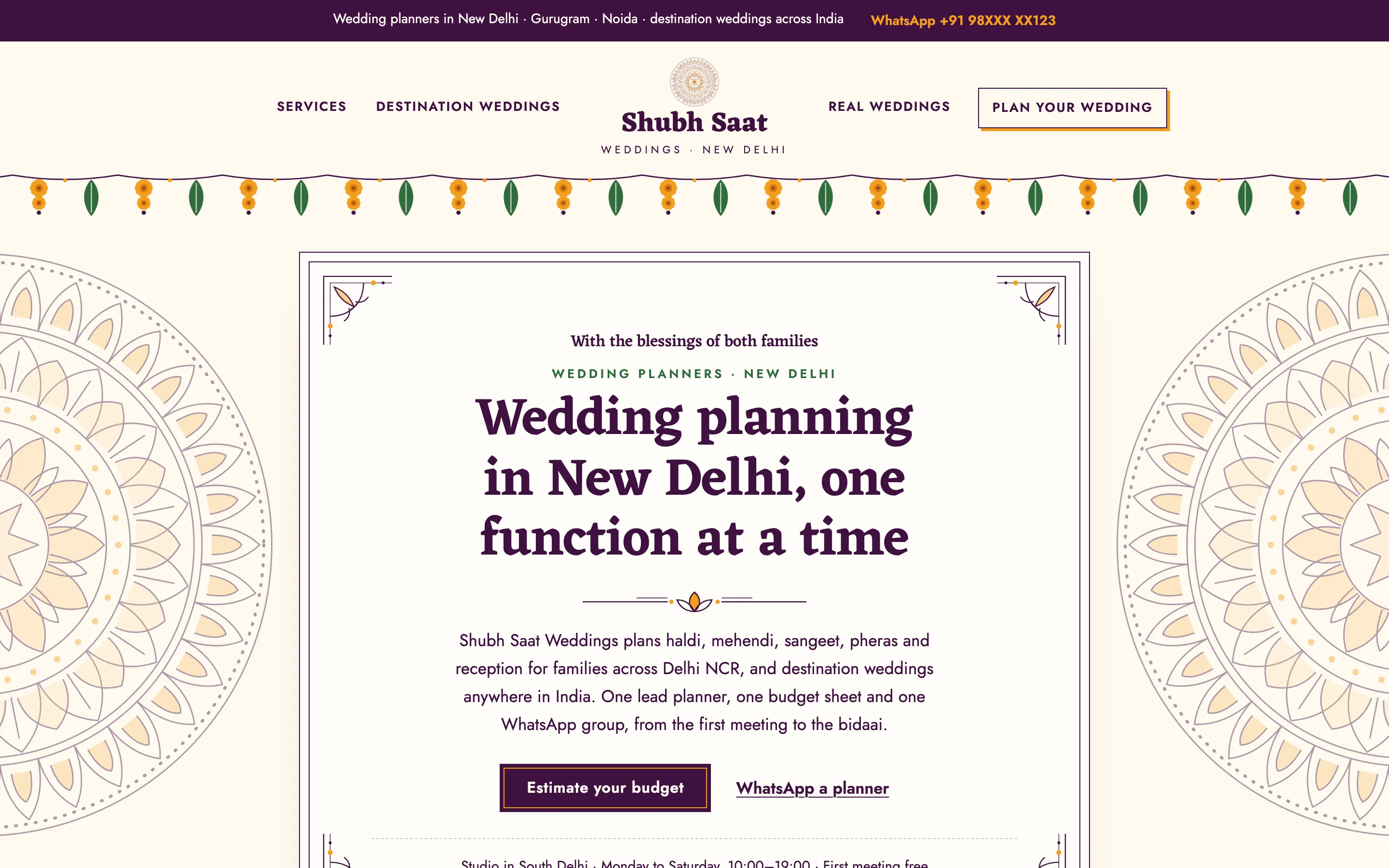
Shubh Saat Weddings is a fictional planner in New Delhi. The home page is set like a wedding card: a centred invitation with double rules and corner ornaments, a marigold toran under the header and the five functions laid out as cards, each with what the planner actually does for it. The haldi card talks about a changing area and towels; the wedding card talks about the baraat route, the pandit's samagri list and a schedule built around the muhurat. These details tell a family that the planner has done this before.
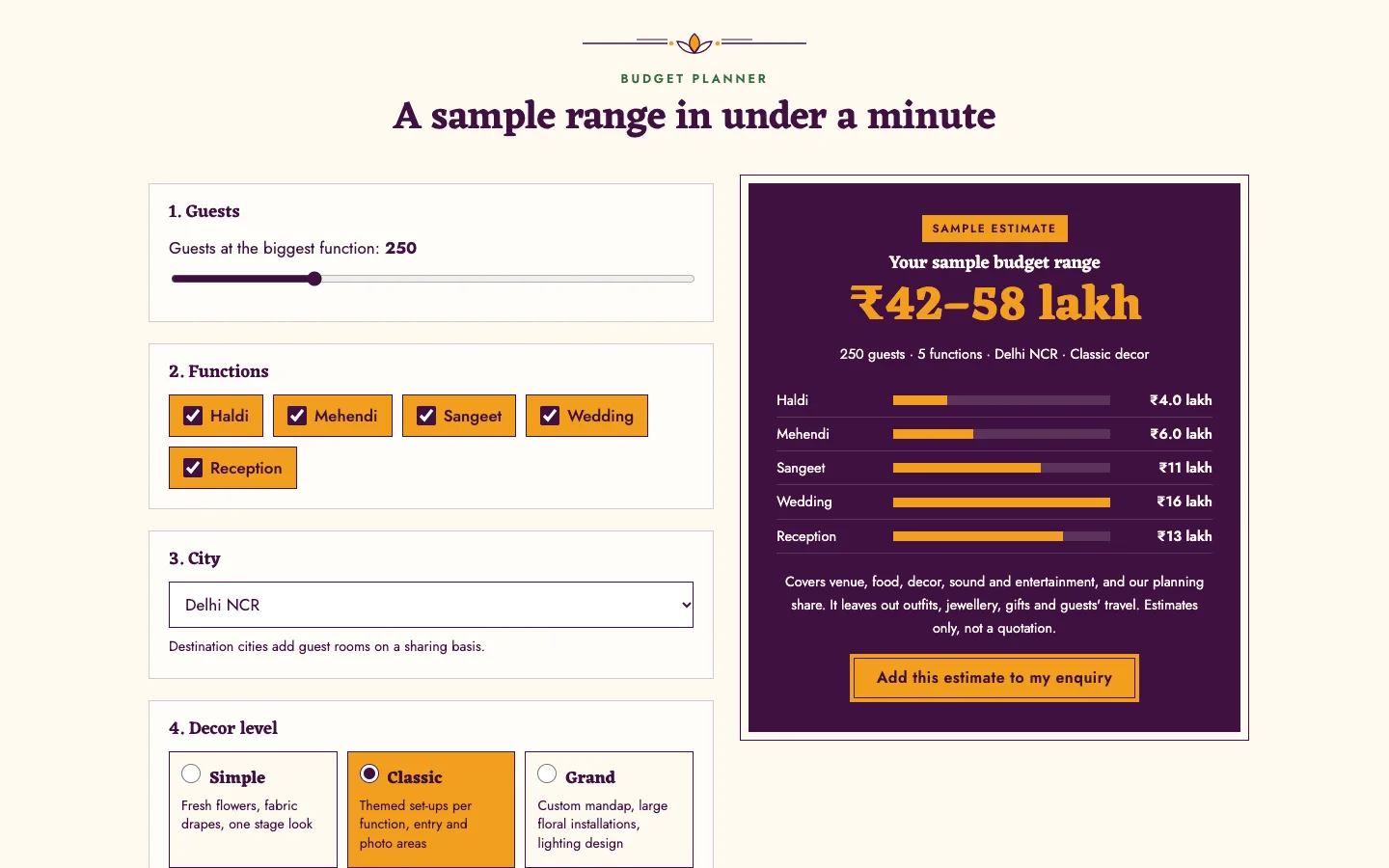
The signature feature is the budget planner on the Plan Your Wedding page. Families choose the number of guests, tick the functions they want, pick Delhi NCR or a destination city and choose a decor level. The planner shows a sample range in lakh with a breakdown by function, and adds guest rooms for destination cities. Every figure is labelled as an estimate, and a short note explains how the range is worked out. One button copies the estimate into the enquiry form, so the planner receives a real brief instead of a blank message.
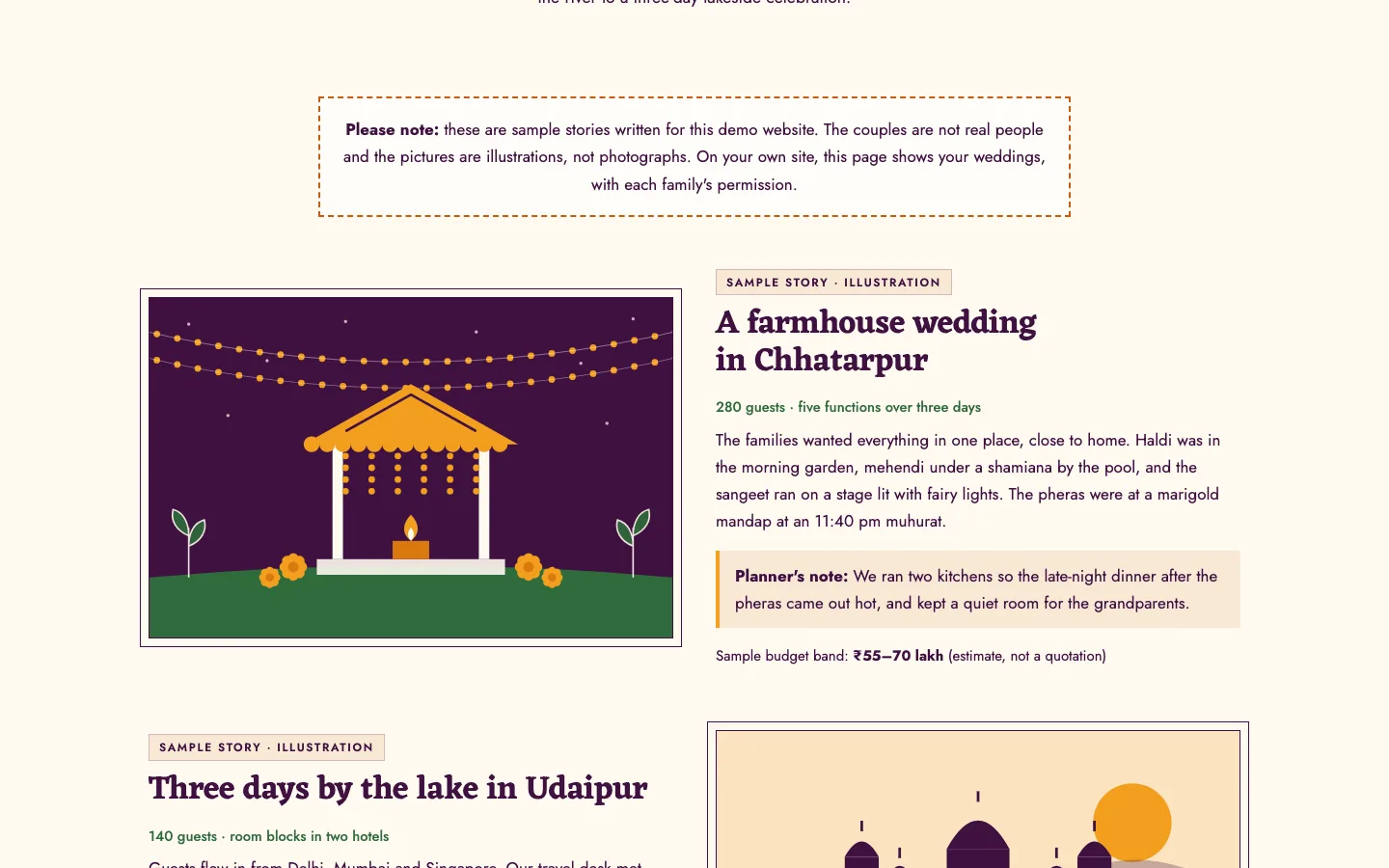
The rest of the site supports the same decision. The Services page explains full planning, partial planning and wedding-week coordination, so families can choose how much help they need. The Destination Weddings page covers Udaipur, Jaipur, Rishikesh, Mussoorie, Goa and Jim Corbett with the best months for each, and lists the logistics that families worry about most: room blocks, flights and trains, welcome desks, sound limits and a weather back-up. Real Weddings holds three sample stories with illustrations and a clear notice that the couples are not real. On a live site, that page becomes the planner's own portfolio, published with each family's permission.
Pages in the demo
- Home: the invitation-card introduction, the five functions, seven promises to families, the planning steps and sample stories.
- Services: three ways to work with the planner and the eight things the team handles, from venue visits to ritual timings.
- Destination Weddings: six destinations with seasons, and the guest travel checklist.
- Real Weddings: sample stories with a planner's note in each, ready for real weddings.
- Plan Your Wedding: the budget planner and an enquiry form with WhatsApp, phone or email as the preferred reply.
Local search set-up
Families search for "wedding planners in Delhi", "destination wedding planner Udaipur" or "wedding planner for 300 guests". Each page in the demo has its own title, description and canonical address, and one clear heading that uses the words families type. The structured data describes the business as a ProfessionalService with its city, service areas across Delhi NCR, opening hours and contact details, and adds Service entries for each planning package and for destination weddings, with the destination cities as service areas.
For a real planner, the Google Business Profile matters as much as the website. The name, area and phone number should match the site exactly, the categories should include wedding planner, and the profile should link to the Plan Your Wedding page. Reviews belong on that profile, not invented on the site; the demo shows no ratings for that reason.
Building for India
India
The demo is written in Indian English for families in Delhi NCR and the cities they travel to. Amounts are in rupees and shown in lakh and crore, which is how families talk about wedding budgets; every amount is a sample range marked as an estimate, never a quotation. WhatsApp is the main contact button, because that is where most families prefer to talk to a planner, and the phone number is shown in the familiar format. The footer has space for a GSTIN, and the services page explains that fees are paid in stages by UPI or bank transfer with a GST invoice. A real site would often add a Hindi version of the key pages, function names in both scripts, and separate pages for the destination cities where the planner does the most work.
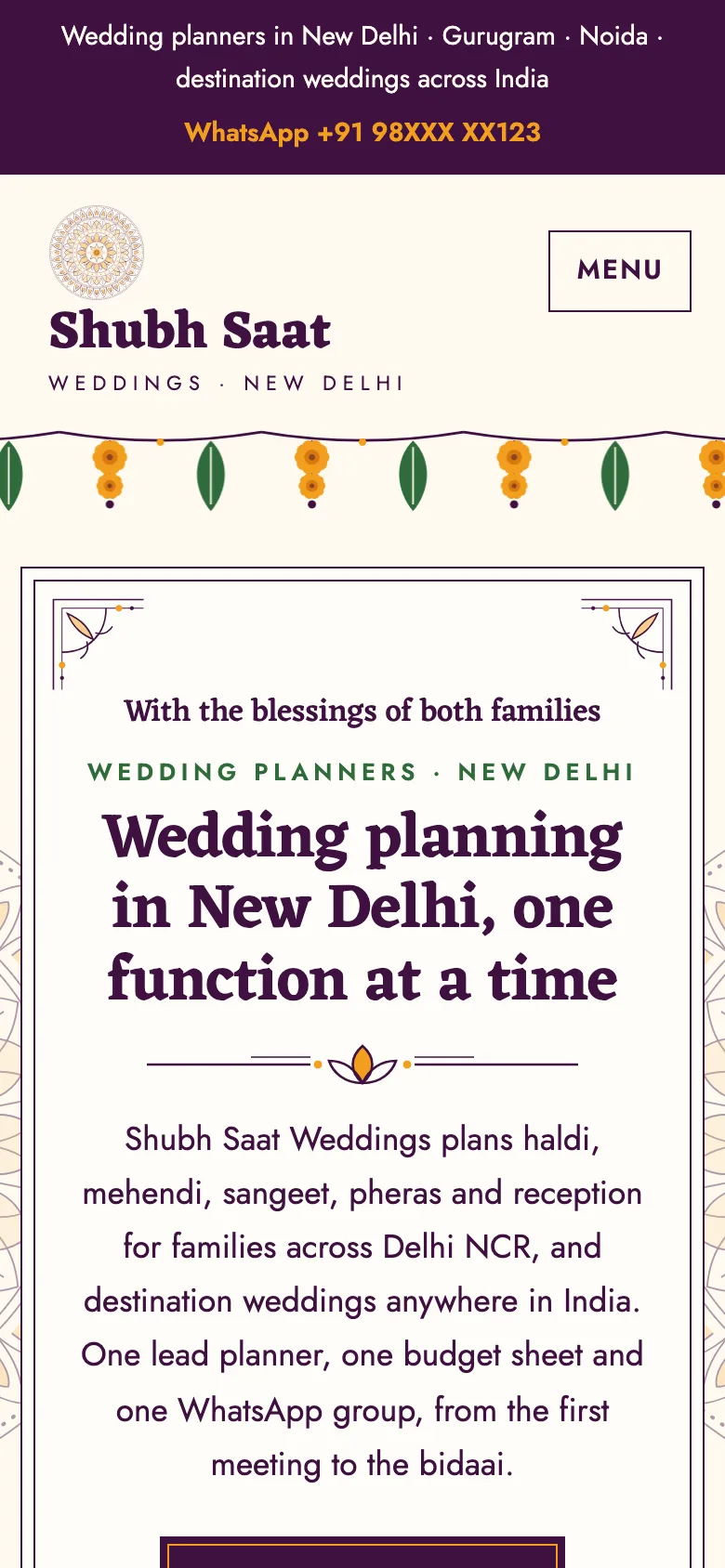
The site is plain HTML, CSS and a small amount of JavaScript with self-hosted fonts and drawn illustrations, so it loads quickly on mobile data at a venue or on a family member's older phone. Forms are accessible by keyboard, every control has a label, and nothing moves for visitors who prefer reduced motion.